In 2026, “PHP vs Node.js” is no longer a debate about which language is “faster” or “more modern.” It’s a strategic decision about delivery speed, operational simplicity, team productivity, and how your backend will evolve as your product grows. Both ecosystems are mature, battle-tested, and capable of powering high-traffic systems—yet they shine in different scenarios.
This guide will help you choose the right backend stack for your next build (or your next phase). You’ll get a clear comparison, a decision matrix, architecture patterns that work in real life, and a practical 30–60–90 day execution plan.
Quick Verdict (When You Need an Answer Today)
- Choose PHP if you want ultra-fast delivery for CRUD-heavy apps, content platforms, admin panels, and business workflows—especially with Laravel’s ecosystem and conventions.
- Choose Node.js if your product is real-time by nature (chat, live dashboards, collaboration), heavily event-driven, or benefits from a unified JavaScript/TypeScript stack across frontend + backend.
- Choose both if you’re building a platform: PHP/Laravel for the core business system + Node.js for real-time gateways, streaming, and event processors.
Need implementation help? Explore our backend services:
PHP vs Node.js in 2026: The Comparison Table (Decision-Friendly)
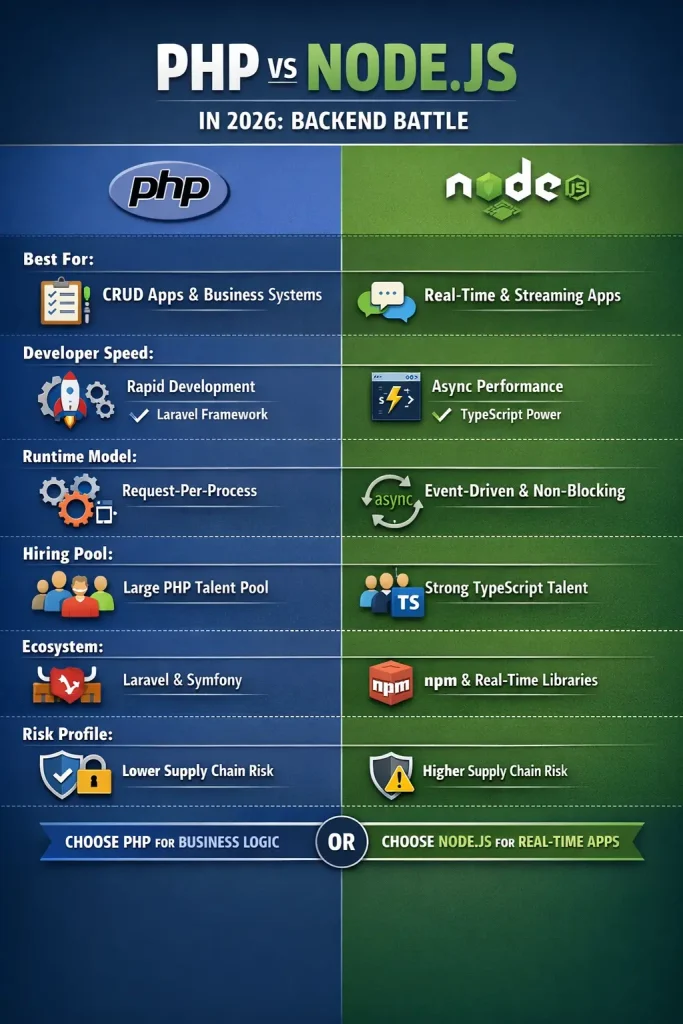
| Category | PHP (Modern PHP + Laravel) | Node.js (Modern Node + TypeScript) |
|---|---|---|
| Best fit | CRUD apps, admin panels, SaaS backoffices, content-driven platforms, multi-tenant business systems | Real-time apps, event-driven systems, streaming APIs, BFF layers, high-concurrency I/O workloads |
| Developer speed | Very high with conventions (Laravel scaffolding, ORM, queues, auth) | High with frameworks (NestJS/Fastify) but depends on architecture discipline |
| Runtime model | Traditionally request-per-process (PHP-FPM). Modern options exist (workers/app servers) | Event loop, async I/O, excellent for concurrent network workloads |
| Hiring | Deep global pool (especially for web + CMS + Laravel) | Strong pool, especially TypeScript engineers; competition can be higher |
| Operational simplicity | Very straightforward on shared hosting/VPS; mature deployment patterns | Simple in containers; requires process management & monitoring discipline |
| Ecosystem strengths | Laravel, Symfony, WordPress ecosystem, strong server-side patterns, stable tooling | npm ecosystem, TypeScript tooling, real-time libs, modern dev workflows |
| Risk profile | Lower supply-chain risk exposure by default (Composer is generally more conservative) | Higher supply-chain exposure (npm is huge); strong practices mitigate this |
The Real Question: “What Kind of Backend Are You Building?”
Choosing a backend stack becomes simple when you classify your product into one of these patterns:
1) Business Systems (CRUD + Workflows + Roles)
If your core product is a business process—customers, invoices, inventory, scheduling, approvals—then delivery speed and maintainability matter more than theoretical throughput.
- PHP/Laravel wins because you get authentication, roles, queues, validation, migrations, admin tooling, and a clean MVC workflow that teams understand quickly.
- Node.js works too, but the “speed advantage” depends on your team’s ability to standardize patterns (DTOs, modules, guards, validation, error contracts).
2) Real-Time Products (Chat, Live Tracking, Collaboration)
Real-time features are not “just one more endpoint.” They change the architecture: websockets, pub/sub, message fan-out, presence, and stream state.
- Node.js shines due to async I/O and the ecosystem around real-time communication.
- PHP can do real-time too (especially with modern app servers and pub/sub), but Node is often the most direct path to production.
3) Platform Backends (Multiple Services, Events, Integrations)
If you’re building a platform (billing, notifications, data pipelines, integrations, APIs), the best answer in 2026 is often hybrid:
- Laravel/PHP for the core business domain + admin UX + core APIs
- Node.js for real-time gateway, event consumers, streaming endpoints, and lightweight edge/BFF services
Framework Reality Check: Laravel vs NestJS (And Why This Matters More Than Language)
Most teams don’t adopt a language—they adopt a framework + conventions. Here’s the practical view:
Laravel (PHP) is a “productivity engine”
- Faster for standard SaaS patterns: auth, roles, CRUD, billing logic, background jobs, email, events.
- Opinionated defaults reduce decision fatigue.
- Great fit when you need a stable long-term codebase with predictable architecture.
NestJS (Node.js) is a “structure engine”
- NestJS brings enterprise structure to Node: modules, dependency injection, guards, pipes, interceptors.
- When paired with TypeScript and strict linting, you can build highly maintainable systems.
- Best for teams already strong in modern JS/TS and building event-driven services.
Actionable tip: If your Node backend currently looks like “Express + random folders,” your future pain is not Node—it’s missing architecture. If your PHP codebase is “controllers doing everything,” your pain is not PHP—it’s lack of service-layer discipline.
Performance in 2026: What Actually Matters in Production
In production, performance is not a single number. It’s the combination of:
- Latency (how fast the API responds)
- Throughput (requests per second)
- Concurrency (how many connections you can handle)
- Cost efficiency (how much traffic per server/container)
- Predictability under load (no surprise timeouts)
Node.js: Great for concurrent I/O
Node’s event loop model performs extremely well when your workload is dominated by network I/O: database calls, APIs, websockets, message brokers, and streaming responses.
PHP: Great for request/response business workloads
PHP’s traditional model (PHP-FPM) is still excellent for typical web APIs and server-rendered apps. Plus, modern PHP has evolved with better language features and modern deployment choices.
Modern PHP App Servers: The 2026 upgrade path
One of the biggest shifts in the PHP ecosystem is the growing adoption of modern application servers and worker-style execution (where your app stays warm in memory). This can significantly reduce bootstrapping overhead for high-traffic APIs.
Bottom line: If your app is “standard business SaaS,” either stack will be fast enough. If your app is “10k concurrent websocket connections,” Node is often simpler. If your app is “API + heavy business rules + lots of admin workflows,” PHP/Laravel will feel like a shortcut.
Security & Supply Chain: A Practical Checklist (Both Stacks)
In 2026, most backend breaches aren’t from the language—they’re from:
- weak auth/session handling
- misconfigured cloud storage
- dependency vulnerabilities
- secrets leaked in CI/CD
- missing rate limits
Use this baseline security checklist
- Dependency hygiene: lock files committed, automated audits, controlled upgrades
- Secrets: vault or secret manager, no secrets in repos, rotation policy
- Auth: MFA for admins, refresh token strategy, session invalidation, device tracking
- Rate limiting: per IP + per account + per endpoint category
- Logging: structured logs + alerting on suspicious patterns
- Backups: tested restores, not just “enabled backups”
Recommended reading (non-competitor references):
Hiring & Team Fit: The “Lowest Friction” Rule
Here’s the most reliable hiring strategy for 2026:
Pick the stack that your team can execute cleanly for the next 24 months.
Choose PHP/Laravel if:
- your team already ships business systems in Laravel
- you want predictable conventions and fast onboarding
- your roadmap is heavy on workflows, admin panels, and data integrity
Choose Node.js/TypeScript if:
- your team is strong in TypeScript and modern JS tooling
- your roadmap includes real-time, streaming, or event-driven architecture
- you want one language across frontend and backend (especially for BFF layers)
Actionable hiring tip: The best backend teams aren’t defined by language; they’re defined by consistency: code standards, reviews, testing culture, and operational discipline.
Decision Matrix: Score PHP vs Node.js for Your Project
Give each category a score from 1 (low) to 5 (high) based on your project needs. Then see which side dominates.
| Criteria | If this is HIGH, lean toward… | Why |
|---|---|---|
| Admin panels + CRUD | PHP/Laravel | Faster scaffolding, conventions, stable patterns |
| Real-time features | Node.js | Direct ecosystem fit for websockets + event-driven services |
| Complex business rules | PHP/Laravel | Clean domain/service layering, strong tooling for long-lived apps |
| Streaming APIs / long-lived connections | Node.js | Async I/O and concurrency model excel here |
| Team is TypeScript-first | Node.js | Unified language and tooling reduces friction |
| Time-to-market for SaaS MVP | PHP/Laravel | Rapid feature delivery with fewer architectural decisions |
Rule of thumb: If your top 3 needs are CRUD/workflows/admin/billing → pick Laravel. If your top 3 needs are real-time/streaming/events/BFF → pick Node.js.
Modern Architecture Patterns That Win in 2026
Pattern A: Laravel Core + Node Real-Time Gateway (Best of Both)
- Laravel: auth, users, billing, admin, core business logic
- Node.js: websockets, live events, presence, stream fan-out
- Redis/Kafka/RabbitMQ: event backbone
Why it works: You keep the business system stable while scaling real-time features independently.
Pattern B: Node BFF + PHP Services (Great for frontend-heavy teams)
- Node BFF aggregates data for web/mobile
- PHP services handle billing/workflows/legacy modules
- Shared contracts via OpenAPI/Swagger
Pattern C: One Stack, Two Runtimes
- PHP only: Laravel + queues + modern server runtime where needed
- Node only: NestJS + background workers + message-driven modules
Why it works: Lower cognitive load. Best when your product doesn’t demand a hybrid approach yet.
30–60–90 Day Execution Plan (Actionable)
First 30 Days: Prove the core
- Define your API contract (OpenAPI) and error format
- Implement auth + roles + rate limiting
- Build the 3–5 highest-value workflows end-to-end
- Add basic observability: logs + traces + metrics
Day 31–60: Make it stable
- Add background jobs + retries + DLQs (dead letter queues)
- Implement caching strategy (what to cache, TTL, invalidation)
- Load test the top endpoints and fix slow queries
- Harden security: secrets, headers, WAF rules, audit logs
Day 61–90: Make it scalable
- Split real-time/streaming workloads into separate services if needed
- Introduce event-driven patterns for heavy processes
- Set SLOs (latency, error rate) and alerting thresholds
- Document runbooks: deployment, rollback, incident response
Internal Linking Ideas (For Your WordPress Blog)
These are safe internal articles to create/link (no competitor links):
- Laravel Best Practices for SaaS Projects
- Node.js Architecture for Real-Time Apps
- API Security Checklist (2026 Edition)
- Choosing a Database: MySQL vs PostgreSQL
- Monolith vs Microservices: A Practical Guide
FAQs
Is PHP still a good choice in 2026?
Yes. Modern PHP is productive, stable, and widely used for business systems and content-driven platforms. With the Laravel ecosystem, it remains one of the fastest ways to ship and maintain SaaS backends.
Is Node.js better for scaling?
Node.js scales very well for concurrent I/O and real-time workloads. But scaling success depends more on architecture, caching, DB design, and observability than language alone.
Should I rewrite my PHP app in Node.js?
Usually no. Instead, extract the parts that truly need Node.js (real-time, streaming, event processing) and keep the stable business core in PHP.
Which is better for an MVP?
For most SaaS MVPs with workflows and admin features, Laravel is often the quickest path. For real-time-first MVPs, Node.js can be faster.
What’s the best approach if I’m unsure?
Start with the stack your team is strongest in, and design your system so you can add a second service later (event bus + clean API boundaries).
Can you help me choose and implement the right architecture?
Yes—if you want a guided build with production-ready patterns, explore our Laravel development, Node.js development, and PHP development services.
Final Takeaway
In 2026, the winning move isn’t “PHP or Node.js forever.” The winning move is choosing the stack that matches your product’s workload and your team’s strengths—then building with clean boundaries so your system can evolve.
If your product is workflow-heavy: PHP/Laravel is a strategic advantage.
If your product is real-time and event-driven: Node.js is a strategic advantage.
If you’re building a platform: a hybrid architecture is often the most effective path.