If your Laravel app is growing, testing isn’t “nice to have”—it’s what lets you ship faster without breaking production. This guide gives you a practical testing strategy (not theory) you can implement in a week and improve every sprint.
Quick answer
A strong Laravel testing strategy in 2026 means:
- Feature tests for critical flows (auth, billing, permissions, APIs)
- Unit tests for business logic (services, pricing rules, policies)
- Fakes for external systems (HTTP, queues, notifications, storage)
- Repeatable CI pipeline (tests + lint + static analysis)
- Stable test data (factories + minimal seeds)
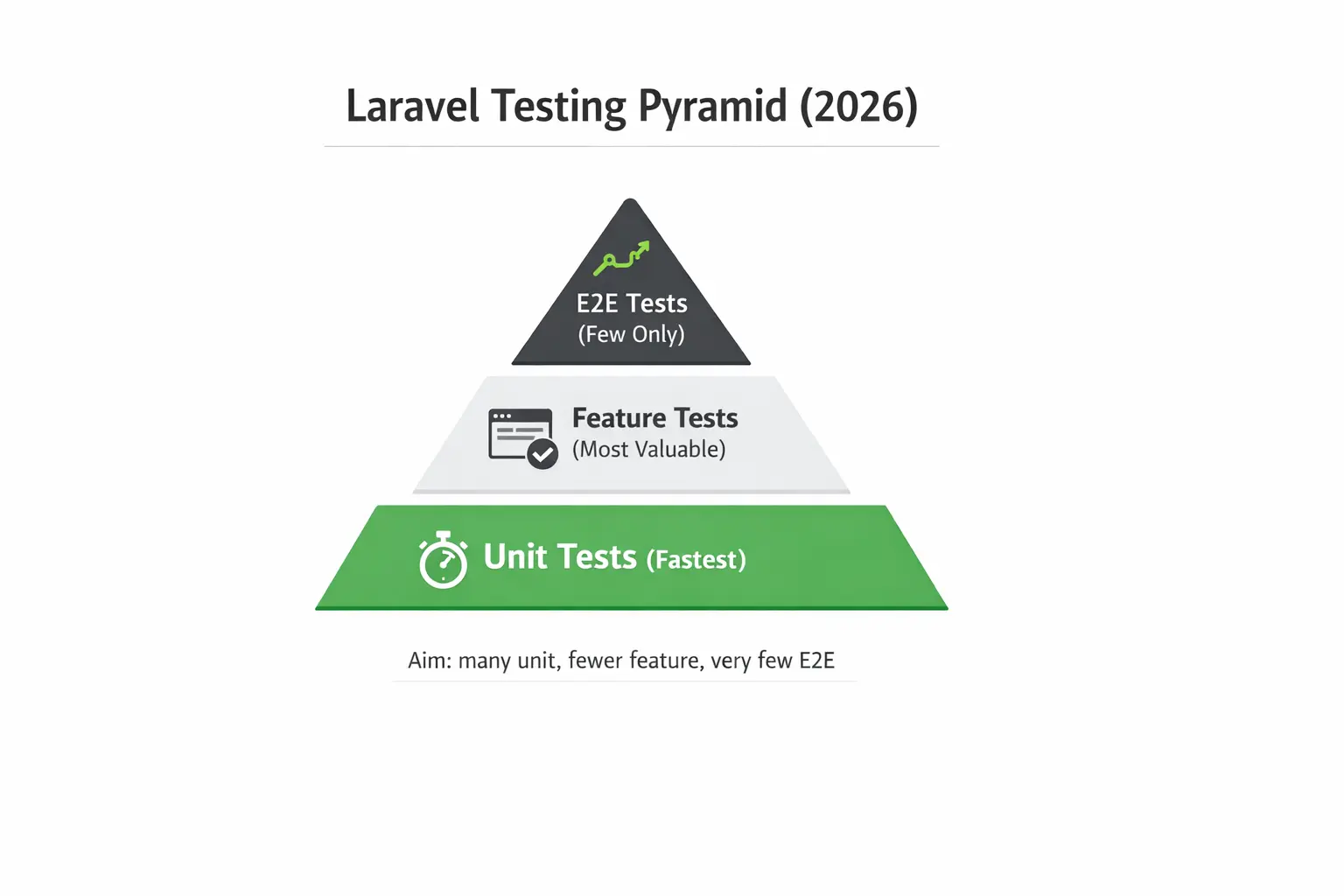
1) The testing pyramid that actually works in Laravel
Think in layers:
- Unit tests (fastest): Pure business rules (calculations, validators, service classes)
- Feature tests (most valuable): HTTP endpoints, middleware, auth, validation, database writes
- E2E tests (few only): A tiny set for “login → checkout → success” style flows
Rule: Start by covering the top 5 revenue / risk flows with feature tests. Then expand unit tests around complex logic.
2) PHPUnit vs Pest: what we recommend in 2026
Laravel supports both. The best choice depends on your team’s style:
- If your team prefers clean, readable tests: use Pest
- If your codebase is PHPUnit-heavy: keep PHPUnit and modernize gradually
Either way, keep assertions consistent and avoid mixing styles everywhere.
Example (Pest feature test)
use App\Models\User;

it('requires auth to access dashboard', function () {
    $this->get('/dashboard')->assertRedirect('/login');
});

it('shows dashboard for authenticated users', function () {
    $user = User::factory()->create();

    $this->actingAs($user)
        ->get('/dashboard')
        ->assertOk()
        ->assertSee('Dashboard');
});
3) Set up a stable test environment (the biggest win)
Most teams don’t “lack tests”—they lack stable tests. Do this once and you’ll save weeks:
- Create
.env.testing - Choose a test database strategy:
- MySQL/Postgres in CI (closest to production)
- SQLite for speed (good early, but may diverge in edge cases)
- Ensure migrations + factories are reliable
Recommended Laravel defaults:
- Use
RefreshDatabasefor most feature tests - Prefer factories over heavy seeds
use Illuminate\Foundation\Testing\RefreshDatabase;

uses(RefreshDatabase::class);
Run tests fast locally:
php artisan test
php artisan test --parallel
4) Write feature tests for the flows that matter
Start with flows where a bug costs money or trust:
- Signup / Login / OTP
- Subscription purchase / billing
- Admin permissions
- File uploads / downloads
- API endpoints (mobile/web)
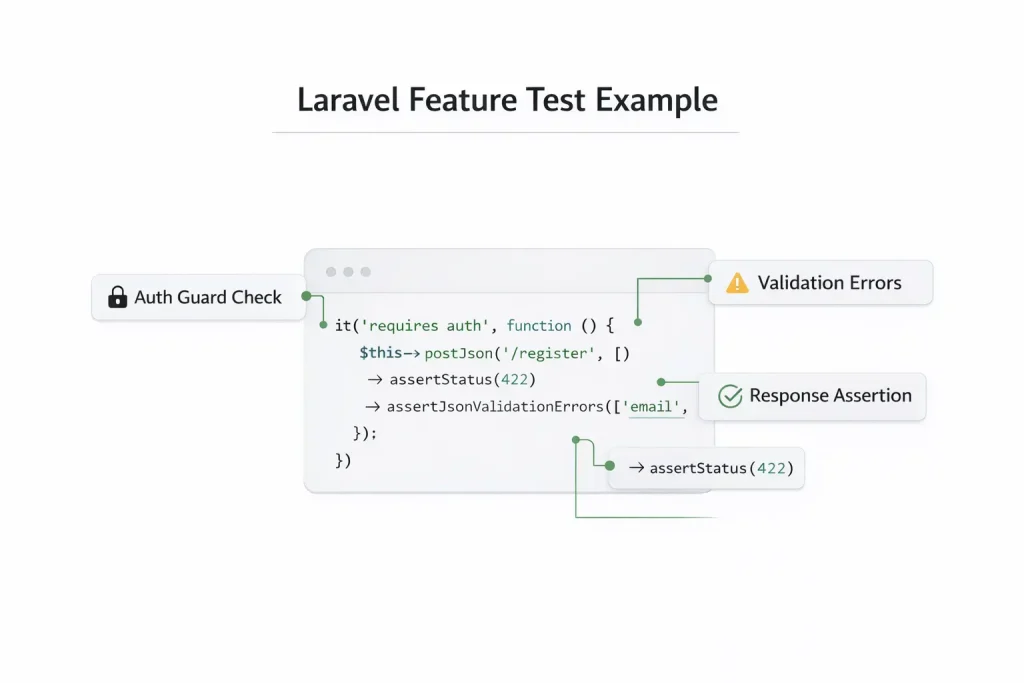
Feature test pattern (validation + response)
it('validates required fields on registration', function () {
    $this->postJson('/register', [])
        ->assertStatus(422)
        ->assertJsonValidationErrors(['email', 'password']);
});
Tip: Always assert HTTP status, JSON shape/message, and database changes (only when relevant).
5) Use Laravel fakes to avoid flaky tests
External dependencies make tests slow and flaky. Laravel provides clean fakes.
HTTP fake
use Illuminate\Support\Facades\Http;

Http::fake([
    'api.partner.com/*' => Http::response(['ok' => true], 200),
]);
Queue / Events / Mail / Notifications / Storage fakes
Queue::fake();
Event::fake();
Mail::fake();
Notification::fake();
Storage::fake('public');

Queue::assertPushed(\App\Jobs\SendInvoiceJob::class);
6) Testing APIs: the “API-first” baseline
If you want stable mobile/web APIs, enforce consistency in error format, pagination, auth guards, and rate limiting behavior.
it('returns paginated data in expected structure', function () {
    $this->getJson('/api/v1/products')
        ->assertOk()
        ->assertJsonStructure([
            'data',
            'links' => ['first','last','prev','next'],
            'meta'  => ['current_page','last_page','per_page','total'],
        ]);
});
7) CI pipeline checklist (ship with confidence)
The goal: every PR runs the same quality gate.
Minimum CI checks
- ✅
php artisan test - ✅ Lint/format (Laravel Pint)
- ✅ Static analysis (PHPStan/Larastan)
- ✅ (Optional) coverage threshold for critical folders
Example GitHub Actions workflow (simple)
name: CI

on: [push, pull_request]

jobs:
  tests:
    runs-on: ubuntu-latest
    steps:
      - uses: actions/checkout@v4
      - uses: shivammathur/setup-php@v2
        with:
          php-version: '8.3'
          coverage: none
      - run: composer install --no-interaction --prefer-dist
      - run: cp .env.example .env
      - run: php artisan key:generate
      - run: php artisan test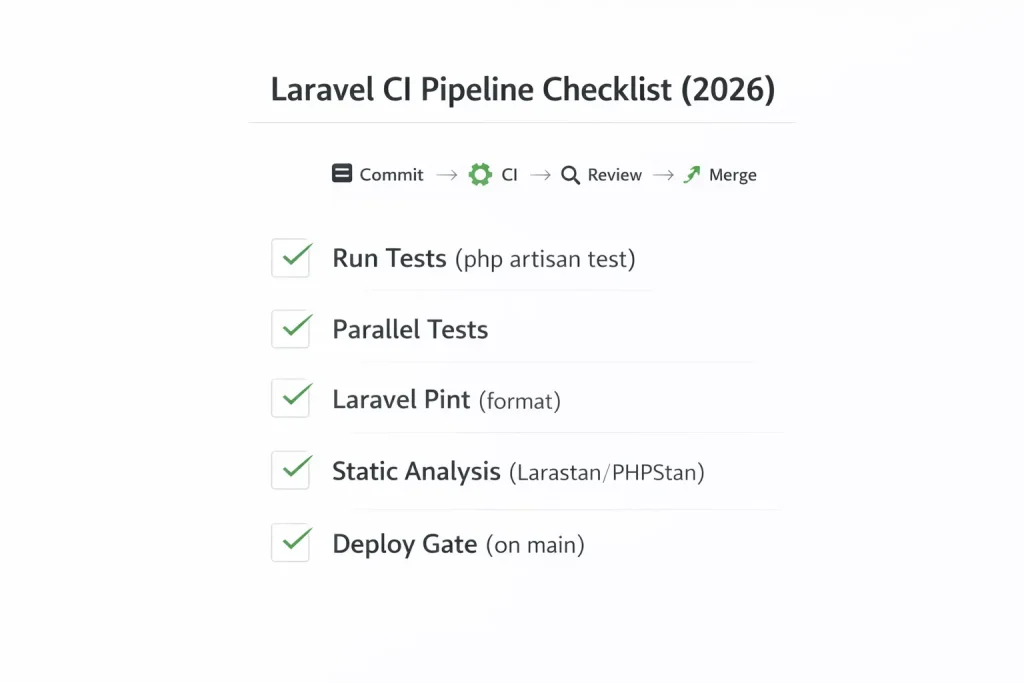
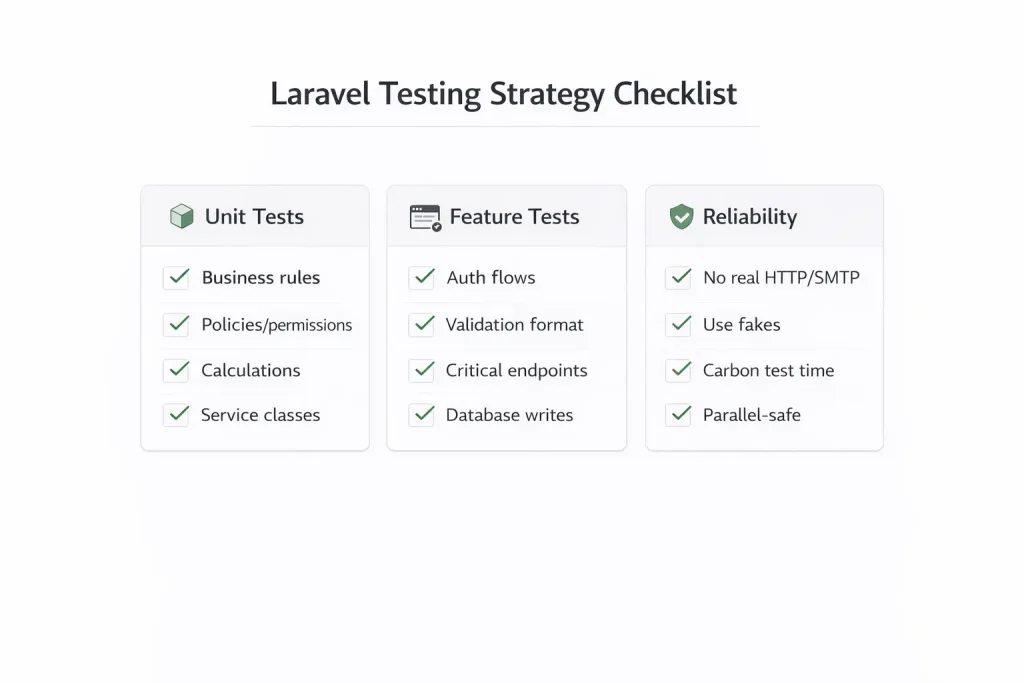
8) The testing checklist we use for Laravel delivery
- Unit tests
- [ ] All pricing/calculation logic tested
- [ ] Policy/permission logic tested
- [ ] Any complex parser/mapper tested
- Feature tests
- [ ] Auth (success + failure)
- [ ] Validation errors return correct format
- [ ] Critical endpoints protected by middleware
- [ ] Database writes verified for core flows
- Reliability
- [ ] No tests depend on real HTTP/SMTP
- [ ] Time-based logic uses
Carbon::setTestNow() - [ ] Parallel tests pass
9) Common mistakes (and quick fixes)
- Flaky tests: remove real external calls → use fakes
- Slow suite: reduce heavy seeds, prefer factories
- Random failures: stop relying on record order; assert by IDs/fields
- SQLite surprises: match production DB for critical flows in CI
Need a Laravel testing baseline quickly?
If you already have a Laravel app but almost no tests, the fastest path is:
- Add tests for top 5 flows
- Add CI gate
- Refactor safely after baseline is green
Want us to set up a production-grade testing baseline and CI for your Laravel app? Visit our Laravel Development Service.
FAQ
1) How many tests do I need to start?
Start with 10–20 feature tests for critical flows. That alone reduces production bugs massively.
2) Is 100% coverage required?
No. Focus coverage on risk areas: billing, auth, permissions, and critical APIs.
3) Pest or PHPUnit?
Both are fine. Pest is faster to write and read; PHPUnit is more traditional.
4) Should I use SQLite for tests?
SQLite is fast, but for critical apps, run CI on the same DB engine as production.
5) What’s the fastest way to add tests to a legacy app?
Begin with feature tests around the most-used endpoints, then extract business logic into services and unit test those.
Leave a Reply