Author: Binu Mathew

  • BigCommerce to Adobe Commerce Migration (2026): Complete Guide for Scaling Brands

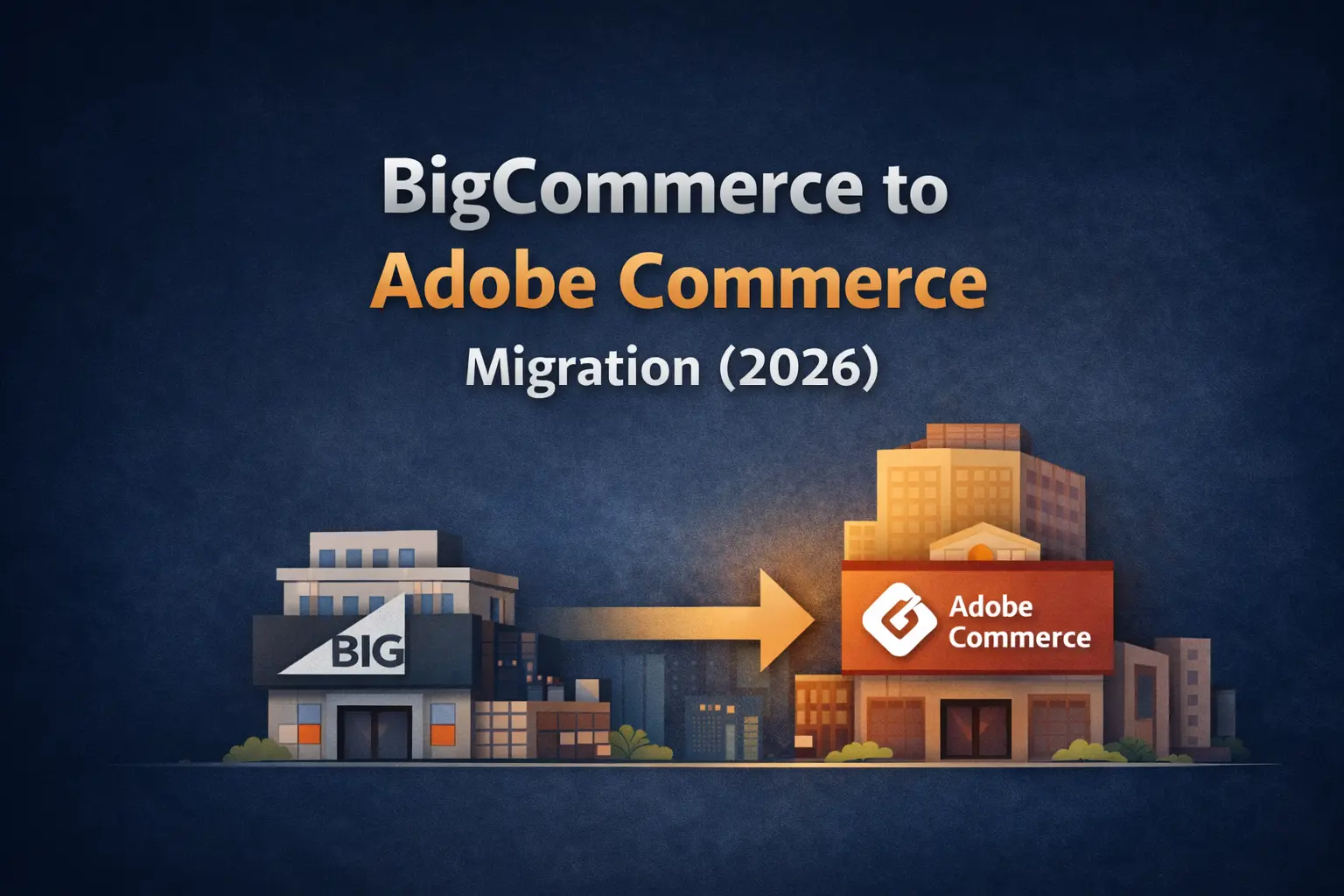
    BigCommerce to Adobe Commerce Migration (2026): Complete Guide for Scaling Brands

    BigCommerce is an excellent platform for getting an online store live quickly. But as brands scale in catalog size, revenue, complexity, and regional expansion, many hit unavoidable platform limits.

    By 2026, a clear pattern has emerged:

    Fast-growing and enterprise-focused brands eventually outgrow BigCommerce and migrate to Adobe Commerce (Magento).

    This guide is a complete, end-to-end resource on migrating from BigCommerce to Adobe Commerce, covering:

    • Why brands migrate
    • When migration makes sense
    • Data, SEO, and technical considerations
    • Cost, timeline, and risks
    • How to migrate safely without losing revenue or rankings
    • Who should not migrate

    This is not a sales pitch—it’s a decision framework for scaling brands.


    Why Brands Outgrow BigCommerce

    BigCommerce is a SaaS-first eCommerce platform, optimized for simplicity and speed. But SaaS convenience comes with architectural trade-offs.

    Common BigCommerce Scaling Limitations

    As stores grow, brands often face:

    • Limited backend customization
    • Restricted checkout logic
    • App dependency for core features
    • Revenue-based pricing tiers
    • Complex B2B workflows handled externally
    • Difficult multi-store or multi-region control

    BigCommerce works best when:

    • Business logic is simple
    • Catalog size is manageable
    • Custom pricing is limited
    • SaaS constraints are acceptable

    When these assumptions break, Adobe Commerce becomes the natural next step.


    Why Adobe Commerce Is Built for Scale

    Adobe Commerce (Magento) is not a SaaS platform—it’s a fully customizable commerce framework.

    It is designed for:

    • Complex catalogs (10k+ SKUs)
    • Multi-store, multi-currency, multi-region setups
    • B2B commerce
    • Advanced pricing & promotions
    • Custom checkout workflows
    • Deep ERP, CRM, and PIM integrations

    👉 Adobe Commerce development services


    BigCommerce vs Adobe Commerce: Architectural Difference

    AreaBigCommerceAdobe Commerce
    Platform modelSaaSSelf-hosted / Cloud
    Custom logicLimitedUnlimited
    CheckoutRestrictedFully customizable
    B2B featuresAdd-on basedNative
    Pricing modelRevenue-basedFixed / license
    IntegrationsApp-firstAPI & backend-first
    ScalabilityPlan-limitedInfrastructure-driven

    Key takeaway:
    BigCommerce scales until business logic becomes complex.
    Adobe Commerce scales with complexity.


    When Should You Migrate from BigCommerce to Adobe Commerce?

    Migration makes sense if 2 or more of the following are true:

    • Your store revenue is growing rapidly
    • You need advanced pricing or customer-specific catalogs
    • You run B2B or hybrid B2B+B2C
    • Checkout customization is required
    • App costs are increasing
    • BigCommerce plan limits are blocking growth
    • You need deeper backend integrations

    If your store is still simple and SaaS-friendly, BigCommerce may still be the right choice.

    👉 BigCommerce development services


    What Data Can Be Migrated from BigCommerce?

    ✅ Data That Can Be Migrated Safely

    • Products & variants
    • Categories
    • Customers
    • Orders (historical)
    • Coupons & discounts
    • Reviews
    • CMS pages
    • URLs & SEO metadata

    ❌ Data That Must Be Rebuilt

    • Apps & app-based logic
    • Checkout customizations
    • Theme-specific features
    • SaaS workflow automations

    Adobe Commerce replaces apps with native features or custom modules, which is more stable long-term.


    SEO Considerations (Critical)

    SEO is the highest-risk area of any eCommerce migration.

    Common SEO Risks

    • URL changes without redirects
    • Metadata loss
    • Category restructuring errors
    • Pagination & faceted navigation issues
    • Duplicate content

    SEO-Safe Migration Requires

    • Full URL mapping
    • 301 redirect strategy
    • Metadata parity
    • Canonical control
    • XML sitemap regeneration
    • Post-launch monitoring

    👉 Dedicated migration services

    Adobe Commerce Migration
    BigCommerce Migrations


    BigCommerce to Adobe Commerce Migration Phases

    Phase 1: Discovery & Planning

    • Business logic analysis
    • App dependency audit
    • SEO audit
    • Data mapping
    • Risk identification

    Phase 2: Adobe Commerce Architecture

    • Hosting & infrastructure setup
    • Store structure design
    • Attribute & product modeling
    • Pricing logic planning

    Phase 3: Data Migration

    • Products, customers, orders
    • Media assets
    • CMS content
    • Metadata

    Phase 4: Custom Development

    • Checkout customization
    • B2B workflows
    • ERP / CRM integrations
    • Performance optimization

    Phase 5: SEO, QA & Launch

    • Redirects
    • SEO validation
    • Load testing
    • Staged rollout

    Phase 6: Post-Launch Optimization

    • Performance tuning
    • Conversion optimization
    • Analytics validation

    Migration Timeline (2026)

    Store ComplexityTimeline
    Small catalog6–8 weeks
    Medium store8–12 weeks
    Enterprise / B2B12–20+ weeks

    Rushed migrations almost always cause SEO or revenue loss.


    Migration Cost Breakdown (High-Level)

    Store TypeTypical Cost
    Small store$8k – $15k
    Mid-sized brand$15k – $35k
    Enterprise / B2B$35k – $80k+

    Cost depends on:

    • Custom logic
    • Integrations
    • SEO complexity
    • Performance requirements

    Important:
    Adobe Commerce costs more upfront but reduces long-term platform and app fees.


    BigCommerce vs Adobe Commerce: Total Cost of Ownership

    BigCommerce Long-Term Costs

    • Monthly SaaS fees
    • Revenue-based pricing
    • App subscriptions
    • Limited customization
    • Scaling penalties

    Adobe Commerce Long-Term Costs

    • Hosting
    • Maintenance
    • Custom development
    • No revenue-based lock-in

    At scale, Adobe Commerce is often cheaper over 3–5 years.


    Who Should NOT Migrate

    Do NOT migrate if:

    • Your store is small and stable
    • You rely on BigCommerce SaaS simplicity
    • Custom logic is minimal
    • Budget or timeline is tight

    Migration is a scaling decision, not a trend.


    Why Brands Choose Adobe Commerce After BigCommerce

    Brands migrate to Adobe Commerce for:

    • Control over business logic
    • Scalable architecture
    • B2B readiness
    • Custom checkout & pricing
    • Long-term cost predictability

    This is why Adobe Commerce dominates enterprise and high-growth commerce.


    Choosing the Right Migration Partner

    A BigCommerce → Adobe Commerce migration partner must:

    • Understand both platforms deeply
    • Plan SEO before development
    • Handle data integrity
    • Build scalable architecture
    • Support post-launch optimization

    👉 Adobe Commerce migration & development


    Final Verdict (2026)

    BigCommerce helps you launch.
    Adobe Commerce helps you scale without compromise.

    If BigCommerce is starting to limit growth, migration is not a failure—it’s a strategic upgrade.


    FAQ: BigCommerce to Adobe Commerce Migration (2026)

    1. Why should I migrate from BigCommerce to Adobe Commerce?

    Brands migrate from BigCommerce to Adobe Commerce when they outgrow SaaS limitations. Adobe Commerce offers deeper customization, better support for complex catalogs, B2B features, advanced pricing, custom checkout logic, and long-term scalability without revenue-based platform fees.


    2. When is the right time to migrate from BigCommerce to Adobe Commerce?

    Migration makes sense when your store requires custom business logic, B2B workflows, multi-store or multi-region setups, or when BigCommerce plan limits and app costs start restricting growth.


    3. How long does a BigCommerce to Adobe Commerce migration take?

    A typical migration takes:

    • 6–8 weeks for small stores
    • 8–12 weeks for mid-sized stores
    • 12–20+ weeks for enterprise or B2B stores
      The timeline depends on catalog size, integrations, SEO complexity, and customization needs.

    4. Will I lose SEO rankings during the migration?

    No—if the migration is done correctly. SEO-safe migration includes full URL mapping, 301 redirects, metadata preservation, canonical control, and post-launch monitoring. Poor planning, not the platform, causes ranking loss.


    5. What data can be migrated from BigCommerce to Adobe Commerce?

    You can migrate products, categories, customers, orders, CMS pages, URLs, and SEO metadata. Apps, SaaS workflows, and theme-specific features usually need to be rebuilt natively in Adobe Commerce.


    6. How much does BigCommerce to Adobe Commerce migration cost in 2026?

    Typical costs range from:

    • $8,000–$15,000 for small stores
    • $15,000–$35,000 for mid-sized brands
    • $35,000–$80,000+ for enterprise or B2B stores
      Costs depend on customization, integrations, SEO sensitivity, and scale.

    7. Is Adobe Commerce more expensive than BigCommerce long term?

    Not necessarily. While Adobe Commerce has a higher upfront cost, it often reduces long-term expenses by eliminating revenue-based fees, lowering app subscriptions, and offering greater control over infrastructure and performance.


    8. Who should not migrate from BigCommerce to Adobe Commerce?

    Migration may not be suitable if your store is small, stable, budget-constrained, or if you prefer SaaS simplicity over customization and control.


    9. Do I need a specialized migration partner?

    Yes. A successful migration requires expertise in both BigCommerce and Adobe Commerce, SEO planning, data integrity handling, and post-launch optimization. Generic replatforming often leads to revenue or SEO loss.
  • Laravel Best Practices for SaaS Projects

    Laravel Best Practices for SaaS Projects

    A Practical, Scalable, and Secure Guide for Modern SaaS Teams

    Building a SaaS product is not just about writing code — it’s about scalability, security, performance, and long-term maintainability. Laravel has become one of the most reliable frameworks for SaaS development, but real success depends on how you use it.

    This guide covers Laravel best practices specifically for SaaS projects, based on real-world production systems running at scale.

    Why Laravel Is a Strong Choice for SaaS

    Laravel is particularly well-suited for SaaS platforms because it offers:

    • Opinionated yet flexible architecture
    • Built-in authentication, queues, jobs, and events
    • A rich ecosystem for billing, notifications, caching, and APIs
    • High developer productivity and long-term maintainability

    For SaaS businesses, time-to-market and stability matter more than theoretical benchmarks — and Laravel delivers both.

    👉 If you’re planning a SaaS build, explore our
    Laravel Development Services

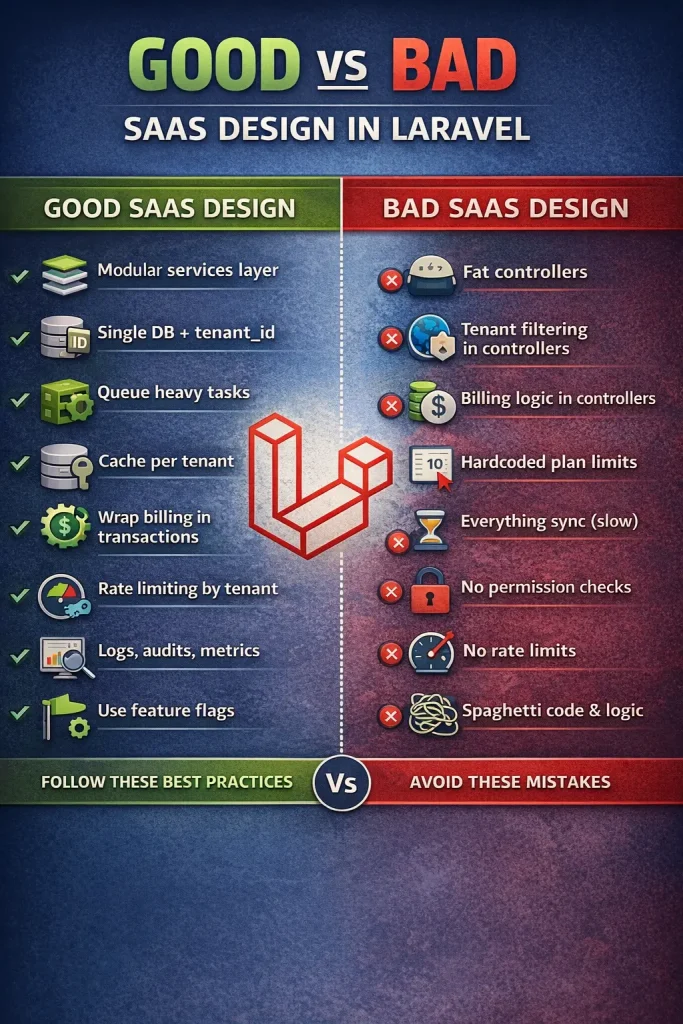
    Good vs bad SaaS design in Laravel showing best practices versus common architectural mistakes

    1. Choose the Right SaaS Architecture Early

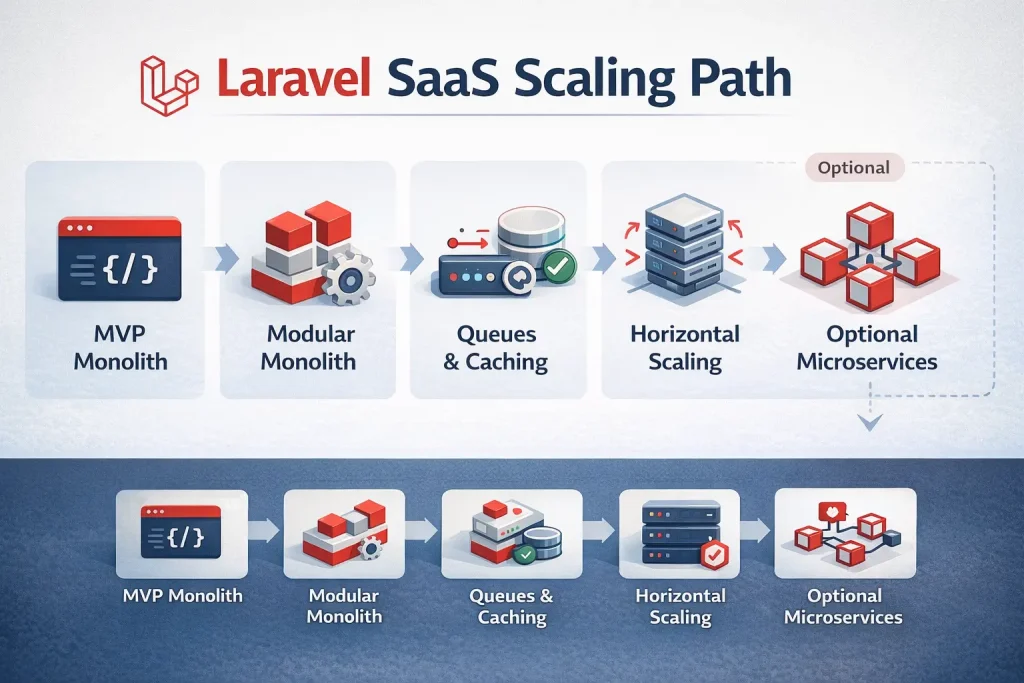
    Monolith First, Modular Always

    For most SaaS startups, the best approach is:

    Modular Monolith → Selective Microservices

    Best practices:

    • Start with a modular monolith
    • Split the system by business domains, not technical layers

    Example domain-based structure:

    app/
     ├── Domains/
     │    ├── Billing/
     │    ├── Users/
     │    ├── Subscriptions/
     │    ├── Notifications/
     │    ├── Reporting/
    

    Avoid early microservices unless you truly need:

    • Independent scaling
    • Heavy async workloads
    • Multiple teams working in parallel

    2. Multi-Tenancy: The Core of SaaS

    Multi-tenancy is the foundation of any SaaS platform.

    Common Multi-Tenant Models in Laravel

    • Single database + tenant_id – Best for early and mid-stage SaaS
    • Schema per tenant – Useful for regulated environments
    • Database per tenant – Enterprise-grade isolation

    Recommended Best Practice

    • Use single database + tenant_id
    • Enforce isolation at:
      • Middleware
      • Global scopes
      • Repository or service layer

    Never rely only on controllers to filter tenant data.

    3. Authentication & Authorization Best Practices

    Use Token-Based Authentication

    For SaaS APIs, use:

    • Laravel Sanctum (SPA + mobile)
    • OAuth2 (for public APIs)

    Implement Role-Based Access Control (RBAC)

    Typical SaaS roles:

    • Owner
    • Admin
    • Manager
    • User

    Best practices:

    • Store permissions in the database
    • Cache permission checks
    • Avoid hardcoding role logic

    4. Service Layer Over Fat Controllers

    One of the biggest Laravel SaaS mistakes is putting business logic in controllers.

    Correct Pattern

    Controller → Service → Repository → Model
    

    Benefits:

    • Testable business logic
    • Cleaner controllers
    • Easier refactoring
    • Safer long-term scaling

    5. Billing & Subscription Management

    Golden Rules for SaaS Billing

    • Billing logic should never live in controllers
    • Always log billing actions
    • Never trust frontend prices
    • Support proration and retries

    A proper SaaS billing system should include:

    • Plans and add-ons
    • Usage-based pricing
    • Invoices and taxes
    • Webhooks and retries
    • Grace periods

    Always wrap billing actions in database transactions and process webhooks via queues.


    6. Queues, Jobs & Asynchronous Processing

    No serious SaaS application runs everything synchronously.

    What Must Be Queued

    • Emails
    • Notifications
    • Webhooks
    • PDF generation
    • Reports
    • Third-party API calls
    • Heavy calculations

    Rule of thumb:

    If it can fail or take more than 200ms — queue it.

    Best practices:

    • Use separate queues (billing, notifications, imports)
    • Configure retries and backoff
    • Monitor failures

    7. Database & Data Integrity Best Practices

    Use Transactions Aggressively

    Critical business operations should always be wrapped in database transactions.

    Avoid Common Eloquent Pitfalls

    Avoid:

    • N+1 queries
    • Business logic in model events
    • Missing indexes

    Always index:

    • tenant_id
    • foreign keys
    • date columns used in filters

    Use UUIDs for Public SaaS Entities

    Benefits:

    • Safer API exposure
    • Better security
    • Easier horizontal scaling later

    8. Caching Strategy for SaaS Performance

    Caching is mandatory for SaaS scalability.

    What to Cache

    • Permissions
    • Feature flags
    • Tenant settings
    • Expensive reports
    • Aggregated metrics

    Best practices:

    • Cache per tenant
    • Use TTL wisely
    • Invalidate cache on writes, not reads

    9. Feature Flags & Plan Enforcement

    Never hardcode SaaS limits.

    Best practices:

    • Store plans in database
    • Enforce limits centrally
    • Cache feature flags

    This allows:

    • Upselling
    • A/B testing
    • Custom enterprise plans

    10. Observability: Logs, Metrics & Audits

    Logging Best Practices

    • Use structured logs
    • Include tenant_id and user_id
    • Separate business logs from system logs

    Audit Trails Are Mandatory

    Track:

    • Billing changes
    • Role updates
    • Settings changes
    • Security events

    Audit logs protect both you and your customers.


    11. Security Best Practices for Laravel SaaS

    Must-Have Security Measures

    • Rate limiting per tenant
    • MFA for admin users
    • Webhook signature validation
    • Encrypted sensitive fields
    • Strict CORS policies

    Never:

    • Store secrets in repositories
    • Skip webhook verification
    • Trust client-side limits

    12. CI/CD & Deployment Best Practices

    Recommended deployment flow:

    1. Automated tests
    2. Static analysis
    3. Database migrations
    4. Cache warm-up
    5. Zero-downtime deployment
    6. Queue restart

    Laravel SaaS checklist:

    • config caching
    • route caching
    • queue monitoring
    • rollback strategy

    13. Scaling Laravel SaaS the Right Way

    Scale in this order:

    1. Query optimization
    2. Caching
    3. Background jobs
    4. Horizontal scaling
    5. Read replicas
    6. Service extraction

    Do not start with microservices — start with clean boundaries.


    14. Common Laravel SaaS Mistakes to Avoid

    • No tenant isolation enforcement
    • Billing logic in controllers
    • No background jobs
    • Hardcoded plan limits
    • No audit logs
    • No rate limiting

    Each of these becomes very expensive to fix later.


    Final Thoughts

    Laravel is not “just a PHP framework.”
    Used correctly, it is a complete SaaS application platform.

    If you follow these best practices, your Laravel SaaS will be:

    • Easier to scale
    • Safer to operate
    • Faster to evolve
    • Cheaper to maintain

    Need Help Building or Scaling a Laravel SaaS?

    If you’re looking for:

    • SaaS architecture planning
    • Multi-tenant Laravel setup
    • Subscription and billing systems
    • Performance and security optimization

    👉 Explore our Laravel SaaS expertise:

  • PHP vs Node.js in 2026: Which Backend Is Better for SaaS, APIs, and Real-Time Apps?

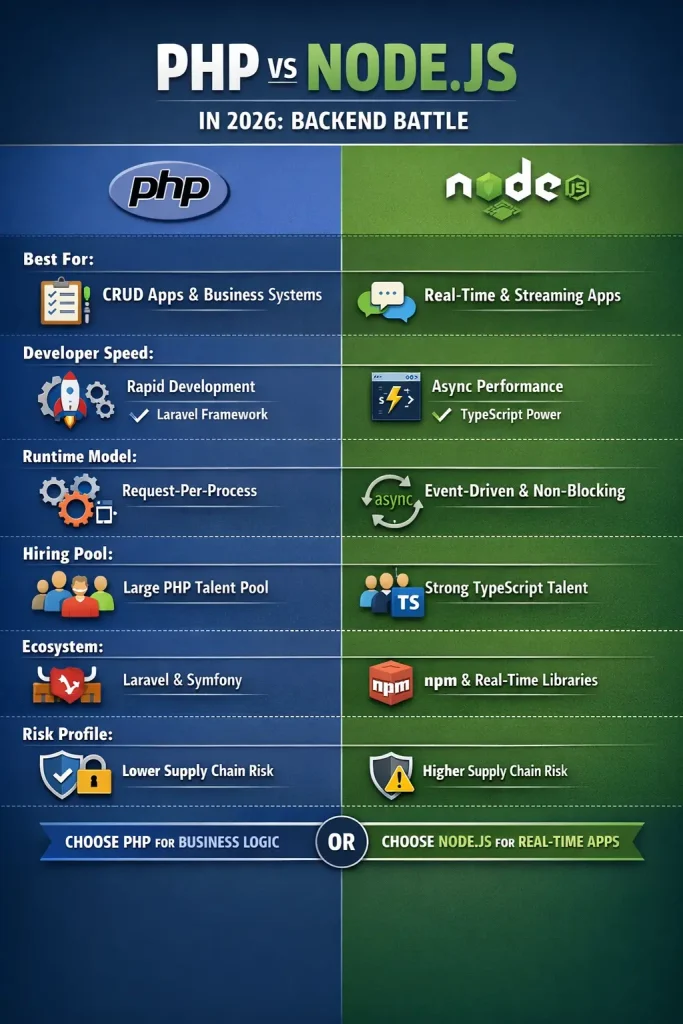
    In 2026, “PHP vs Node.js” is no longer a debate about which language is “faster” or “more modern.” It’s a strategic decision about delivery speed, operational simplicity, team productivity, and how your backend will evolve as your product grows. Both ecosystems are mature, battle-tested, and capable of powering high-traffic systems—yet they shine in different scenarios.

    This guide will help you choose the right backend stack for your next build (or your next phase). You’ll get a clear comparison, a decision matrix, architecture patterns that work in real life, and a practical 30–60–90 day execution plan.


    Quick Verdict (When You Need an Answer Today)

    • Choose PHP if you want ultra-fast delivery for CRUD-heavy apps, content platforms, admin panels, and business workflows—especially with Laravel’s ecosystem and conventions.
    • Choose Node.js if your product is real-time by nature (chat, live dashboards, collaboration), heavily event-driven, or benefits from a unified JavaScript/TypeScript stack across frontend + backend.
    • Choose both if you’re building a platform: PHP/Laravel for the core business system + Node.js for real-time gateways, streaming, and event processors.

    Need implementation help? Explore our backend services:


    PHP vs Node.js in 2026: The Comparison Table (Decision-Friendly)

    Category PHP (Modern PHP + Laravel) Node.js (Modern Node + TypeScript)
    Best fit CRUD apps, admin panels, SaaS backoffices, content-driven platforms, multi-tenant business systems Real-time apps, event-driven systems, streaming APIs, BFF layers, high-concurrency I/O workloads
    Developer speed Very high with conventions (Laravel scaffolding, ORM, queues, auth) High with frameworks (NestJS/Fastify) but depends on architecture discipline
    Runtime model Traditionally request-per-process (PHP-FPM). Modern options exist (workers/app servers) Event loop, async I/O, excellent for concurrent network workloads
    Hiring Deep global pool (especially for web + CMS + Laravel) Strong pool, especially TypeScript engineers; competition can be higher
    Operational simplicity Very straightforward on shared hosting/VPS; mature deployment patterns Simple in containers; requires process management & monitoring discipline
    Ecosystem strengths Laravel, Symfony, WordPress ecosystem, strong server-side patterns, stable tooling npm ecosystem, TypeScript tooling, real-time libs, modern dev workflows
    Risk profile Lower supply-chain risk exposure by default (Composer is generally more conservative) Higher supply-chain exposure (npm is huge); strong practices mitigate this

    The Real Question: “What Kind of Backend Are You Building?”

    Choosing a backend stack becomes simple when you classify your product into one of these patterns:

    1) Business Systems (CRUD + Workflows + Roles)

    If your core product is a business process—customers, invoices, inventory, scheduling, approvals—then delivery speed and maintainability matter more than theoretical throughput.

    • PHP/Laravel wins because you get authentication, roles, queues, validation, migrations, admin tooling, and a clean MVC workflow that teams understand quickly.
    • Node.js works too, but the “speed advantage” depends on your team’s ability to standardize patterns (DTOs, modules, guards, validation, error contracts).

    2) Real-Time Products (Chat, Live Tracking, Collaboration)

    Real-time features are not “just one more endpoint.” They change the architecture: websockets, pub/sub, message fan-out, presence, and stream state.

    • Node.js shines due to async I/O and the ecosystem around real-time communication.
    • PHP can do real-time too (especially with modern app servers and pub/sub), but Node is often the most direct path to production.

    3) Platform Backends (Multiple Services, Events, Integrations)

    If you’re building a platform (billing, notifications, data pipelines, integrations, APIs), the best answer in 2026 is often hybrid:

    • Laravel/PHP for the core business domain + admin UX + core APIs
    • Node.js for real-time gateway, event consumers, streaming endpoints, and lightweight edge/BFF services

    Framework Reality Check: Laravel vs NestJS (And Why This Matters More Than Language)

    Most teams don’t adopt a language—they adopt a framework + conventions. Here’s the practical view:

    Laravel (PHP) is a “productivity engine”

    • Faster for standard SaaS patterns: auth, roles, CRUD, billing logic, background jobs, email, events.
    • Opinionated defaults reduce decision fatigue.
    • Great fit when you need a stable long-term codebase with predictable architecture.

    NestJS (Node.js) is a “structure engine”

    • NestJS brings enterprise structure to Node: modules, dependency injection, guards, pipes, interceptors.
    • When paired with TypeScript and strict linting, you can build highly maintainable systems.
    • Best for teams already strong in modern JS/TS and building event-driven services.

    Actionable tip: If your Node backend currently looks like “Express + random folders,” your future pain is not Node—it’s missing architecture. If your PHP codebase is “controllers doing everything,” your pain is not PHP—it’s lack of service-layer discipline.


    Performance in 2026: What Actually Matters in Production

    In production, performance is not a single number. It’s the combination of:

    • Latency (how fast the API responds)
    • Throughput (requests per second)
    • Concurrency (how many connections you can handle)
    • Cost efficiency (how much traffic per server/container)
    • Predictability under load (no surprise timeouts)

    Node.js: Great for concurrent I/O

    Node’s event loop model performs extremely well when your workload is dominated by network I/O: database calls, APIs, websockets, message brokers, and streaming responses.

    PHP: Great for request/response business workloads

    PHP’s traditional model (PHP-FPM) is still excellent for typical web APIs and server-rendered apps. Plus, modern PHP has evolved with better language features and modern deployment choices.

    Modern PHP App Servers: The 2026 upgrade path

    One of the biggest shifts in the PHP ecosystem is the growing adoption of modern application servers and worker-style execution (where your app stays warm in memory). This can significantly reduce bootstrapping overhead for high-traffic APIs.

    Bottom line: If your app is “standard business SaaS,” either stack will be fast enough. If your app is “10k concurrent websocket connections,” Node is often simpler. If your app is “API + heavy business rules + lots of admin workflows,” PHP/Laravel will feel like a shortcut.


    Security & Supply Chain: A Practical Checklist (Both Stacks)

    In 2026, most backend breaches aren’t from the language—they’re from:

    • weak auth/session handling
    • misconfigured cloud storage
    • dependency vulnerabilities
    • secrets leaked in CI/CD
    • missing rate limits

    Use this baseline security checklist

    • Dependency hygiene: lock files committed, automated audits, controlled upgrades
    • Secrets: vault or secret manager, no secrets in repos, rotation policy
    • Auth: MFA for admins, refresh token strategy, session invalidation, device tracking
    • Rate limiting: per IP + per account + per endpoint category
    • Logging: structured logs + alerting on suspicious patterns
    • Backups: tested restores, not just “enabled backups”

    Recommended reading (non-competitor references):


    Hiring & Team Fit: The “Lowest Friction” Rule

    Here’s the most reliable hiring strategy for 2026:

    Pick the stack that your team can execute cleanly for the next 24 months.

    Choose PHP/Laravel if:

    • your team already ships business systems in Laravel
    • you want predictable conventions and fast onboarding
    • your roadmap is heavy on workflows, admin panels, and data integrity

    Choose Node.js/TypeScript if:

    • your team is strong in TypeScript and modern JS tooling
    • your roadmap includes real-time, streaming, or event-driven architecture
    • you want one language across frontend and backend (especially for BFF layers)

    Actionable hiring tip: The best backend teams aren’t defined by language; they’re defined by consistency: code standards, reviews, testing culture, and operational discipline.


    Decision Matrix: Score PHP vs Node.js for Your Project

    Give each category a score from 1 (low) to 5 (high) based on your project needs. Then see which side dominates.

    Criteria If this is HIGH, lean toward… Why
    Admin panels + CRUD PHP/Laravel Faster scaffolding, conventions, stable patterns
    Real-time features Node.js Direct ecosystem fit for websockets + event-driven services
    Complex business rules PHP/Laravel Clean domain/service layering, strong tooling for long-lived apps
    Streaming APIs / long-lived connections Node.js Async I/O and concurrency model excel here
    Team is TypeScript-first Node.js Unified language and tooling reduces friction
    Time-to-market for SaaS MVP PHP/Laravel Rapid feature delivery with fewer architectural decisions

    Rule of thumb: If your top 3 needs are CRUD/workflows/admin/billing → pick Laravel. If your top 3 needs are real-time/streaming/events/BFF → pick Node.js.


    Modern Architecture Patterns That Win in 2026

    Pattern A: Laravel Core + Node Real-Time Gateway (Best of Both)

    • Laravel: auth, users, billing, admin, core business logic
    • Node.js: websockets, live events, presence, stream fan-out
    • Redis/Kafka/RabbitMQ: event backbone

    Why it works: You keep the business system stable while scaling real-time features independently.

    Pattern B: Node BFF + PHP Services (Great for frontend-heavy teams)

    • Node BFF aggregates data for web/mobile
    • PHP services handle billing/workflows/legacy modules
    • Shared contracts via OpenAPI/Swagger

    Pattern C: One Stack, Two Runtimes

    • PHP only: Laravel + queues + modern server runtime where needed
    • Node only: NestJS + background workers + message-driven modules

    Why it works: Lower cognitive load. Best when your product doesn’t demand a hybrid approach yet.


    30–60–90 Day Execution Plan (Actionable)

    First 30 Days: Prove the core

    • Define your API contract (OpenAPI) and error format
    • Implement auth + roles + rate limiting
    • Build the 3–5 highest-value workflows end-to-end
    • Add basic observability: logs + traces + metrics

    Day 31–60: Make it stable

    • Add background jobs + retries + DLQs (dead letter queues)
    • Implement caching strategy (what to cache, TTL, invalidation)
    • Load test the top endpoints and fix slow queries
    • Harden security: secrets, headers, WAF rules, audit logs

    Day 61–90: Make it scalable

    • Split real-time/streaming workloads into separate services if needed
    • Introduce event-driven patterns for heavy processes
    • Set SLOs (latency, error rate) and alerting thresholds
    • Document runbooks: deployment, rollback, incident response

    Internal Linking Ideas (For Your WordPress Blog)

    These are safe internal articles to create/link (no competitor links):


    FAQs

    Is PHP still a good choice in 2026?

    Yes. Modern PHP is productive, stable, and widely used for business systems and content-driven platforms. With the Laravel ecosystem, it remains one of the fastest ways to ship and maintain SaaS backends.

    Is Node.js better for scaling?

    Node.js scales very well for concurrent I/O and real-time workloads. But scaling success depends more on architecture, caching, DB design, and observability than language alone.

    Should I rewrite my PHP app in Node.js?

    Usually no. Instead, extract the parts that truly need Node.js (real-time, streaming, event processing) and keep the stable business core in PHP.

    Which is better for an MVP?

    For most SaaS MVPs with workflows and admin features, Laravel is often the quickest path. For real-time-first MVPs, Node.js can be faster.

    What’s the best approach if I’m unsure?

    Start with the stack your team is strongest in, and design your system so you can add a second service later (event bus + clean API boundaries).

    Can you help me choose and implement the right architecture?

    Yes—if you want a guided build with production-ready patterns, explore our Laravel development, Node.js development, and PHP development services.


    Final Takeaway

    PHP Vs Node JS in 2026

    In 2026, the winning move isn’t “PHP or Node.js forever.” The winning move is choosing the stack that matches your product’s workload and your team’s strengths—then building with clean boundaries so your system can evolve.

    If your product is workflow-heavy: PHP/Laravel is a strategic advantage.
    If your product is real-time and event-driven: Node.js is a strategic advantage.
    If you’re building a platform: a hybrid architecture is often the most effective path.

  • Is Laravel still the right choice in 2026? (Updated for Laravel 13)

    Is Laravel still the right choice in 2026? (Updated for Laravel 13)

    Quick answer: Yes. Laravel 13, released March 17, 2026, remains the right choice for the vast majority of PHP teams. It ships with zero breaking changes from Laravel 12, a production-stable first-party AI SDK, passkey authentication, and PHP 8.3 as its minimum. If you are already on Laravel, there is no reason to switch. If you are starting a new PHP project in 2026, Laravel is still the default answer.

    But “right choice” depends entirely on what you are building, your team’s skills, and your timeline. This article gives you the complete picture — the data, the new features, the honest trade-offs, and the scenarios where Laravel is the wrong answer too.

    What the data actually says about Laravel in 2026

    Before any opinion, look at the numbers. The JetBrains State of PHP 2025 report surveyed 1,720 professional PHP developers across 194 countries. The headline stat: Laravel leads PHP framework adoption at 64%, with WordPress at roughly 25% and Symfony at 23%. That is not a framework “clinging on” — that is dominance.

    Three other data points from the same report matter for your decision:

    • 89% of PHP developers are already on PHP 8.x, signalling that the ecosystem has modernised.
    • 58% of PHP developers have no plans to switch to another language.
    • 95% of PHP developers have tried AI tools, and 80% use them regularly — meaning your Laravel team is already AI-augmented whether you planned for it or not.

    Laravel also ranked first in the Stack Overflow Developer Survey for the fifth consecutive year as the most-used PHP framework. These are not vanity metrics. They translate directly into hiring pools, community support, package availability, and the speed at which your developers solve problems.

    If you want a deeper breakdown of what the JetBrains data means specifically for teams managing Laravel applications, see our analysis of the State of PHP 2025 for Laravel teams.

    What changed in Laravel 13 — and why it matters for your decision

    Laravel 13 launched on March 17, 2026, announced by Taylor Otwell at Laracon EU in Amsterdam. The official release notes describe it as “a relatively minor upgrade in terms of effort, while still delivering substantial new capabilities.” That is accurate — and it is actually good news if you are evaluating whether to adopt or stay on Laravel.

    Zero breaking changes from Laravel 12

    For most standard applications, upgrading from Laravel 12 to Laravel 13 takes under ten minutes. The one meaningful infrastructure requirement is PHP 8.3 as the minimum. Once your server is on PHP 8.3 or higher, the framework upgrade itself is straightforward. If your team has been deferring the upgrade conversation, Laravel 13 is the easiest entry point in years. See our Laravel upgrade guide for 2026 for the complete step-by-step process.

    The Laravel AI SDK is now production-stable

    This is the single most significant addition in Laravel 13 for teams evaluating the framework in 2026. The Laravel AI SDK ships as a first-party package providing a unified, provider-agnostic interface for text generation, tool-calling agents, embeddings, image generation, audio synthesis, and vector store integrations. It supports OpenAI, Anthropic Claude, and Google Gemini out of the box.

    This matters beyond chatbot features. Teams can now build semantic search, AI-assisted workflows, and document processing pipelines entirely within the Laravel ecosystem — without choosing a provider-specific third-party package and absorbing that maintenance risk. For product teams considering whether to build AI features on their existing Laravel codebase, this removes the main friction point that previously made Node.js or Python microservices look attractive.

    Our team has been building AI-powered Laravel applications using the SDK since its beta. If you want to explore what is possible with Laravel AI development for your product, the 2026 toolkit is the strongest it has ever been.

    PHP attributes across the framework

    Laravel 13 introduces native PHP attribute syntax as an optional alternative to class property declarations across more than 15 locations — models, controllers, jobs, commands, listeners, mailables, and more. This is a non-breaking change. Your existing code continues working without modification. But for teams writing new code, attributes make configuration more declarative and colocated with the class it belongs to, which improves readability at scale.

    Passkey authentication

    Laravel 13 adds first-party passkey support through Laravel Fortify and the new starter kits. If you are building any application where user authentication security is a priority — and in 2026, that is most applications — passkeys are the direction the industry is moving. Having this built into the framework rather than requiring a third-party package is a meaningful reduction in implementation complexity.

    Support timeline you can plan around

    Laravel 13 receives bug fixes until Q3 2027 and security fixes until March 2028. Laravel 12 remains on bug fixes until August 2026. This gives teams on Laravel 12 a clear, no-emergency window to plan the upgrade. For a full version-by-version breakdown including PHP compatibility ranges, see our Laravel PHP compatibility matrix.

    Where Laravel is the right choice in 2026

    Laravel is the right default for a wide range of projects. These are the scenarios where it consistently delivers.

    SaaS products and internal platforms

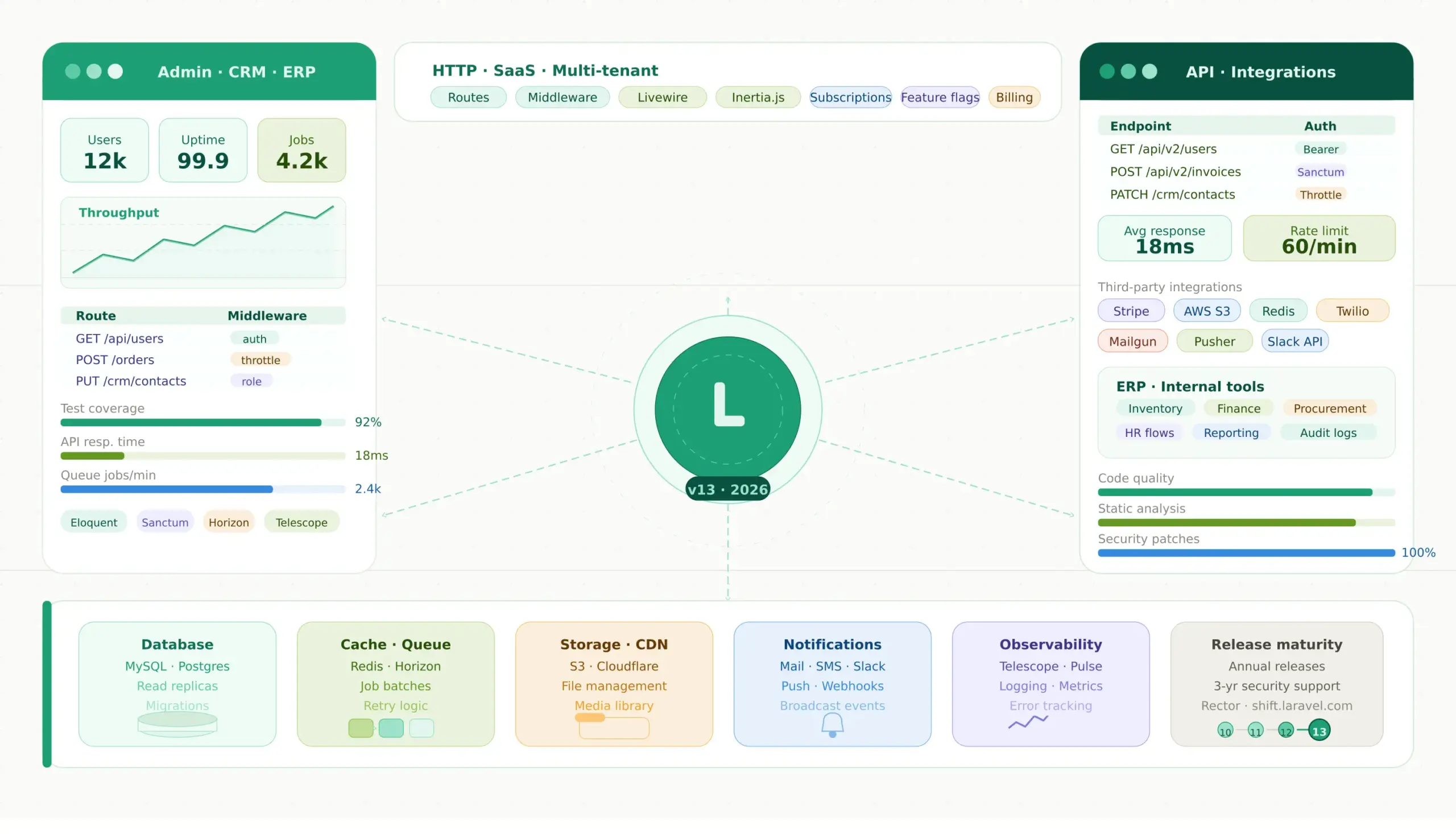
    Laravel’s combination of Eloquent ORM, queues, job processing, Horizon for queue monitoring, and Sanctum for API authentication makes it an exceptionally complete toolkit for SaaS applications. Teams can ship a production-quality multi-tenant SaaS on Laravel 13 without assembling a patchwork of separate packages for each concern. The framework handles the infrastructure so your team focuses on product logic.

    Ecommerce backends and custom platforms

    Laravel powers a significant share of custom ecommerce platforms, particularly where off-the-shelf solutions like Shopify or BigCommerce cannot accommodate the business logic required. The Bagisto ecommerce framework is built entirely on Laravel, making it one of the most developer-friendly paths to a fully custom open-source store. If you are evaluating ecommerce platforms that give you code ownership, Laravel-based options are worth serious consideration.

    Enterprise applications with complex business rules

    For applications where domain logic is complex, testability matters, and long-term maintainability is a priority, Laravel’s architecture scales well. Service providers, policies, form requests, observers, and the event system give teams the structure to manage complexity without reaching for additional frameworks. Our guide to building enterprise Laravel applications in 2026 covers the architectural patterns that hold up at scale.

    Teams that need to move fast without accumulating debt

    Laravel’s opinionated defaults — migrations, Eloquent, Blade, Artisan, testing scaffolding — mean a new developer can be productive on a codebase within hours, not days. For agencies, product studios, and startups where development velocity is a survival metric, this matters enormously. The convention-over-configuration philosophy reduces the number of decisions your team has to make and document.

    AI-powered product features in 2026

    With the Laravel AI SDK now production-stable and natively integrated into Laravel 13, teams building products that need retrieval-augmented generation, document analysis, semantic search, or AI agents no longer need to choose between their existing Laravel stack and the tools required to build those features. The integration is first-party, provider-agnostic, and maintained by the core team. This is a genuinely new capability that did not exist at this level of polish in any previous Laravel version.

    Where Laravel is not the right choice in 2026

    Honest evaluation means naming the scenarios where Laravel is the wrong answer. Choosing the wrong tool costs more than any framework decision.

    High-concurrency real-time systems

    If your core product requirement is handling tens of thousands of persistent WebSocket connections with microsecond latency — live trading platforms, multiplayer game backends, large-scale IoT data pipelines — PHP is structurally at a disadvantage compared to Node.js or Go. Laravel Reverb handles real-time broadcasting well for typical product use cases, but it is not the right tool when real-time concurrency is the primary architectural constraint. For a direct comparison of use cases, see our PHP vs Node.js guide for 2026.

    When your team has deep expertise elsewhere

    Framework choice is always a people problem as much as a technology problem. A team of experienced NestJS developers building a new product will deliver faster and more maintainably in NestJS than in Laravel, regardless of what either framework is capable of. Do not choose Laravel because it is popular. Choose it because your team can build confidently on it.

    Pure data science or ML pipelines

    If your application is primarily a data processing pipeline, a machine learning training system, or a scientific computing environment, Python is the right language and Laravel is not in the conversation. The Laravel AI SDK is for integrating AI features into applications — it is not a replacement for Python in model training and data science contexts.

    Projects where PHP hosting is a constraint

    Laravel 13 requires PHP 8.3. If your production environment is locked to PHP 8.1 or 8.2 by a hosting contract or corporate IT policy, you cannot upgrade to Laravel 13 without first resolving the PHP version. This is not a reason to avoid Laravel — but it is a prerequisite that needs to be in your planning timeline.

    The question teams should actually be asking

    The frame “is Laravel still relevant?” is the wrong question for most teams. It implies the alternative is a clearly superior option waiting to replace it — and there is no such option in the PHP ecosystem. The more useful questions are:

    • Does Laravel match the technical requirements of what we are building?
    • Does our team have the skills to build and maintain a Laravel codebase?
    • Are we on a supported version with a clear upgrade path?
    • Are we taking advantage of what Laravel 13 adds, or treating it like Laravel 9 with a higher version number?

    If you are running an application on Laravel 9 or 10, the support timeline has already closed or is closing. The path forward is an upgrade, not a rewrite. Our Laravel upgrade guide covers the risk-based approach to moving from older versions to Laravel 13 without downtime.

    What Laravel 13 changes in the conversation

    For the past two years, the most common challenge to Laravel’s relevance has come from teams evaluating whether to add AI capabilities to their products. The argument went: “our backend is Laravel, but for AI we need Python microservices, so maybe we should reconsider the whole stack.” Laravel 13 largely closes that argument. The AI SDK’s support for embeddings, vector stores, and provider-agnostic model access means most product AI requirements can be met without leaving the Laravel ecosystem.

    The second shift is the formalisation of PHP attributes as first-class framework configuration. This makes Laravel codebases more readable for developers coming from modern Python or TypeScript backgrounds, and reduces the onboarding gap that some teams cited as a friction point when hiring.

    Together these two changes — AI-native capabilities and modern developer ergonomics — position Laravel 13 as a more competitive answer to “what should we build on?” than it has been at any point in the last several years. Whether you are evaluating Laravel for a new project or deciding whether to invest in upgrading an existing application, the 2026 answer is clearer than it has been for some time.

    If your team needs help assessing whether your current Laravel application is on the right version, or planning an upgrade to Laravel 13, our Laravel development team works with applications at every stage — from greenfield builds to legacy upgrades. You can also hire dedicated Laravel developers to work alongside your existing team.

  • Laravel Upgrade Services in 2026: Costs, Timeline, Risks

    Laravel Upgrade Services in 2026: Costs, Timeline, Risks

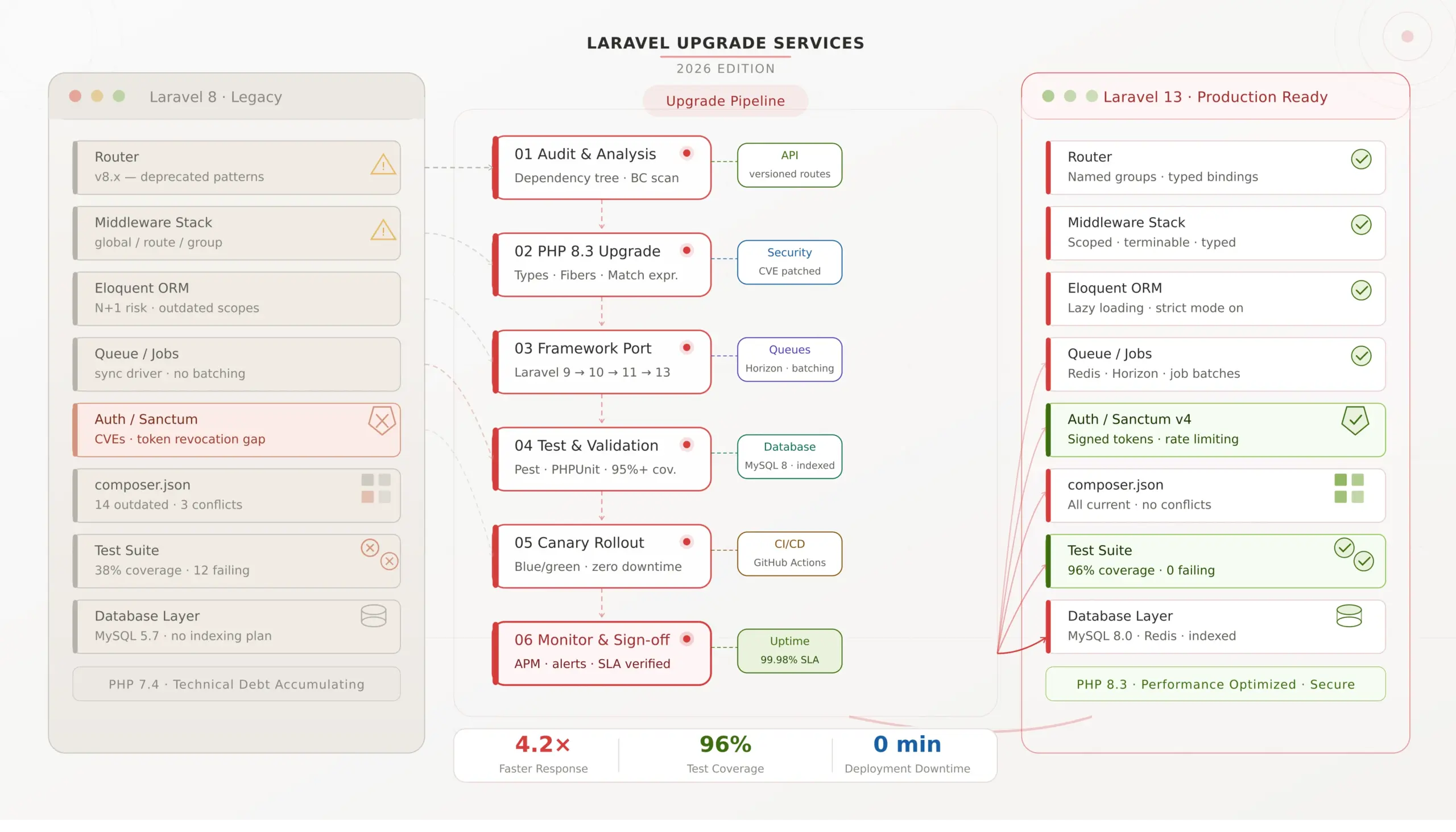
    Laravel Upgrade Services in 2026: Costs, Timeline, Risks, and a Safe Upgrade Plan

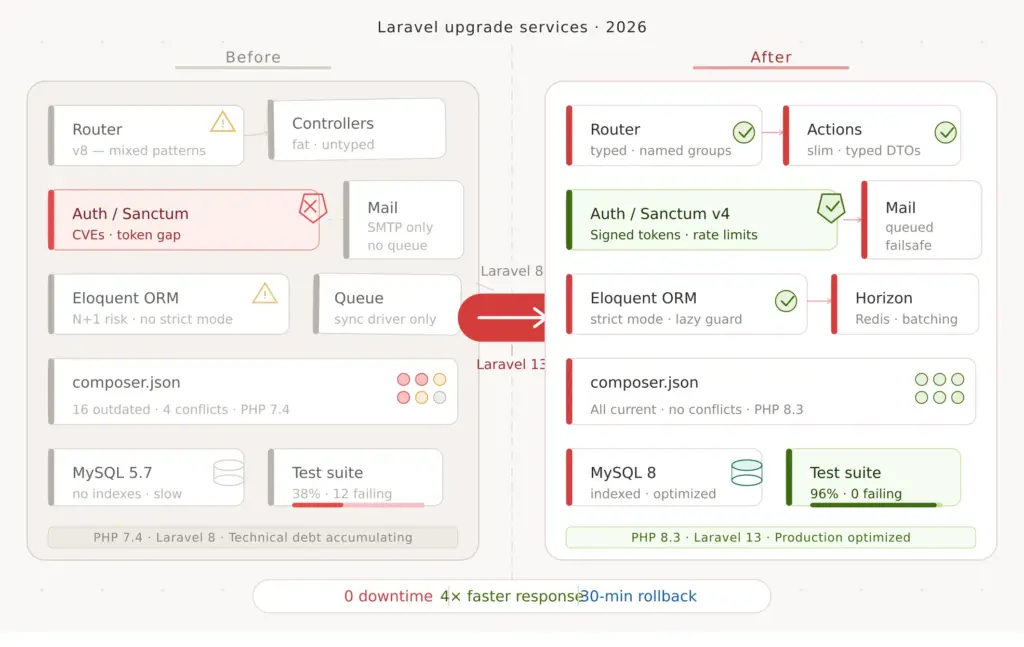
    Laravel upgrade services in 2026 are no longer just a “nice to have” for teams on older versions. If your application is still on Laravel 10 or earlier, you are already outside Laravel’s security support window, and if you stayed on Laravel 11 too long, that window has also now closed. For most teams, Laravel upgrade services are best when the application is business-critical, has payment flows, complex integrations, background jobs, admin workflows, or revenue risk attached to downtime. They are less necessary for tiny internal tools with low complexity and low operational risk. And with Laravel 13 now live, the conversation has shifted from “should we upgrade later?” to “what is the safest upgrade path now?”

    Last updated: April 2026


    The short answer

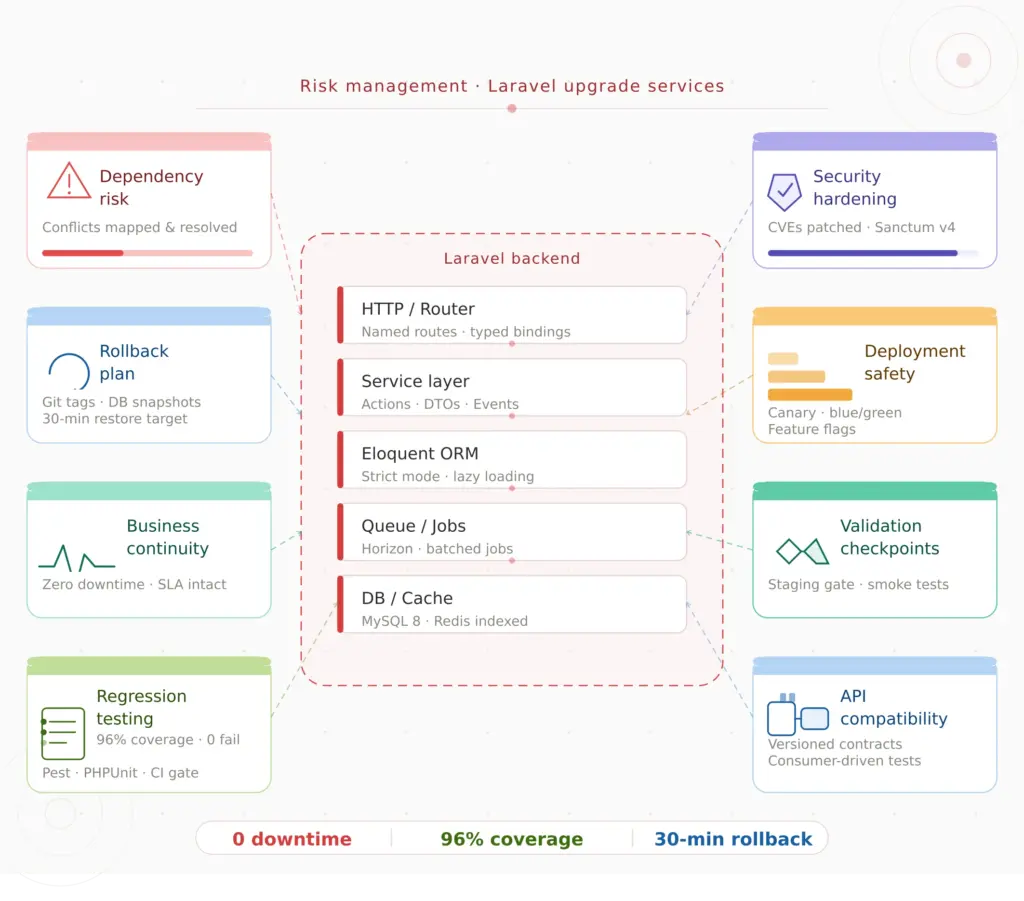
    If your Laravel application powers real business workflows, customer-facing systems, APIs, billing, ecommerce, scheduling, reporting, or internal operations, delaying the upgrade usually increases cost and risk. Laravel upgrade services are valuable because the real work is not changing a version number in composer.json. The real work is reducing operational risk: dependency planning, breaking-change review, testing, database safety, deployment strategy, rollback planning, and post-release monitoring.

    If you already know your application needs a structured version migration, start with our Laravel upgrade service. If your upgrade is part of a broader rebuild, modernization, or platform strategy, our Laravel development services page is the better place to frame the wider project.

    Why Laravel upgrade services matter more in 2026

    A lot of teams postpone framework upgrades because the app still “works.” But in production systems, “still working” is not the same as “still secure, supported, performant, and easy to maintain.” That gap is where upgrade costs quietly grow.

    Once a framework version leaves security support, every decision becomes a little more expensive. Dependencies drift. Package compatibility becomes harder. New engineers spend more time navigating historical decisions. Emergency fixes become riskier. Even small feature work can slow down because the team is coding around framework age rather than building forward confidently.

    That is why Laravel upgrade services are rarely just technical cleanup. In most serious products, they are part risk management, part modernization, and part business continuity planning.

    Laravel support deadlines: what changed in 2026

    Laravel follows an annual major release cadence, with 18 months of bug fixes and 2 years of security fixes per major version. In practical terms, that means old versions age out quickly if you do not actively plan upgrades. Laravel 10 security support ended in February 2025, Laravel 11 security support ended in March 2026, Laravel 12 remains supported into 2027, and Laravel 13 is now the current major release. For teams planning modernization today, the target is no longer “eventually get to Laravel 12.” The safer question is whether you should go directly to Laravel 13, or stabilize on 12 first and then move with a shorter second step.

    If you want the official source for release cadence and support windows, Laravel’s 13.x release notes are the reference you should use internally with stakeholders.

    Who Laravel upgrade services are best for

    • Teams on Laravel 10 or earlier that are already outside framework security support
    • Teams on Laravel 11 that delayed their upgrade planning and now need a current target path
    • Businesses with customer-facing products where downtime, billing disruption, or broken APIs directly affect revenue
    • SaaS products with queues, cron jobs, webhooks, subscriptions, dashboards, and multi-step workflows
    • Admin-heavy internal systems such as ERP, CRM, operations, telecom, healthcare, inventory, or compliance platforms
    • Companies with fragile dependencies where package conflicts or old custom code make direct upgrades risky

    Laravel upgrade services are especially useful when the application is too important to “try in production and see what happens.”

    When you may not need full Laravel upgrade services

    Not every Laravel app needs a large external upgrade project. If your application is small, has healthy dependencies, limited integrations, low uptime pressure, and a team with strong Laravel experience plus decent test coverage, an internal upgrade may be enough.

    But that is usually the exception, not the rule, for business-critical products. The more your application touches payments, reporting, customer accounts, background jobs, third-party APIs, or sensitive data, the more valuable a structured upgrade process becomes.

    Why upgrading late usually costs more

    The biggest misconception around framework upgrades is that waiting saves money. In reality, waiting often compresses multiple upgrade problems into one project:

    • more version jumps
    • older packages and abandoned dependencies
    • larger behavior gaps between framework versions
    • more undocumented custom code
    • more brittle deployment assumptions
    • higher regression risk during rollout

    That is also why teams who read our Laravel relevance guide and still decide Laravel is right for their product often arrive at the same next question: how do we upgrade without turning the app into a fire drill?

    What a professional Laravel upgrade process should include

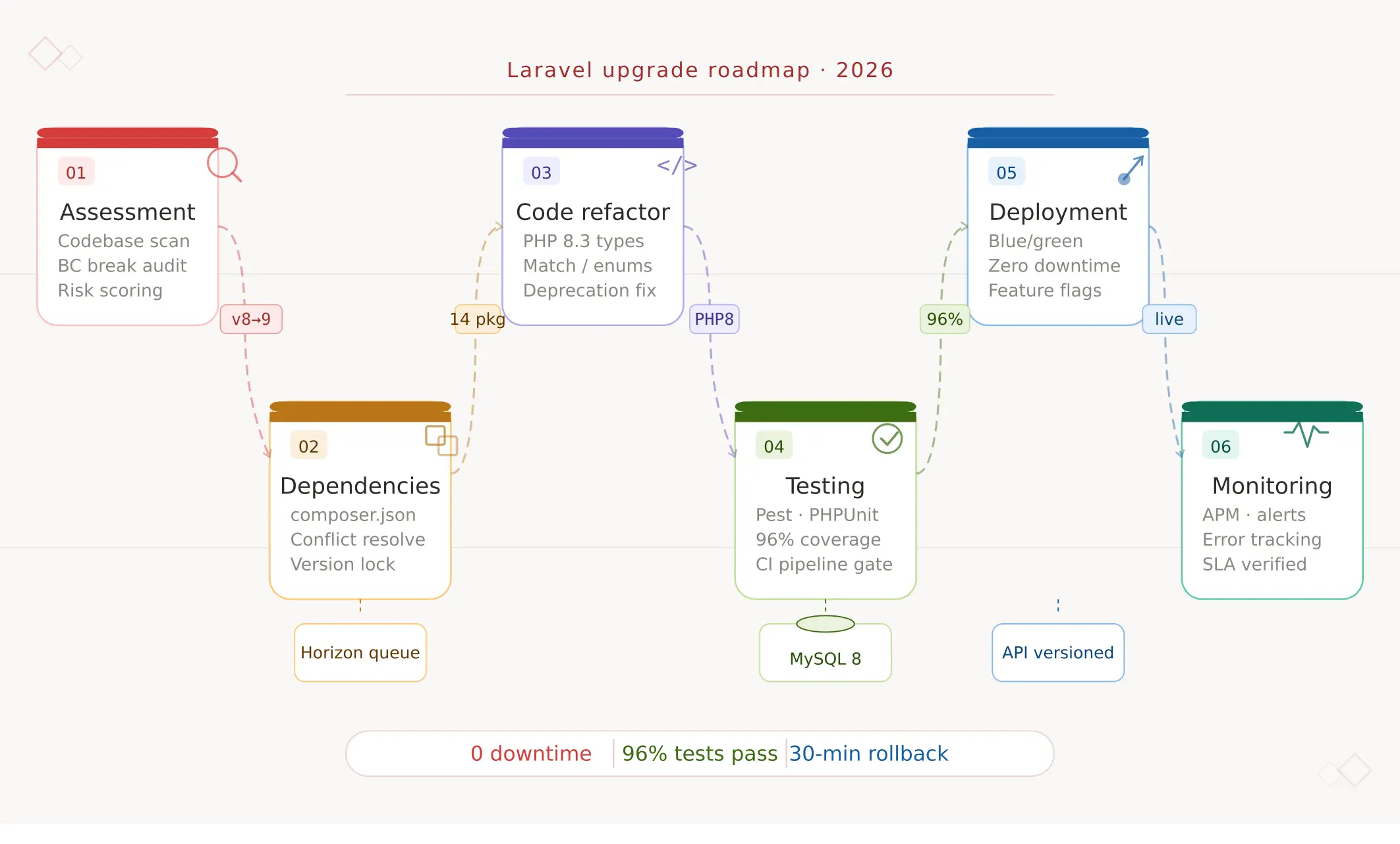
    Good Laravel upgrade services should feel like a controlled engineering program, not a rushed patch job. At minimum, the process should include six stages.

    1. Pre-upgrade assessment

    This is where the real project begins. The team should audit your current Laravel version, PHP version, Composer dependencies, auth flows, custom packages, queue setup, cron jobs, deployment pipeline, and critical user journeys. The output should be a written plan, not just a verbal opinion.

    2. Target version strategy

    The team should decide whether your best path is a direct move to Laravel 13, a phased path through intermediate versions, or a short stabilization step before the main upgrade. This depends on your current version, dependency health, and risk tolerance. The official Laravel 13 upgrade guide is a good starting point, but production apps still need application-specific review.

    3. Breaking-change and dependency analysis

    Most upgrade pain does not come from Laravel itself. It comes from the surrounding ecosystem: old auth SDKs, legacy payment libraries, abandoned notification packages, forks, macros, helper assumptions, and glue code that was never properly tested. That is where experienced upgrade work pays for itself.

    4. Test planning and risk reduction

    A serious upgrade project should include smoke tests for critical flows, feature coverage for major business actions, queue validation, API contract checks, and rollback criteria. “It boots locally” is not a deployment standard.

    5. Deployment and rollback planning

    You should know before deployment how queue workers will be handled, whether feature flags are needed, which database changes are safe during release, how rollback will work, and what KPIs define a stable rollout.

    6. Hypercare after launch

    The project is not done at deploy time. Good Laravel upgrade services include a short monitoring and support window after release to catch edge cases, queue issues, hidden dependency behavior, and performance regressions quickly.

    Laravel 12 vs Laravel 13: what most teams should do now

    For many teams, the practical decision is not whether Laravel 12 is “good enough.” It is whether Laravel 13 is now mature enough to become the target version. In many cases, the answer is yes. Laravel 13 keeps Laravel’s annual cadence, continues the framework’s support policy, and is positioned as a relatively manageable upgrade for most apps already on 12. That is why your version decision should be based on your current starting point, dependency landscape, and deployment risk rather than on old assumptions from early 2025.

    Our own latest Laravel version guide is a good companion read if your team is still deciding between version targets and support windows.

    How long do Laravel upgrade services usually take?

    The honest answer is: it depends on application complexity, not just the version number.

    • Small application with healthy dependencies: often 1–2 weeks including review, implementation, and validation
    • Mid-sized product with moderate package and workflow complexity: often 2–6 weeks
    • Large business-critical platform with legacy code, custom auth, heavy queues, and sensitive database changes: often 6–12+ weeks with phased rollout planning

    The timeline is usually driven by dependency cleanup, test maturity, rollout constraints, and the number of high-risk user journeys that need validation.

    What affects the cost of Laravel upgrade services?

    If you are budgeting for Laravel upgrade services, these are the main variables that change project scope:

    • your current Laravel version
    • number of version jumps required
    • Composer dependency health
    • custom packages or framework overrides
    • test coverage quality
    • database complexity and migration risk
    • deployment constraints and downtime tolerance
    • API compatibility requirements
    • queue, scheduler, and webhook complexity
    • post-upgrade support expectations

    That is why a real estimate should come after an assessment, not before it. The best upgrade partners will give you a scoped plan with assumptions, risks, exclusions, and a clear target version strategy.

    Common upgrade risks that teams underestimate

    • package incompatibility that looks small but affects auth, billing, or notifications
    • hidden database locks during deployment
    • queue payload or worker behavior changes
    • custom middleware or macros that rely on legacy behavior
    • uncovered business flows that only break under production traffic patterns
    • deployment differences between staging and production

    This is also why performance should not be treated as a separate discussion after the upgrade. A framework modernization project often reveals query bottlenecks, cache gaps, queue issues, and indexing problems that should be addressed in the same roadmap. Our Laravel performance checklist is useful here because it helps teams connect version upgrades with actual system behavior.

    DIY vs hiring a Laravel upgrade partner

    A DIY upgrade can work if the app is relatively small, the package ecosystem is clean, the team knows Laravel deeply, and downtime risk is low. But once the application has real business weight behind it, hiring a Laravel upgrade partner often makes more sense because the project is no longer just engineering effort. It becomes a coordination problem across product, operations, QA, deployment, and business continuity.

    If you are comparing options, the question is not just “can our developers technically do this?” The better question is “can we do it without delaying roadmap work, increasing production risk, or discovering hidden upgrade debt too late?”

    What a good Laravel upgrade proposal should contain

    • a version and dependency audit
    • a recommended upgrade path
    • a breaking-change risk list
    • a testing plan
    • a deployment and rollback strategy
    • timeline assumptions
    • clear in-scope and out-of-scope items
    • post-deployment support terms

    If a proposal is vague and mostly promises “we’ll handle it carefully,” that is a warning sign. Laravel upgrade services should reduce uncertainty, not just rename it.

    Our practical view

    Laravel upgrade services in 2026 are really about protecting delivery speed, lowering operational risk, and keeping your product aligned with a supported modern stack. For some teams, that means moving directly to Laravel 13. For others, it means stabilizing the codebase first, then upgrading in a controlled sequence. The right answer depends on your starting point, but the wrong answer is usually to keep postponing until the project becomes urgent and expensive.

    If your Laravel application is important enough that downtime, regressions, or unsupported software would hurt the business, an upgrade deserves a structured plan.

    Need a safe Laravel upgrade plan?

    If you want a clear view of upgrade scope, risk, timeline, dependency issues, and rollout strategy, the best next step is an assessment. Our Laravel upgrade service is designed for teams that want a low-risk path, and our Laravel development services page is there if the upgrade is part of a wider modernization or rebuild effort.


    FAQs

    Why are Laravel upgrade services important in 2026?

    They matter because support windows move quickly, dependency drift gets worse over time, and business-critical applications usually cannot tolerate careless upgrades. A structured upgrade reduces security, compatibility, and rollout risk.

    Should we upgrade to Laravel 12 or Laravel 13?

    That depends on your current version, dependency health, and rollout risk. Many teams should now evaluate Laravel 13 directly, especially if the upgrade path is manageable and the application needs a current target with longer support runway.

    How long do Laravel upgrade services take?

    Smaller apps may take a couple of weeks. Mid-sized business products often take several weeks. Large or legacy platforms can take significantly longer if dependencies, database changes, testing, or rollout complexity are high.

    Can an internal team handle a Laravel upgrade?

    Yes, sometimes. But once the app is business-critical, has complex dependencies, or cannot tolerate production issues, external upgrade support often reduces risk and protects roadmap time.

    What should a Laravel upgrade partner deliver?

    You should expect an assessment, target version strategy, dependency review, breaking-change plan, testing approach, deployment and rollback plan, and post-release support window.

  • Google Cloud Migration Services: A Practical, Low-Risk Playbook to Move Apps & Data to GCP

    Migrating production workloads is never just “copy and paste.” Google Cloud migration services work best when you treat migration as a controlled program—covering discovery, security, data integrity, cutover planning, and post-move optimization—so you can modernize without unexpected downtime or cost surprises.

    In this guide, you’ll get a practical step-by-step playbook to plan and execute a successful move to Google Cloud Platform (GCP). If you want a done-with-you approach, explore our GCP migration offering here:
    Google Cloud Platform migration services.

    Thesis: The lowest-risk way to migrate to Google Cloud Platform is to (1) assess dependencies and readiness, (2) build a secure landing zone, (3) migrate in waves with rollback, (4) validate performance and data, and (5) optimize costs after go-live.


    1) What “Good” Google Cloud Migration Services Should Include

    If you’re evaluating GCP migration consulting, the real deliverable isn’t “we moved servers.” It’s a repeatable process that reduces risk, accelerates delivery, and gives you predictable outcomes.

    A. Discovery & dependency mapping (don’t skip this)

    Before anything moves, you should know what you’re moving, who owns it, and what could break. A solid discovery phase typically includes:

    • Application inventory: all apps/services, owners, environments, and business criticality
    • Dependency mapping: databases, queues, identity, APIs, third-party vendors, batch jobs, DNS, certificates
    • Data classification: PII/PHI/PCI, retention needs, audit requirements
    • Baseline metrics: latency, throughput, error rates, capacity peaks

    B. Landing zone + governance (so cloud doesn’t turn into chaos)

    A secure landing zone is the foundation for scalable google cloud application migration. At minimum, ensure:

    • Org/folder/project strategy (clear ownership and separation)
    • IAM model (least privilege, SSO, break-glass access)
    • Networking (VPC design, private connectivity, DNS, firewall policies)
    • Central logging/monitoring and audit trails
    • Guardrails for cost allocation (labels/tags), budgets, and quotas

    If you want an industry-standard structure for adoption and governance, see the official Google Cloud Adoption Framework:
    Google Cloud Adoption Framework.

    C. Migration waves + rollback strategy (avoid “big bang” cutovers)

    The most reliable approach is to migrate in waves:

    • Start with low-risk apps to validate tools and patterns
    • Group by dependencies (move what must move together)
    • Define cutover runbooks, acceptance tests, and rollback steps

    Google’s migration guidance is a helpful reference for planning and execution:
    Migrate to Google Cloud: Get started.


    2) Choosing the Right Migration Approach: Rehost vs Replatform vs Refactor

    Not every workload needs a rewrite. The “right” approach depends on timeline, risk tolerance, compliance constraints, and the ROI you’re targeting.

    Approach When it fits best Pros Trade-offs
    Rehost (lift-and-shift) Speed is critical; minimal changes Fastest migration; lower engineering effort May carry old inefficiencies/costs into cloud
    Replatform You want managed services benefits with small changes Often best time-to-value; improves reliability/cost Some changes required; careful testing needed
    Refactor (modernize) You need scale, resilience, or significant architecture improvement Best long-term performance and cloud-native benefits Highest effort; larger scope management needed

    In practice, most successful programs use a hybrid plan: rehost the quick wins, replatform the high-ROI systems, and refactor only where it makes strategic sense.

    Cost reality check (use data, not guesses)

    Cost surprises are one of the top reasons cloud programs lose stakeholder trust. In Flexera’s 2025 State of the Cloud findings, 84% of respondents said managing cloud spend is their top cloud challenge:
    Flexera 2025 cloud spend challenge data.

    That’s why “post-migration optimization” should be part of the migration plan—not an afterthought.


    3) Executing Google Cloud Application Migration (Without Breaking Production)

    A strong google cloud application migration approach prioritizes stability and repeatability. Here’s a field-tested way to move apps with lower risk:

    A. Standardize how apps are deployed

    • Use consistent CI/CD and environment configuration patterns
    • Externalize config (secrets and environment variables)
    • Set clear SLOs: latency, uptime targets, and error budgets

    B. Create a “golden path” for observability

    Before cutover, ensure you have dashboards and alerts for:

    • App latency, error rates, throughput
    • Database and queue health
    • Infrastructure capacity and saturation
    • Log correlation and tracing (where applicable)

    C. Cut over safely with proven release patterns

    • Blue/green (switch traffic after validation)
    • Canary (move a small % of users first)
    • Shadow traffic (validate behavior without impacting users)

    If you want a structured engagement that focuses specifically on application moves, see:
    Application migrations (itmarkerz).


    4) Database Migration to GCP: Tools, Validation, and Downtime Planning

    Databases are often the highest-risk component because they carry state, require integrity guarantees, and can create cutover pressure. The right approach is to plan for correctness first, then minimize downtime with controlled replication and validation.

    Use Google Cloud Database Migration Service (DMS) where it fits

    Google’s Google Cloud Database Migration Service provides a guided migration experience for popular engines and supports validation before migration:
    Google Cloud Database Migration Service (DMS).

    The official documentation also notes that DMS manages initial snapshot and ongoing replication workflows:
    DMS documentation.

    A practical pre-migration checklist for data moves

    • Compatibility: versions, extensions, SQL modes, collation/charset
    • Connectivity: secure networking path and firewall rules
    • Replication plan: full snapshot + continuous replication (when needed)
    • Validation: row counts, schema checks, query behavior tests
    • Performance tests: index tuning, query plan review, load testing

    Why downtime planning matters (real outage cost data)

    Cutovers must be treated like planned production releases because downtime can be expensive. In Uptime Institute’s outage analysis, 54% of respondents said their most recent significant outage cost more than $100,000, and 1 in 5 said it cost more than $1 million:
    Uptime Institute Annual Outage Analysis (cost data).

    Takeaway: a runbook, rehearsal, and rollback plan are not optional—they’re how you protect revenue and customer trust.


    5) Common Questions Before You Migrate to Google Cloud Platform

    Q1) “How much downtime should we expect?”

    It depends on your architecture and data strategy:

    • Stateless apps: often near-zero with blue/green or canary traffic shifting
    • Stateful systems/databases: depends on replication and final cutover timing

    The key is agreeing on RTO/RPO, rehearsing cutover, and having an explicit rollback path.

    Q2) “Is GCP secure enough for regulated workloads?”

    Security is usually not the blocker—configuration is. A proper landing zone with least-privilege IAM, network segmentation, logging, and auditability is what makes the environment defensible. This is why governance must come before migration waves.

    Q3) “Will cloud costs spike after we migrate?”

    They can—if you migrate without:

    • right-sizing and autoscaling strategy
    • budgets and alerts
    • labels/tags for cost allocation
    • turning off unused resources (especially dev/test)

    A good migration partner includes FinOps basics and optimization in the migration plan, not as a “phase 2 maybe.”

    Q4) “Are we locking ourselves into Google Cloud?”

    You can reduce lock-in by:

    • containerizing where it makes sense
    • using portable CI/CD patterns
    • documenting architectural decisions and exit paths
    • choosing managed services intentionally (where ROI beats portability needs)

    Conclusion: A Low-Risk Path to Google Cloud Migration Success

    Successful migrations aren’t “lift and pray.” The winning approach is predictable:
    assess dependencies, build a secure landing zone, migrate in waves with rollback, validate data and performance, then optimize costs post-go-live.

    If you’re planning to migrate to Google Cloud Platform and want a clear, low-risk execution plan, we can help you scope the right approach and deliver a phased roadmap with cutover runbooks and measurable success metrics.

    Next steps:


  • Why Businesses Choose PHP Laravel for Secure & Scalable Web Applications

    Why Businesses Choose PHP Laravel for Secure & Scalable Web Applications

    In today’s competitive digital environment, businesses need web applications that are secure, scalable, and easy to maintain. PHP Laravel has become one of the most trusted frameworks for building modern web applications, powering thousands of business solutions worldwide.


    What Is Laravel?

    Laravel is an open-source PHP web application framework designed to make development faster, cleaner, and more efficient. It follows the MVC (Model–View–Controller) architecture and provides built-in tools that simplify common development tasks.