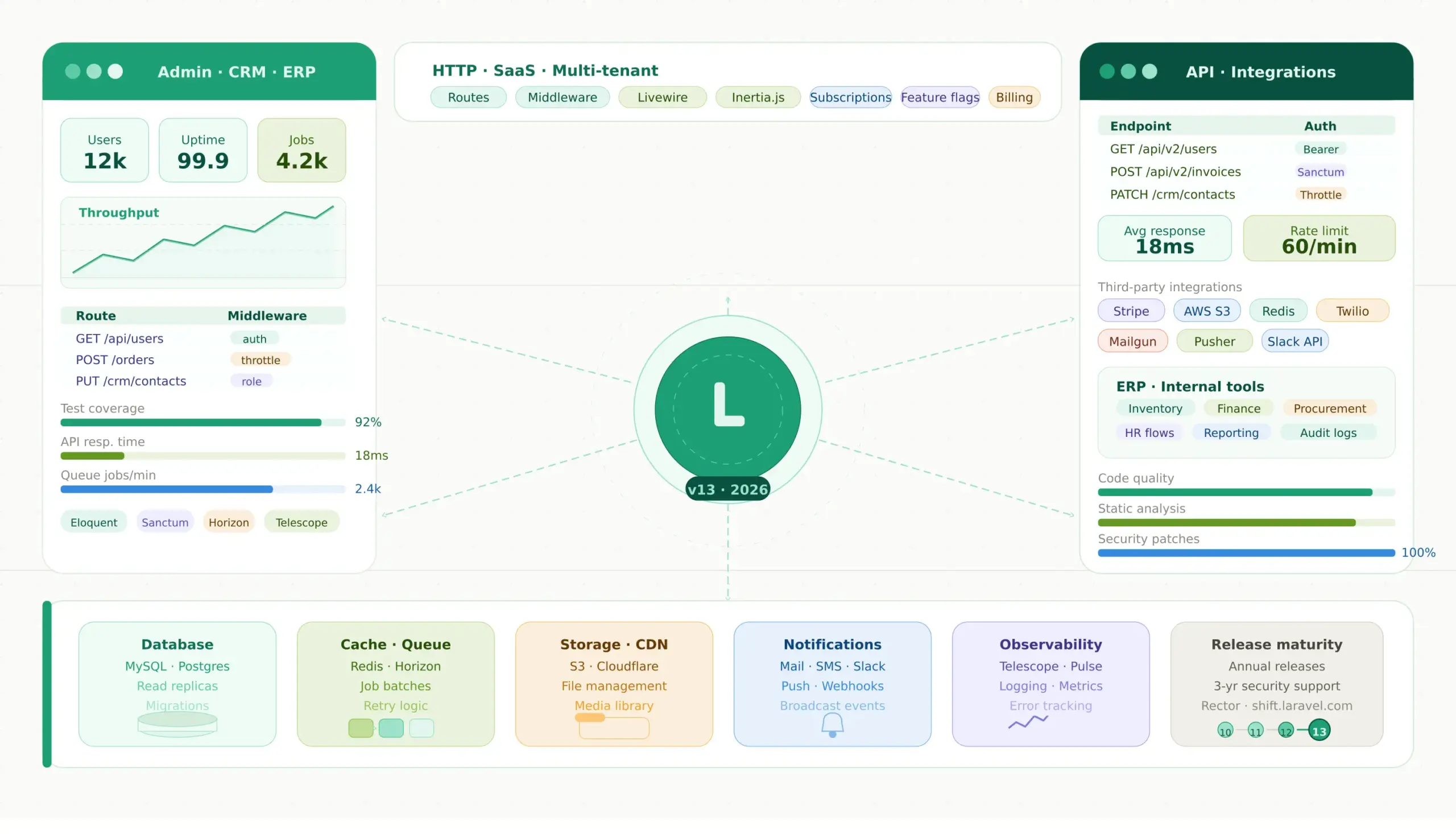
Quick answer: Yes. Laravel 13, released March 17, 2026, remains the right choice for the vast majority of PHP teams. It ships with zero breaking changes from Laravel 12, a production-stable first-party AI SDK, passkey authentication, and PHP 8.3 as its minimum. If you are already on Laravel, there is no reason to switch. If you are starting a new PHP project in 2026, Laravel is still the default answer.
But “right choice” depends entirely on what you are building, your team’s skills, and your timeline. This article gives you the complete picture — the data, the new features, the honest trade-offs, and the scenarios where Laravel is the wrong answer too.
What the data actually says about Laravel in 2026
Before any opinion, look at the numbers. The JetBrains State of PHP 2025 report surveyed 1,720 professional PHP developers across 194 countries. The headline stat: Laravel leads PHP framework adoption at 64%, with WordPress at roughly 25% and Symfony at 23%. That is not a framework “clinging on” — that is dominance.
Three other data points from the same report matter for your decision:
- 89% of PHP developers are already on PHP 8.x, signalling that the ecosystem has modernised.
- 58% of PHP developers have no plans to switch to another language.
- 95% of PHP developers have tried AI tools, and 80% use them regularly — meaning your Laravel team is already AI-augmented whether you planned for it or not.
Laravel also ranked first in the Stack Overflow Developer Survey for the fifth consecutive year as the most-used PHP framework. These are not vanity metrics. They translate directly into hiring pools, community support, package availability, and the speed at which your developers solve problems.
If you want a deeper breakdown of what the JetBrains data means specifically for teams managing Laravel applications, see our analysis of the State of PHP 2025 for Laravel teams.
What changed in Laravel 13 — and why it matters for your decision
Laravel 13 launched on March 17, 2026, announced by Taylor Otwell at Laracon EU in Amsterdam. The official release notes describe it as “a relatively minor upgrade in terms of effort, while still delivering substantial new capabilities.” That is accurate — and it is actually good news if you are evaluating whether to adopt or stay on Laravel.
Zero breaking changes from Laravel 12
For most standard applications, upgrading from Laravel 12 to Laravel 13 takes under ten minutes. The one meaningful infrastructure requirement is PHP 8.3 as the minimum. Once your server is on PHP 8.3 or higher, the framework upgrade itself is straightforward. If your team has been deferring the upgrade conversation, Laravel 13 is the easiest entry point in years. See our Laravel upgrade guide for 2026 for the complete step-by-step process.
The Laravel AI SDK is now production-stable
This is the single most significant addition in Laravel 13 for teams evaluating the framework in 2026. The Laravel AI SDK ships as a first-party package providing a unified, provider-agnostic interface for text generation, tool-calling agents, embeddings, image generation, audio synthesis, and vector store integrations. It supports OpenAI, Anthropic Claude, and Google Gemini out of the box.
This matters beyond chatbot features. Teams can now build semantic search, AI-assisted workflows, and document processing pipelines entirely within the Laravel ecosystem — without choosing a provider-specific third-party package and absorbing that maintenance risk. For product teams considering whether to build AI features on their existing Laravel codebase, this removes the main friction point that previously made Node.js or Python microservices look attractive.
Our team has been building AI-powered Laravel applications using the SDK since its beta. If you want to explore what is possible with Laravel AI development for your product, the 2026 toolkit is the strongest it has ever been.
PHP attributes across the framework
Laravel 13 introduces native PHP attribute syntax as an optional alternative to class property declarations across more than 15 locations — models, controllers, jobs, commands, listeners, mailables, and more. This is a non-breaking change. Your existing code continues working without modification. But for teams writing new code, attributes make configuration more declarative and colocated with the class it belongs to, which improves readability at scale.
Passkey authentication
Laravel 13 adds first-party passkey support through Laravel Fortify and the new starter kits. If you are building any application where user authentication security is a priority — and in 2026, that is most applications — passkeys are the direction the industry is moving. Having this built into the framework rather than requiring a third-party package is a meaningful reduction in implementation complexity.
Support timeline you can plan around
Laravel 13 receives bug fixes until Q3 2027 and security fixes until March 2028. Laravel 12 remains on bug fixes until August 2026. This gives teams on Laravel 12 a clear, no-emergency window to plan the upgrade. For a full version-by-version breakdown including PHP compatibility ranges, see our Laravel PHP compatibility matrix.
Where Laravel is the right choice in 2026
Laravel is the right default for a wide range of projects. These are the scenarios where it consistently delivers.
SaaS products and internal platforms
Laravel’s combination of Eloquent ORM, queues, job processing, Horizon for queue monitoring, and Sanctum for API authentication makes it an exceptionally complete toolkit for SaaS applications. Teams can ship a production-quality multi-tenant SaaS on Laravel 13 without assembling a patchwork of separate packages for each concern. The framework handles the infrastructure so your team focuses on product logic.
Ecommerce backends and custom platforms
Laravel powers a significant share of custom ecommerce platforms, particularly where off-the-shelf solutions like Shopify or BigCommerce cannot accommodate the business logic required. The Bagisto ecommerce framework is built entirely on Laravel, making it one of the most developer-friendly paths to a fully custom open-source store. If you are evaluating ecommerce platforms that give you code ownership, Laravel-based options are worth serious consideration.
Enterprise applications with complex business rules
For applications where domain logic is complex, testability matters, and long-term maintainability is a priority, Laravel’s architecture scales well. Service providers, policies, form requests, observers, and the event system give teams the structure to manage complexity without reaching for additional frameworks. Our guide to building enterprise Laravel applications in 2026 covers the architectural patterns that hold up at scale.
Teams that need to move fast without accumulating debt
Laravel’s opinionated defaults — migrations, Eloquent, Blade, Artisan, testing scaffolding — mean a new developer can be productive on a codebase within hours, not days. For agencies, product studios, and startups where development velocity is a survival metric, this matters enormously. The convention-over-configuration philosophy reduces the number of decisions your team has to make and document.
AI-powered product features in 2026
With the Laravel AI SDK now production-stable and natively integrated into Laravel 13, teams building products that need retrieval-augmented generation, document analysis, semantic search, or AI agents no longer need to choose between their existing Laravel stack and the tools required to build those features. The integration is first-party, provider-agnostic, and maintained by the core team. This is a genuinely new capability that did not exist at this level of polish in any previous Laravel version.
Where Laravel is not the right choice in 2026
Honest evaluation means naming the scenarios where Laravel is the wrong answer. Choosing the wrong tool costs more than any framework decision.
High-concurrency real-time systems
If your core product requirement is handling tens of thousands of persistent WebSocket connections with microsecond latency — live trading platforms, multiplayer game backends, large-scale IoT data pipelines — PHP is structurally at a disadvantage compared to Node.js or Go. Laravel Reverb handles real-time broadcasting well for typical product use cases, but it is not the right tool when real-time concurrency is the primary architectural constraint. For a direct comparison of use cases, see our PHP vs Node.js guide for 2026.
When your team has deep expertise elsewhere
Framework choice is always a people problem as much as a technology problem. A team of experienced NestJS developers building a new product will deliver faster and more maintainably in NestJS than in Laravel, regardless of what either framework is capable of. Do not choose Laravel because it is popular. Choose it because your team can build confidently on it.
Pure data science or ML pipelines
If your application is primarily a data processing pipeline, a machine learning training system, or a scientific computing environment, Python is the right language and Laravel is not in the conversation. The Laravel AI SDK is for integrating AI features into applications — it is not a replacement for Python in model training and data science contexts.
Projects where PHP hosting is a constraint
Laravel 13 requires PHP 8.3. If your production environment is locked to PHP 8.1 or 8.2 by a hosting contract or corporate IT policy, you cannot upgrade to Laravel 13 without first resolving the PHP version. This is not a reason to avoid Laravel — but it is a prerequisite that needs to be in your planning timeline.
The question teams should actually be asking
The frame “is Laravel still relevant?” is the wrong question for most teams. It implies the alternative is a clearly superior option waiting to replace it — and there is no such option in the PHP ecosystem. The more useful questions are:
- Does Laravel match the technical requirements of what we are building?
- Does our team have the skills to build and maintain a Laravel codebase?
- Are we on a supported version with a clear upgrade path?
- Are we taking advantage of what Laravel 13 adds, or treating it like Laravel 9 with a higher version number?
If you are running an application on Laravel 9 or 10, the support timeline has already closed or is closing. The path forward is an upgrade, not a rewrite. Our Laravel upgrade guide covers the risk-based approach to moving from older versions to Laravel 13 without downtime.
What Laravel 13 changes in the conversation
For the past two years, the most common challenge to Laravel’s relevance has come from teams evaluating whether to add AI capabilities to their products. The argument went: “our backend is Laravel, but for AI we need Python microservices, so maybe we should reconsider the whole stack.” Laravel 13 largely closes that argument. The AI SDK’s support for embeddings, vector stores, and provider-agnostic model access means most product AI requirements can be met without leaving the Laravel ecosystem.
The second shift is the formalisation of PHP attributes as first-class framework configuration. This makes Laravel codebases more readable for developers coming from modern Python or TypeScript backgrounds, and reduces the onboarding gap that some teams cited as a friction point when hiring.
Together these two changes — AI-native capabilities and modern developer ergonomics — position Laravel 13 as a more competitive answer to “what should we build on?” than it has been at any point in the last several years. Whether you are evaluating Laravel for a new project or deciding whether to invest in upgrading an existing application, the 2026 answer is clearer than it has been for some time.
If your team needs help assessing whether your current Laravel application is on the right version, or planning an upgrade to Laravel 13, our Laravel development team works with applications at every stage — from greenfield builds to legacy upgrades. You can also hire dedicated Laravel developers to work alongside your existing team.
Leave a Reply