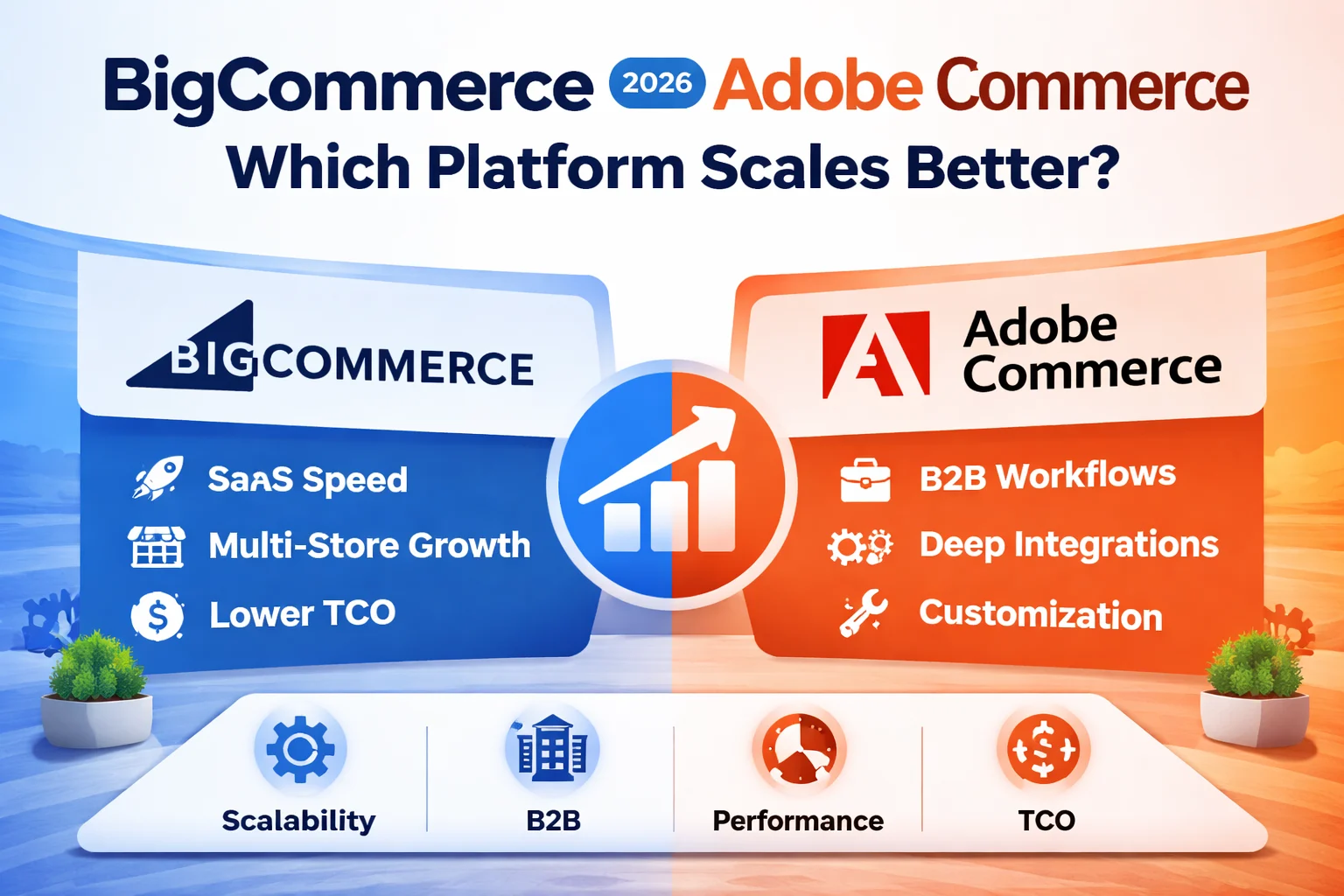
If you’re comparing BigCommerce and Adobe Commerce in 2026, you’re not just comparing features—you’re choosing a scaling model:
- BigCommerce scales best when you want SaaS speed, predictable operations, and faster expansion without heavy platform engineering.
- Adobe Commerce (Magento) scales best when “scale” means complex business logic: B2B workflows, customer-specific pricing/catalogs, deep ERP/OMS/PIM integrations, and custom checkout rules.
This article is part of our migration cluster. Start with the pillar guide for the full migration blueprint:
BigCommerce to Adobe Commerce Migration (2026): Complete Guide for Scaling Brands
Quick Verdict: Which platform “scales better” depends on your type of scale
Choose BigCommerce if…
- You want faster go-live with less ops overhead (hosting, patching, maintenance).
- Your roadmap is mostly configure + integrate, not “build custom backend business logic.”
- You’re scaling by adding brands/regions/storefronts with standardized rules.
- You want to differentiate mainly through storefront UX, headless, and integrations.
Choose Adobe Commerce if…
- Your “scale problem” is complexity: contract pricing, approvals, quotes, customer catalogs.
- Checkout/promo logic needs heavy customization (not “within guardrails”).
- Your integrations are core workflows: ERP/OMS/PIM/WMS drives pricing, stock, fulfillment, terms.
- You need enterprise flexibility and long-term control over architecture.
If you want expert help on either path:
At-a-glance comparison (2026 scaling view)
| Scaling dimension | BigCommerce | Adobe Commerce | Best fit |
|---|---|---|---|
| Speed to launch | Fast (SaaS) | Medium–Slow (build/architecture) | BigCommerce |
| Operational overhead | Lower | Higher (depends on hosting model) | BigCommerce |
| Customization depth | Moderate (guardrails) | High (modules + architecture control) | Adobe Commerce |
| B2B complexity | Strong for standard workflows | Strong for advanced workflows + customization | Depends |
| Multi-store expansion | Strong for standardized multi-store | Strong for complex multi-store rules | Depends |
| Integrations (ERP/OMS/PIM) | Great when mostly plug-and-play | Best when integrations are business logic | Adobe Commerce |
| Headless storefront flexibility | Strong | Strong | Either |
| Total cost of ownership (TCO) | Predictable fees; app costs can grow | Higher build/maintenance; pays off with complexity | Depends |
What “scaling” really means in 2026
Most brands don’t outgrow platforms because of traffic alone. They outgrow platforms because the business becomes harder to express:
- Catalog complexity: more SKUs, more attributes, multiple catalogs per region/customer type
- Pricing complexity: price lists, tier pricing, contract pricing, negotiated terms
- B2B workflows: company accounts, roles, approvals, quotes, re-ordering logic
- Multi-store growth: multi-brand, multi-region, unique rules per storefront
- Integration depth: ERP/OMS/PIM/WMS syncing pricing, inventory, fulfillment rules
- Experiment velocity: headless storefronts, faster UX iteration, personalization
Simple decision rule:
If your scale problem is operational speed and simplicity → BigCommerce.
If your scale problem is complexity and deep integrations → Adobe Commerce.
Platform DNA: how each one is built to scale
BigCommerce: SaaS-first scaling
BigCommerce is designed to reduce infrastructure and maintenance work so teams can focus on growth. This is ideal when scaling is driven by:
- Launching new channels/regions faster
- Managing multiple storefronts with consistent backend rules
- Keeping ops overhead low (less platform engineering)
Internal resources: If you’re staying on BigCommerce and want performance + conversion upgrades, start here: BigCommerce development services.
External references: BigCommerce resources you can review:
Adobe Commerce: scaling through control (business rules + architecture)
Adobe Commerce is typically chosen when scaling requires platform-level control—custom workflows, advanced promotions, complex catalogs, and deep enterprise integrations.
Internal resources: planning an enterprise build? Start here: Adobe Commerce development services.
External references: Adobe Commerce resources you can review:
- Adobe Commerce B2B overview
- Adobe Commerce on Cloud Infrastructure overview
- Adobe Commerce product overview
Multi-store expansion: brand + region growth
BigCommerce is typically the faster path when you want multi-store growth with consistent back-office logic and standardized workflows.
Adobe Commerce tends to win when each storefront needs unique logic—different catalogs by customer type/region, custom pricing, complex fulfillment rules, and deeper integration-driven behavior.
B2B and enterprise: where most brands feel “platform limits”
This is where “scaling better” becomes obvious.
- BigCommerce often fits when B2B needs are standard and you want faster rollout with less platform engineering.
- Adobe Commerce often fits when B2B is deeply customized: approvals, contract pricing, customer-specific catalogs, ERP-driven workflows, and highly tailored checkout rules.
If you’re already leaning toward a platform change, see our migration pages:
Customization & checkout control (the hidden scaling breakpoint)
Many brands don’t “outgrow” product pages—they outgrow checkout and promotions.
- BigCommerce is better when you want a stable checkout within platform patterns and quick iteration without deep backend changes.
- Adobe Commerce is better when your growth requires custom checkout validation, complex shipping/payment logic, advanced promotion logic, and rule-heavy business flows.
Performance & headless: both can scale—if the storefront is engineered properly
In 2026, performance is rarely “platform-only.” It’s driven by storefront architecture, caching, search, scripts, and image/CDN discipline.
- BigCommerce: often wins fast by keeping the backend SaaS and building a high-performance headless storefront.
- Adobe Commerce: can scale extremely well, but benefits from solid architecture decisions and optimization discipline.
External references:
- BigCommerce headless commerce overview
- BigCommerce headless docs
- Adobe Commerce on Cloud Infrastructure
Integrations & extensibility: where TCO quietly explodes
Here’s the common pattern:
- BigCommerce starts fast. But if you need many “apps” to mimic core enterprise workflows, costs and complexity can increase over time.
- Adobe Commerce starts heavier. But if complexity is your competitive advantage, it can be more scalable long-term because logic becomes native to your architecture.
Rule of thumb: If integrations are mostly plug-and-play, BigCommerce scales cleanly. If integrations are your business logic, Adobe Commerce usually scales better.
Decision framework: 5 questions that decide 90% of cases
- Do we need customer-specific catalogs/pricing and complex B2B workflows (quotes/approvals)?
- Are we blocked by SaaS constraints (checkout logic, backend rules, app dependency, limitations)?
- Is ERP/OMS/PIM logic core to how we sell (not just reporting)?
- Is multi-store expansion standardized—or does each store need unique rules and integrations?
- Do we prefer platform-managed operations (SaaS), or are we ready to invest in controlled customization?
If you answered “yes” to 3 or more, Adobe Commerce is usually the better scaling direction.
Next steps: if you’re planning a migration (recommended path)
If you’re leaning toward Adobe Commerce, don’t jump straight into development. The safest approach is a blueprint first: data, SEO risk, integrations, and launch plan.
- Full blueprint guide (pillar): BigCommerce to Adobe Commerce Migration (2026)
- Migration services: Adobe Commerce migration services
- Implementation services: Adobe Commerce development services
If BigCommerce is still your best fit and you want a stronger storefront (performance/CWV/conversion):
FAQ
Is Adobe Commerce only for enterprise in 2026?
Not strictly—but it delivers the most value when your business needs advanced rules, deep integrations, and complex B2B workflows. If your needs are simple, a SaaS platform can be faster and more cost-efficient.
Can BigCommerce handle B2B?
Yes. BigCommerce can be strong for B2B when your workflows are standard and you want faster rollout with lower operational overhead. If B2B requires heavy customization and ERP-driven logic, Adobe Commerce often fits better.
Which is safer for SEO and a clean migration?
Both can be safe if you follow a blueprint approach: URL mapping, redirects, category faceting control, and post-launch monitoring. Use the pillar guide to plan the migration properly: BigCommerce to Adobe Commerce Migration (2026).
Leave a Reply