BigCommerce is an excellent platform for getting an online store live quickly. But as brands scale in catalog size, revenue, complexity, and regional expansion, many hit unavoidable platform limits.
By 2026, a clear pattern has emerged:
Fast-growing and enterprise-focused brands eventually outgrow BigCommerce and migrate to Adobe Commerce (Magento).
This guide is a complete, end-to-end resource on migrating from BigCommerce to Adobe Commerce, covering:
- Why brands migrate
- When migration makes sense
- Data, SEO, and technical considerations
- Cost, timeline, and risks
- How to migrate safely without losing revenue or rankings
- Who should not migrate
This is not a sales pitch—it’s a decision framework for scaling brands.
Why Brands Outgrow BigCommerce
BigCommerce is a SaaS-first eCommerce platform, optimized for simplicity and speed. But SaaS convenience comes with architectural trade-offs.
Common BigCommerce Scaling Limitations
As stores grow, brands often face:
- Limited backend customization
- Restricted checkout logic
- App dependency for core features
- Revenue-based pricing tiers
- Complex B2B workflows handled externally
- Difficult multi-store or multi-region control
BigCommerce works best when:
- Business logic is simple
- Catalog size is manageable
- Custom pricing is limited
- SaaS constraints are acceptable
When these assumptions break, Adobe Commerce becomes the natural next step.
Why Adobe Commerce Is Built for Scale
Adobe Commerce (Magento) is not a SaaS platform—it’s a fully customizable commerce framework.
It is designed for:
- Complex catalogs (10k+ SKUs)
- Multi-store, multi-currency, multi-region setups
- B2B commerce
- Advanced pricing & promotions
- Custom checkout workflows
- Deep ERP, CRM, and PIM integrations
👉 Adobe Commerce development services
BigCommerce vs Adobe Commerce: Architectural Difference
| Area | BigCommerce | Adobe Commerce |
|---|---|---|
| Platform model | SaaS | Self-hosted / Cloud |
| Custom logic | Limited | Unlimited |
| Checkout | Restricted | Fully customizable |
| B2B features | Add-on based | Native |
| Pricing model | Revenue-based | Fixed / license |
| Integrations | App-first | API & backend-first |
| Scalability | Plan-limited | Infrastructure-driven |
Key takeaway:
BigCommerce scales until business logic becomes complex.
Adobe Commerce scales with complexity.
When Should You Migrate from BigCommerce to Adobe Commerce?
Migration makes sense if 2 or more of the following are true:
- Your store revenue is growing rapidly
- You need advanced pricing or customer-specific catalogs
- You run B2B or hybrid B2B+B2C
- Checkout customization is required
- App costs are increasing
- BigCommerce plan limits are blocking growth
- You need deeper backend integrations
If your store is still simple and SaaS-friendly, BigCommerce may still be the right choice.
👉 BigCommerce development services
What Data Can Be Migrated from BigCommerce?
✅ Data That Can Be Migrated Safely
- Products & variants
- Categories
- Customers
- Orders (historical)
- Coupons & discounts
- Reviews
- CMS pages
- URLs & SEO metadata
❌ Data That Must Be Rebuilt
- Apps & app-based logic
- Checkout customizations
- Theme-specific features
- SaaS workflow automations
Adobe Commerce replaces apps with native features or custom modules, which is more stable long-term.
SEO Considerations (Critical)
SEO is the highest-risk area of any eCommerce migration.
Common SEO Risks
- URL changes without redirects
- Metadata loss
- Category restructuring errors
- Pagination & faceted navigation issues
- Duplicate content
SEO-Safe Migration Requires
- Full URL mapping
- 301 redirect strategy
- Metadata parity
- Canonical control
- XML sitemap regeneration
- Post-launch monitoring
👉 Dedicated migration services
Adobe Commerce Migration
BigCommerce Migrations
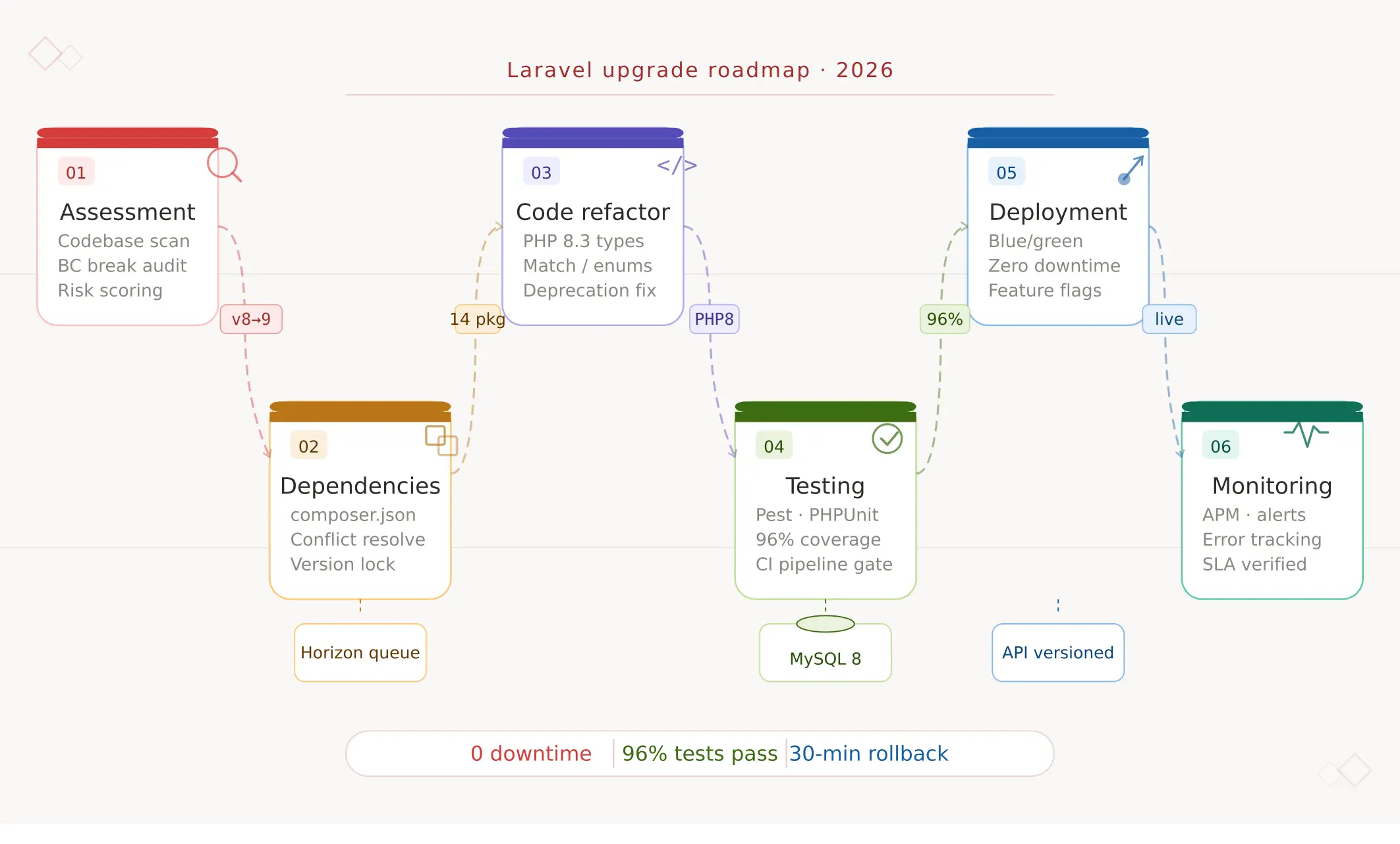
BigCommerce to Adobe Commerce Migration Phases
Phase 1: Discovery & Planning
- Business logic analysis
- App dependency audit
- SEO audit
- Data mapping
- Risk identification
Phase 2: Adobe Commerce Architecture
- Hosting & infrastructure setup
- Store structure design
- Attribute & product modeling
- Pricing logic planning
Phase 3: Data Migration
- Products, customers, orders
- Media assets
- CMS content
- Metadata
Phase 4: Custom Development
- Checkout customization
- B2B workflows
- ERP / CRM integrations
- Performance optimization
Phase 5: SEO, QA & Launch
- Redirects
- SEO validation
- Load testing
- Staged rollout
Phase 6: Post-Launch Optimization
- Performance tuning
- Conversion optimization
- Analytics validation
Migration Timeline (2026)
| Store Complexity | Timeline |
|---|---|
| Small catalog | 6–8 weeks |
| Medium store | 8–12 weeks |
| Enterprise / B2B | 12–20+ weeks |
Rushed migrations almost always cause SEO or revenue loss.
Migration Cost Breakdown (High-Level)
| Store Type | Typical Cost |
|---|---|
| Small store | $8k – $15k |
| Mid-sized brand | $15k – $35k |
| Enterprise / B2B | $35k – $80k+ |
Cost depends on:
- Custom logic
- Integrations
- SEO complexity
- Performance requirements
Important:
Adobe Commerce costs more upfront but reduces long-term platform and app fees.
BigCommerce vs Adobe Commerce: Total Cost of Ownership
BigCommerce Long-Term Costs
- Monthly SaaS fees
- Revenue-based pricing
- App subscriptions
- Limited customization
- Scaling penalties
Adobe Commerce Long-Term Costs
- Hosting
- Maintenance
- Custom development
- No revenue-based lock-in
At scale, Adobe Commerce is often cheaper over 3–5 years.
Who Should NOT Migrate
Do NOT migrate if:
- Your store is small and stable
- You rely on BigCommerce SaaS simplicity
- Custom logic is minimal
- Budget or timeline is tight
Migration is a scaling decision, not a trend.
Why Brands Choose Adobe Commerce After BigCommerce
Brands migrate to Adobe Commerce for:
- Control over business logic
- Scalable architecture
- B2B readiness
- Custom checkout & pricing
- Long-term cost predictability
This is why Adobe Commerce dominates enterprise and high-growth commerce.
Choosing the Right Migration Partner
A BigCommerce → Adobe Commerce migration partner must:
- Understand both platforms deeply
- Plan SEO before development
- Handle data integrity
- Build scalable architecture
- Support post-launch optimization
👉 Adobe Commerce migration & development
Final Verdict (2026)
BigCommerce helps you launch.
Adobe Commerce helps you scale without compromise.
If BigCommerce is starting to limit growth, migration is not a failure—it’s a strategic upgrade.
FAQ: BigCommerce to Adobe Commerce Migration (2026)
1. Why should I migrate from BigCommerce to Adobe Commerce?
Brands migrate from BigCommerce to Adobe Commerce when they outgrow SaaS limitations. Adobe Commerce offers deeper customization, better support for complex catalogs, B2B features, advanced pricing, custom checkout logic, and long-term scalability without revenue-based platform fees.
2. When is the right time to migrate from BigCommerce to Adobe Commerce?
Migration makes sense when your store requires custom business logic, B2B workflows, multi-store or multi-region setups, or when BigCommerce plan limits and app costs start restricting growth.
3. How long does a BigCommerce to Adobe Commerce migration take?
A typical migration takes:
- 6–8 weeks for small stores
- 8–12 weeks for mid-sized stores
- 12–20+ weeks for enterprise or B2B stores
The timeline depends on catalog size, integrations, SEO complexity, and customization needs.
4. Will I lose SEO rankings during the migration?
No—if the migration is done correctly. SEO-safe migration includes full URL mapping, 301 redirects, metadata preservation, canonical control, and post-launch monitoring. Poor planning, not the platform, causes ranking loss.
5. What data can be migrated from BigCommerce to Adobe Commerce?
You can migrate products, categories, customers, orders, CMS pages, URLs, and SEO metadata. Apps, SaaS workflows, and theme-specific features usually need to be rebuilt natively in Adobe Commerce.
6. How much does BigCommerce to Adobe Commerce migration cost in 2026?
Typical costs range from:
- $8,000–$15,000 for small stores
- $15,000–$35,000 for mid-sized brands
- $35,000–$80,000+ for enterprise or B2B stores
Costs depend on customization, integrations, SEO sensitivity, and scale.
7. Is Adobe Commerce more expensive than BigCommerce long term?
Not necessarily. While Adobe Commerce has a higher upfront cost, it often reduces long-term expenses by eliminating revenue-based fees, lowering app subscriptions, and offering greater control over infrastructure and performance.
8. Who should not migrate from BigCommerce to Adobe Commerce?
Migration may not be suitable if your store is small, stable, budget-constrained, or if you prefer SaaS simplicity over customization and control.
9. Do I need a specialized migration partner?
Yes. A successful migration requires expertise in both BigCommerce and Adobe Commerce, SEO planning, data integrity handling, and post-launch optimization. Generic replatforming often leads to revenue or SEO loss.