Blog

  • BigCommerce vs Adobe Commerce (2026): Which Platform Scales Better

    BigCommerce vs Adobe Commerce (2026): Which Platform Scales Better

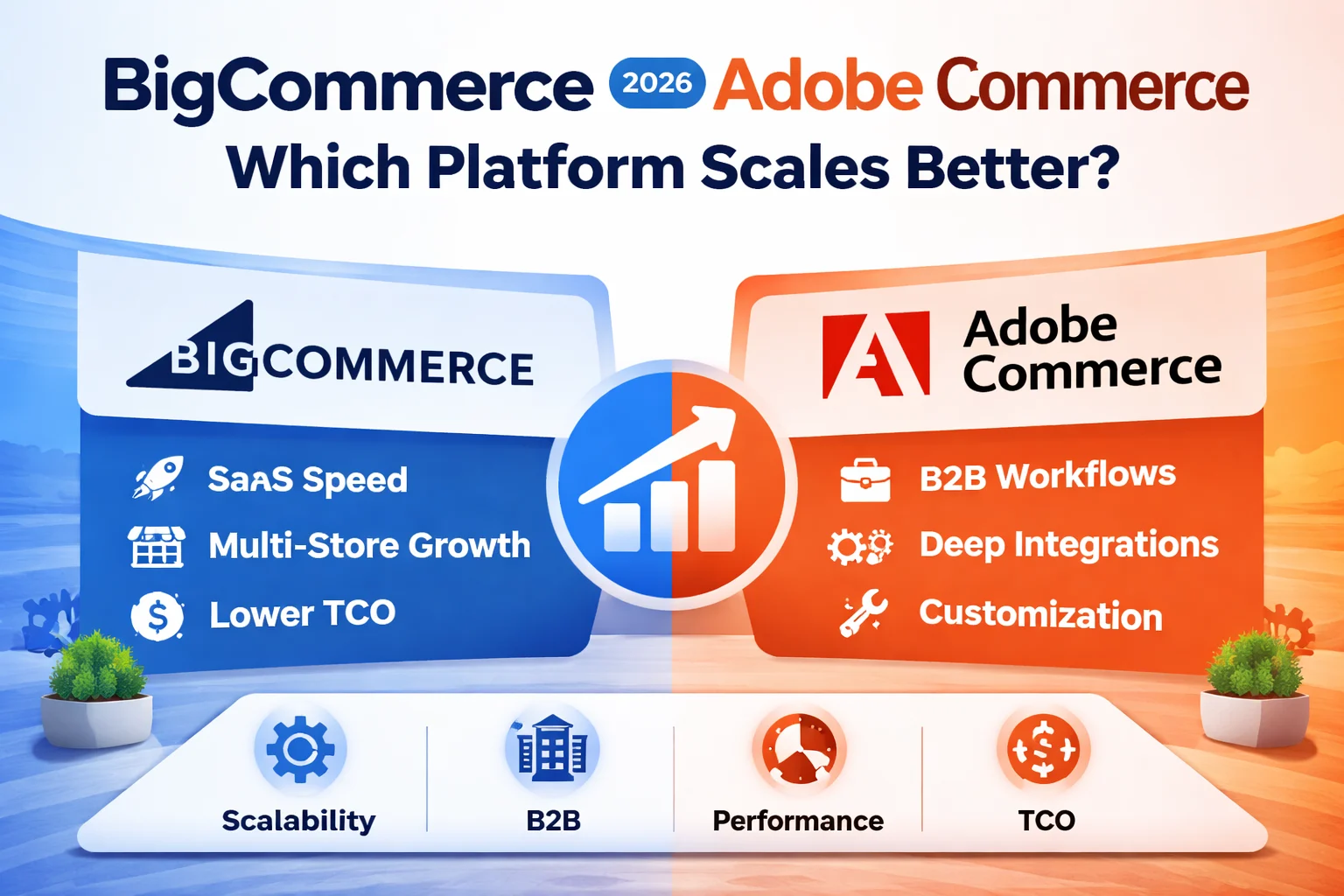
    If you’re comparing BigCommerce and Adobe Commerce in 2026, you’re not just comparing features—you’re choosing a scaling model:

    • BigCommerce scales best when you want SaaS speed, predictable operations, and faster expansion without heavy platform engineering.
    • Adobe Commerce (Magento) scales best when “scale” means complex business logic: B2B workflows, customer-specific pricing/catalogs, deep ERP/OMS/PIM integrations, and custom checkout rules.

    This article is part of our migration cluster. Start with the pillar guide for the full migration blueprint:

    BigCommerce to Adobe Commerce Migration (2026): Complete Guide for Scaling Brands


    Quick Verdict: Which platform “scales better” depends on your type of scale

    Choose BigCommerce if…

    • You want faster go-live with less ops overhead (hosting, patching, maintenance).
    • Your roadmap is mostly configure + integrate, not “build custom backend business logic.”
    • You’re scaling by adding brands/regions/storefronts with standardized rules.
    • You want to differentiate mainly through storefront UX, headless, and integrations.

    Choose Adobe Commerce if…

    • Your “scale problem” is complexity: contract pricing, approvals, quotes, customer catalogs.
    • Checkout/promo logic needs heavy customization (not “within guardrails”).
    • Your integrations are core workflows: ERP/OMS/PIM/WMS drives pricing, stock, fulfillment, terms.
    • You need enterprise flexibility and long-term control over architecture.

    If you want expert help on either path:


    At-a-glance comparison (2026 scaling view)

    Scaling dimensionBigCommerceAdobe CommerceBest fit
    Speed to launchFast (SaaS)Medium–Slow (build/architecture)BigCommerce
    Operational overheadLowerHigher (depends on hosting model)BigCommerce
    Customization depthModerate (guardrails)High (modules + architecture control)Adobe Commerce
    B2B complexityStrong for standard workflowsStrong for advanced workflows + customizationDepends
    Multi-store expansionStrong for standardized multi-storeStrong for complex multi-store rulesDepends
    Integrations (ERP/OMS/PIM)Great when mostly plug-and-playBest when integrations are business logicAdobe Commerce
    Headless storefront flexibilityStrongStrongEither
    Total cost of ownership (TCO)Predictable fees; app costs can growHigher build/maintenance; pays off with complexityDepends

    What “scaling” really means in 2026

    Most brands don’t outgrow platforms because of traffic alone. They outgrow platforms because the business becomes harder to express:

    • Catalog complexity: more SKUs, more attributes, multiple catalogs per region/customer type
    • Pricing complexity: price lists, tier pricing, contract pricing, negotiated terms
    • B2B workflows: company accounts, roles, approvals, quotes, re-ordering logic
    • Multi-store growth: multi-brand, multi-region, unique rules per storefront
    • Integration depth: ERP/OMS/PIM/WMS syncing pricing, inventory, fulfillment rules
    • Experiment velocity: headless storefronts, faster UX iteration, personalization

    Simple decision rule:

    If your scale problem is operational speed and simplicity → BigCommerce.
    If your scale problem is complexity and deep integrations → Adobe Commerce.


    Platform DNA: how each one is built to scale

    BigCommerce: SaaS-first scaling

    BigCommerce is designed to reduce infrastructure and maintenance work so teams can focus on growth. This is ideal when scaling is driven by:

    • Launching new channels/regions faster
    • Managing multiple storefronts with consistent backend rules
    • Keeping ops overhead low (less platform engineering)

    Internal resources: If you’re staying on BigCommerce and want performance + conversion upgrades, start here: BigCommerce development services.

    External references: BigCommerce resources you can review:

    Adobe Commerce: scaling through control (business rules + architecture)

    Adobe Commerce is typically chosen when scaling requires platform-level control—custom workflows, advanced promotions, complex catalogs, and deep enterprise integrations.

    Internal resources: planning an enterprise build? Start here: Adobe Commerce development services.

    External references: Adobe Commerce resources you can review:


    Multi-store expansion: brand + region growth

    BigCommerce is typically the faster path when you want multi-store growth with consistent back-office logic and standardized workflows.

    Adobe Commerce tends to win when each storefront needs unique logic—different catalogs by customer type/region, custom pricing, complex fulfillment rules, and deeper integration-driven behavior.


    B2B and enterprise: where most brands feel “platform limits”

    This is where “scaling better” becomes obvious.

    • BigCommerce often fits when B2B needs are standard and you want faster rollout with less platform engineering.
    • Adobe Commerce often fits when B2B is deeply customized: approvals, contract pricing, customer-specific catalogs, ERP-driven workflows, and highly tailored checkout rules.

    If you’re already leaning toward a platform change, see our migration pages:


    Customization & checkout control (the hidden scaling breakpoint)

    Many brands don’t “outgrow” product pages—they outgrow checkout and promotions.

    • BigCommerce is better when you want a stable checkout within platform patterns and quick iteration without deep backend changes.
    • Adobe Commerce is better when your growth requires custom checkout validation, complex shipping/payment logic, advanced promotion logic, and rule-heavy business flows.

    Performance & headless: both can scale—if the storefront is engineered properly

    In 2026, performance is rarely “platform-only.” It’s driven by storefront architecture, caching, search, scripts, and image/CDN discipline.

    • BigCommerce: often wins fast by keeping the backend SaaS and building a high-performance headless storefront.
    • Adobe Commerce: can scale extremely well, but benefits from solid architecture decisions and optimization discipline.

    External references:


    Integrations & extensibility: where TCO quietly explodes

    Here’s the common pattern:

    • BigCommerce starts fast. But if you need many “apps” to mimic core enterprise workflows, costs and complexity can increase over time.
    • Adobe Commerce starts heavier. But if complexity is your competitive advantage, it can be more scalable long-term because logic becomes native to your architecture.

    Rule of thumb: If integrations are mostly plug-and-play, BigCommerce scales cleanly. If integrations are your business logic, Adobe Commerce usually scales better.


    Decision framework: 5 questions that decide 90% of cases

    1. Do we need customer-specific catalogs/pricing and complex B2B workflows (quotes/approvals)?
    2. Are we blocked by SaaS constraints (checkout logic, backend rules, app dependency, limitations)?
    3. Is ERP/OMS/PIM logic core to how we sell (not just reporting)?
    4. Is multi-store expansion standardized—or does each store need unique rules and integrations?
    5. Do we prefer platform-managed operations (SaaS), or are we ready to invest in controlled customization?

    If you answered “yes” to 3 or more, Adobe Commerce is usually the better scaling direction.


    Next steps: if you’re planning a migration (recommended path)

    If you’re leaning toward Adobe Commerce, don’t jump straight into development. The safest approach is a blueprint first: data, SEO risk, integrations, and launch plan.

    If BigCommerce is still your best fit and you want a stronger storefront (performance/CWV/conversion):


    FAQ

    Is Adobe Commerce only for enterprise in 2026?

    Not strictly—but it delivers the most value when your business needs advanced rules, deep integrations, and complex B2B workflows. If your needs are simple, a SaaS platform can be faster and more cost-efficient.

    Can BigCommerce handle B2B?

    Yes. BigCommerce can be strong for B2B when your workflows are standard and you want faster rollout with lower operational overhead. If B2B requires heavy customization and ERP-driven logic, Adobe Commerce often fits better.

    Which is safer for SEO and a clean migration?

    Both can be safe if you follow a blueprint approach: URL mapping, redirects, category faceting control, and post-launch monitoring. Use the pillar guide to plan the migration properly: BigCommerce to Adobe Commerce Migration (2026).
  • Enterprise Laravel Architecture Blueprint: DDD, Service Layer, Events, Queues

    Enterprise Laravel success isn’t about “writing more code.” It’s about building a system that stays stable as teams grow, features multiply, and traffic becomes unpredictable. This blueprint gives you a practical reference architecture for DDD-inspired structure, a clean Service Layer, event-driven workflows, and queue design that scales—without overengineering.

    If you want the full enterprise guide first, start here: Laravel Development (2026): The Complete Guide to Building & Scaling Enterprise Applications.


    What you’ll get in this blueprint


    When DDD is worth it (and when it isn’t)

    DDD is not a requirement. It’s a scaling strategy. Use it when the problem domain is complex and the business rules change frequently (pricing, billing, compliance, multi-tenant workflows, approvals, auditability). Avoid heavy DDD when your app is mostly CRUD with light rules—because complexity becomes cost.

    SignalDDD is a good ideaDDD is probably overkill
    Business rulesMany rules, exceptions, approvals, validationsSimple CRUD, minimal rules
    Team scaleMultiple teams, parallel delivery1–3 developers
    Change frequencyRules change monthly/weeklyRare changes, mostly content
    RiskCompliance, payments, audit trails, SLAsLow-stakes internal tools

    Enterprise shortcut: You don’t need “full DDD.” In Laravel, a DDD-inspired modular structure + a strong Service Layer gives you 80% of the value with far less ceremony.


    Reference architecture: layers + responsibilities

    This architecture keeps your domain rules stable while allowing UI, API, jobs, and integrations to evolve independently.

    LayerWhat belongs hereWhat should NOT be here
    Presentation (Controllers, Console Commands)Auth, request validation, mapping DTOs, returning responsesBusiness rules, pricing logic, workflow decisions
    Application (Service Layer / Use Cases)Use-case orchestration, transactions, authorization, emitting eventsLow-level DB queries scattered everywhere
    Domain (Entities, Value Objects, Domain Services)Core business rules, invariants, domain eventsHTTP, Queue, Mail, external APIs, frameworks
    Infrastructure (Repositories, 3rd party integrations)Eloquent models, DB queries, clients, queue adapters, storageBusiness decisions that should be in Domain/Application

    How this looks in a real Laravel codebase

    app/
      Domains/
        Billing/
          Actions/
          DTO/
          Events/
          Jobs/
          Models/
          Policies/
          Repositories/
          Services/
          ValueObjects/
      Http/
        Controllers/
      Console/
      Support/
        Idempotency/
        Outbox/
        Tenancy/
        Observability/

    Important: You don’t have to rename everything. The point is separation: controllers stay thin, services orchestrate, domain rules are centralized, and infrastructure details don’t leak everywhere.


    Service Layer pattern: the enterprise “center of gravity”

    The Service Layer is where most enterprise Laravel teams win or lose. It’s the layer that:

    • Coordinates use cases (create order, approve invoice, renew subscription, apply bundle, etc.)
    • Wraps operations in transactions
    • Enforces authorization + policies
    • Emits events after state changes
    • Schedules jobs for async work (emails, exports, webhooks, heavy computation)

    Thin Controllers rule (copy/paste standard)

    Controllers validate input, call a single service method, and return a response. If a controller starts accumulating “ifs” and complex logic, it’s leaking business rules.

    Service Layer example (credible Laravel shape)

    <?php
    // app/Domains/Billing/Services/InvoiceService.php
    
    namespace App\Domains\Billing\Services;
    
    use App\Domains\Billing\Events\InvoiceIssued;
    use App\Domains\Billing\Models\Invoice;
    use App\Domains\Billing\Repositories\InvoiceRepository;
    use Illuminate\Support\Facades\DB;
    
    class InvoiceService
    {
        public function __construct(
            private InvoiceRepository $invoices,
        ) {}
    
        public function issue(array $data): Invoice
        {
            return DB::transaction(function () use ($data) {
                // 1) validate invariants (domain rules should live in domain models/value objects too)
                // 2) persist state changes via repository
                $invoice = $this->invoices->createIssued($data);
    
                // 3) emit domain event (listeners/jobs can react)
                event(new InvoiceIssued($invoice->id));
    
                return $invoice;
            });
        }
    }

    This pattern keeps your workflows testable and your controllers clean. Most importantly, it creates a single place to trace “what happened” in production.


    Events: Domain events vs Integration events (don’t mix them)

    Enterprise event-driven systems fail when events become “random notifications.” The fix is classification:

    • Domain events: something meaningful happened in your domain (InvoiceIssued, PaymentCaptured, SubscriptionRenewed).
    • Integration events: messages that leave your system or cross boundaries (InvoiceIssuedToERP, CustomerSyncedToCRM).

    Domain event example

    <?php
    // app/Domains/Billing/Events/InvoiceIssued.php
    
    namespace App\Domains\Billing\Events;
    
    class InvoiceIssued
    {
        public function __construct(public string $invoiceId) {}
    }

    Listener that schedules async work (email/webhook/export)

    <?php
    // app/Domains/Billing/Listeners/QueueInvoiceNotifications.php
    
    namespace App\Domains\Billing\Listeners;
    
    use App\Domains\Billing\Events\InvoiceIssued;
    use App\Domains\Billing\Jobs\SendInvoiceEmailJob;
    
    class QueueInvoiceNotifications
    {
        public function handle(InvoiceIssued $event): void
        {
            SendInvoiceEmailJob::dispatch($event->invoiceId)
                ->onQueue('notifications');
        }
    }

    Enterprise rule: Your domain event is not “send an email.” Your domain event is the business fact. Emails, webhooks, and exports are reactions.


    Queues at scale: how enterprise Laravel stays fast

    Queues aren’t just “background processing.” In enterprise apps they are the safety valve that protects your API from slow tasks and unpredictable workloads.

    Queue design: separate workloads (don’t dump everything into “default”)

    • default: small, quick jobs only
    • imports: heavy CSV parsing, normalization, batching
    • rating/compute: CPU-heavy calculations
    • notifications: email/SMS/webhooks
    • reports: exports, PDFs, scheduled reports

    Reliability essentials: retries, timeouts, and backoff

    • Timeout should match real job runtime (plus headroom).
    • Backoff prevents retry storms during outages.
    • Max attempts should match business risk (don’t retry payments 20 times).

    Idempotency: the #1 enterprise queue rule

    Every job should be safe to run more than once. This protects you from retries, worker restarts, and duplicate delivery. Use an idempotency key strategy per use-case.

    <?php
    // app/Support/Idempotency/IdempotencyGuard.php
    
    namespace App\Support\Idempotency;
    
    use Illuminate\Support\Facades\Cache;
    
    class IdempotencyGuard
    {
        public static function once(string $key, int $ttlSeconds, callable $fn)
        {
            $lock = Cache::lock("idem:{$key}", $ttlSeconds);
    
            if (! $lock->get()) {
                return null; // already processing or already processed recently
            }
    
            try {
                return $fn();
            } finally {
                optional($lock)->release();
            }
        }
    }

    In jobs: build a key like invoice-email:{invoiceId} or webhook:{eventId}:{endpoint}.

    The Outbox Pattern (enterprise-grade event delivery)

    If you publish messages to other systems (webhooks, Kafka, CRM, ERP), you will eventually face a failure window: DB commits, but message publish fails. The Outbox Pattern solves this by storing outbound events in your DB inside the same transaction, then delivering them asynchronously.

    // Outbox table fields (conceptual):
    id (uuid)
    aggregate_type (e.g., Invoice)
    aggregate_id
    event_type (e.g., InvoiceIssued)
    payload (json)
    status (pending|sent|failed)
    attempts
    next_attempt_at
    created_at

    Enterprise win: your core data and “messages to the outside world” are consistent and recoverable.

    Queues + Events diagram (paste into a diagram tool if needed)

    HTTP Request
      ↓
    Controller (thin)
      ↓
    Service Layer (transaction)
      ↓
    DB Commit  →  Domain Event emitted
                      ↓
                Listener schedules Jobs
                      ↓
                 Queue Workers
                      ↓
         Notifications / Webhooks / Exports

    Testing strategy that survives enterprise growth

    Enterprise Laravel teams stop trusting tests when tests are slow, brittle, or poorly scoped. The fix is layering your tests the same way you layered your architecture.

    • Unit tests (Domain): fast tests for business rules and invariants.
    • Service tests (Application): test use-case orchestration with DB transactions.
    • Contract tests (Integrations): external APIs mocked + verified.
    • Smoke tests (Production): critical endpoints and queue health checks.

    Enterprise testing rule

    If a test fails, it should clearly answer: “Which business rule broke?” If you can’t tell, the test is noise.


    Enterprise Laravel architecture checklist (copy/paste)

    1. Controllers are thin (validate, call service, return response).
    2. Service Layer owns transactions and orchestrates use cases.
    3. Domain rules are centralized (entities/value objects, not scattered).
    4. Events are classified: domain vs integration events.
    5. Queues are separated by workload type (imports/compute/notifications).
    6. Jobs are idempotent (safe retries).
    7. Outbox used for reliable outbound integrations.
    8. Observability exists: structured logs, error tracking, queue metrics.
    9. Regression suite exists around revenue/auth/data boundaries.
    10. Upgrade cadence defined (quarterly dependencies, yearly Laravel baseline).

    Recommended Next Steps (Internal Links)

    Build / Scale

    Need an enterprise Laravel team to build or refactor architecture with confidence?

    Keep it stable

    Want SLAs, monitoring, security patching, and performance hardening?

    Upgrade safely

    Moving legacy apps to Laravel 12 with staged rollouts and low risk.

    Add AI features

    RAG search, automation, AI copilots—built with enterprise privacy controls.


    FAQ

    Do we need full DDD to build enterprise apps in Laravel?

    No. Most teams succeed with a DDD-inspired modular structure + a strict service layer. Use “full DDD” only when business rules are truly complex and constantly changing.

    Where should business rules live?

    In the domain (entities/value objects/domain services) and orchestrated by the service layer. Avoid scattering core rules inside controllers, jobs, or random model observers.

    When should we use events and queues?

    Use events for meaningful domain facts, and queues for slow or failure-prone work: notifications, exports, webhook delivery, third-party APIs, and heavy computations.

    What’s the biggest queue mistake in enterprise Laravel?

    Non-idempotent jobs. Retries happen. Workers restart. Networks fail. If your jobs aren’t safe to run twice, your system will eventually corrupt state or double-send actions.

  • Case Study: How We Built an Enterprise Telecom Billing Platform in Laravel (CDR/SDR, Bundles, Invoicing)

    Case Study: How We Built an Enterprise Telecom Billing Platform in Laravel (CDR/SDR, Bundles, Invoicing)

    When telecom billing breaks, it’s not just a technical issue—it’s revenue leakage, customer disputes, and operational chaos. This case study shows how our team built Billing Software for UK Client, an enterprise-grade billing platform designed to ingest high-volume CDR/SDR files, apply complex rating and bundles, and generate invoices reliably—at scale.

    Stack: Laravel + MySQL + Redis + Horizon + Queue-based processing + event-driven workflows.


    Executive Summary

    Client profile: Telecom / VoIP / managed connectivity provider (multi-customer billing, complex tariffs, bundles, and contract billing).

    • Core problem: Billing accuracy, performance bottlenecks, and exception handling across CDR/SDR imports and rating workflows.
    • Solution: A Laravel-based billing platform with chunked imports, deterministic normalization, scalable queue-based rating, bundle application, and automated invoice generation.
    • Outcome: A reliable billing pipeline that scales with volume and supports enterprise operations with auditability and exception workflows.

    Replace with your real numbers: Processing time reduced from 4 Hours to 45 Min, billing exceptions reduced by 99% using Invalid Entries, and invoice generation sped up by 95%.

    MetricBeforeAfter
    CDR/SDR file processinge.g., 2–6 hourse.g., 15–45 minutes
    Billing exceptions visibilitymanual tracking / spreadsheetscategorized workflow + export + audit logs
    Invoice generation & accuracyslow + manual verificationautomated + rule-based + traceable
    Operational scalabilitysingle server limitationsqueue-based horizontal scaling profiles

    The Challenge

    Telecom billing is uniquely hard because it combines high-volume event ingestion with complex business logic:

    • CDR/SDR files can contain 100k+ rows and arrive frequently.
    • Data quality varies by supplier: inconsistent date formats, scientific notation, partial numbers, inconsistent charge codes.
    • Rating logic depends on multiple dimensions: charge codes, prefixes, time spans, rounding rules, connect fees, minimum charges, discounts, and custom overrides.
    • Bundles add another layer: included/excluded dial codes and charge codes, remaining allowances, and re-rating when plans change.
    • Operations need a clear exception workflow: what failed, why it failed, who owns it, and what to do next.

    The real requirement wasn’t “import a CSV.” It was to build a system that could produce auditable billing outcomes and remain stable as data and rules evolve.

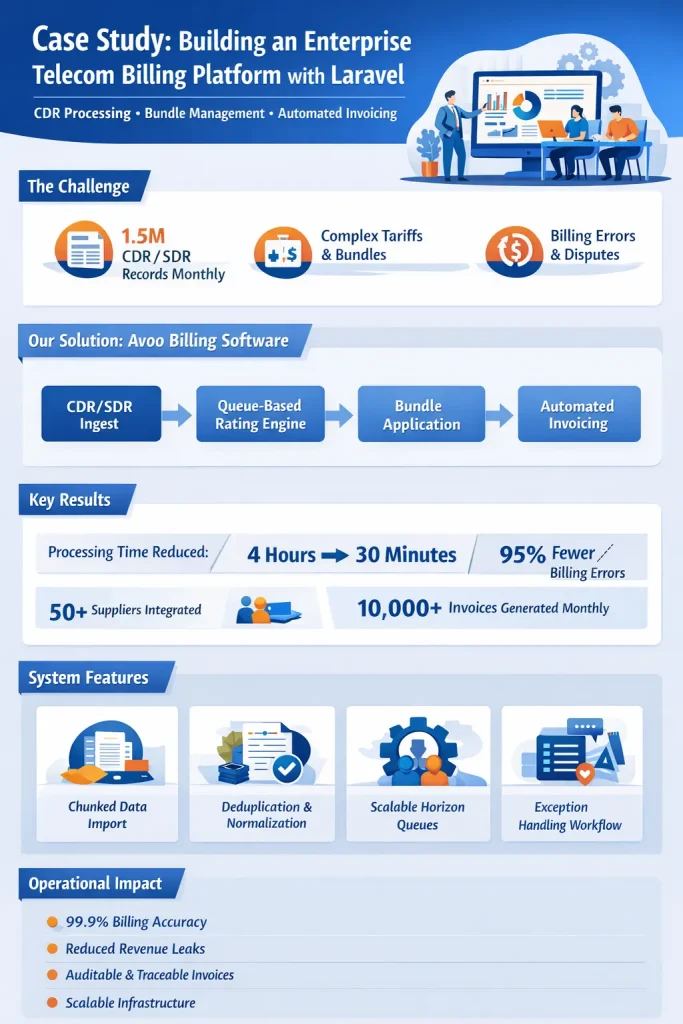
    Infographic case study showing Avoo Billing Software built with Laravel: CDR/SDR ingest, queue-based rating, bundle application, automated invoicing, key results, and system features.

    Our Solution: Avoo Billing Software Architecture

    We designed a billing pipeline that separates responsibilities cleanly and scales via queues:

    Upload Usage File
      → Validate + store
      → Import (chunked)
      → Normalize keys + dedupe
      → Rating (queue-based rerating)
      → Bundle application (voice/SMS/data/MMS)
      → Summary + unbilled charges
      → Invoice generation + audit logs

    1) Import at Scale (Chunking + Safe Write Modes)

    We built import jobs that stream CSV data and process it in chunks. This avoids memory spikes and makes the system stable across different server sizes.

    • Chunked processing (e.g., 1,000–5,000 rows per batch)
    • Write modes for safe operations:
      • Patch: upsert based on a natural key
      • Replace: delete matching key-tuples then insert fresh rows safely
    • Validation + issue logging instead of failing the whole import

    2) Dedupe & Normalization (Enterprise Data Hygiene)

    We implemented deterministic normalization rules for date/time formats and phone fields, and added a deduplication key so reruns don’t create duplicates.

    // Example dedupe key idea (conceptual):
    md5(billing_id|cdr_date|cdr_time|cdr_type|source|destination)

    This dramatically reduces reprocessing risk and helps support teams trust the data.

    3) Queue-Based Rating Engine (Tariffs, Time Spans, Overrides)

    The rating engine runs as queue jobs so it scales horizontally. It supports both “cost from tariff” logic and legacy rules, including:

    • Charge code matching + longest-prefix matching
    • Peak/off-peak/weekend time span rules
    • Unit conversion and billing unit validation
    • Precision handling and rounding rules
    • Connect fees, minimum charges, discounts, post-call surcharges
    • Structured issue creation (missing tariff, currency mismatch, mapping issues)

    Why this matters: enterprises need deterministic calculations and traceability—especially when customers dispute invoices.

    4) Bundle Application (Voice/SMS/Data/MMS) with Accurate Allowance Tracking

    Bundles were implemented as a dedicated queue stage, applying allowances per billing_id and sorting events by start time. The engine supports:

    • Bundle eligibility rules (included/excluded dial codes and charge codes)
    • Longest-prefix dial matching for accurate allowance application
    • Per-type limits (minutes/SMS/MMS, data in MB)
    • Atomic allowance updates to avoid race conditions
    • Reprocessing behavior (mark previous applications rejected and recalculate)

    This stage ensures the final end-user price reflects bundled usage accurately.

    5) Exception Workflow (The “Ops Backbone”)

    Instead of dumping failures into logs, the platform records structured issues with categories (e.g., missing tariff rates, orphan billing IDs, mapping issues, duplicates). This makes exceptions:

    • Searchable (by supplier, billing period, category)
    • Assignable (team workflows)
    • Exportable (for supplier disputes or internal reviews)
    • Auditable (who ignored/resolved what, and why)

    6) Invoice Generation + Unbilled Charges

    After rating and bundles, the system generates usage summaries and writes unbilled charges (daily/monthly). Invoice generation is handled via a dedicated job that calculates outstanding balances, usage charges, VAT/tax, and produces invoice items with a traceable breakdown.


    Operational Scaling: Horizon Queues & Server Profiles

    Billing workloads aren’t uniform—imports, rating, bundles, and exports have different CPU/memory characteristics. We configured dedicated queues (and Horizon supervisors) so each workload scales independently.

    • imports: file ingest + chunk parsing
    • rating: CPU-heavy cost calculations
    • bundles: sequential allowance application with locks
    • default/notifications: webhooks, emails, small tasks

    Result: predictable throughput on different server sizes—from small nodes to high-memory machines—without random “queue interference.”


    What Made This Project Successful

    • Deterministic pipelines: each stage has clear inputs/outputs.
    • Idempotency + dedupe: safe reruns, safe retries.
    • Structured exceptions: operations can act without engineering bottlenecks.
    • Queue-first design: scale horizontally when volume increases.
    • Auditability: the system can explain “why this invoice total is this number.”

    How We Can Help You

    If you’re building (or fixing) an enterprise billing system, the architecture decisions matter more than the UI. We help teams design scalable Laravel systems with reliable queue pipelines, data validation, and auditability.

    Build & Scale

    Enterprise Laravel development: architecture, pipelines, and performance.

    Stability & SLAs

    Monitoring, patching, queue hardening, performance tuning, incident support.

    Upgrade to Laravel 12

    Risk-based upgrade strategy, dependency mapping, staged rollout and rollback planning.

    AI for Ops & Billing Teams

    RAG search for internal SOPs, automated triage, anomaly detection, and reporting copilots.


    FAQ

    What makes telecom billing projects fail?

    Most failures come from weak data normalization, lack of idempotency, unbounded ORM queries, and no operational exception workflow. Enterprises need predictable pipelines and traceability.

    Can Laravel handle high-volume billing workloads?

    Yes—when designed correctly: chunked imports, queue-based rating, workload-separated Horizon queues, and database indexes built around real query patterns.

    How do you handle reprocessing and rerating safely?

    By designing idempotent jobs, using dedupe keys or natural keys, storing processing history, and ensuring reruns either patch safely or replace atomically for matching key-tuples.

  • Latest Laravel Version (April 2026): Laravel 13 Release Date, Support Dates, Laravel 12 vs 13

    Latest Laravel Version (April 2026): Laravel 13 Release Date, Support Dates, Laravel 12 vs 13

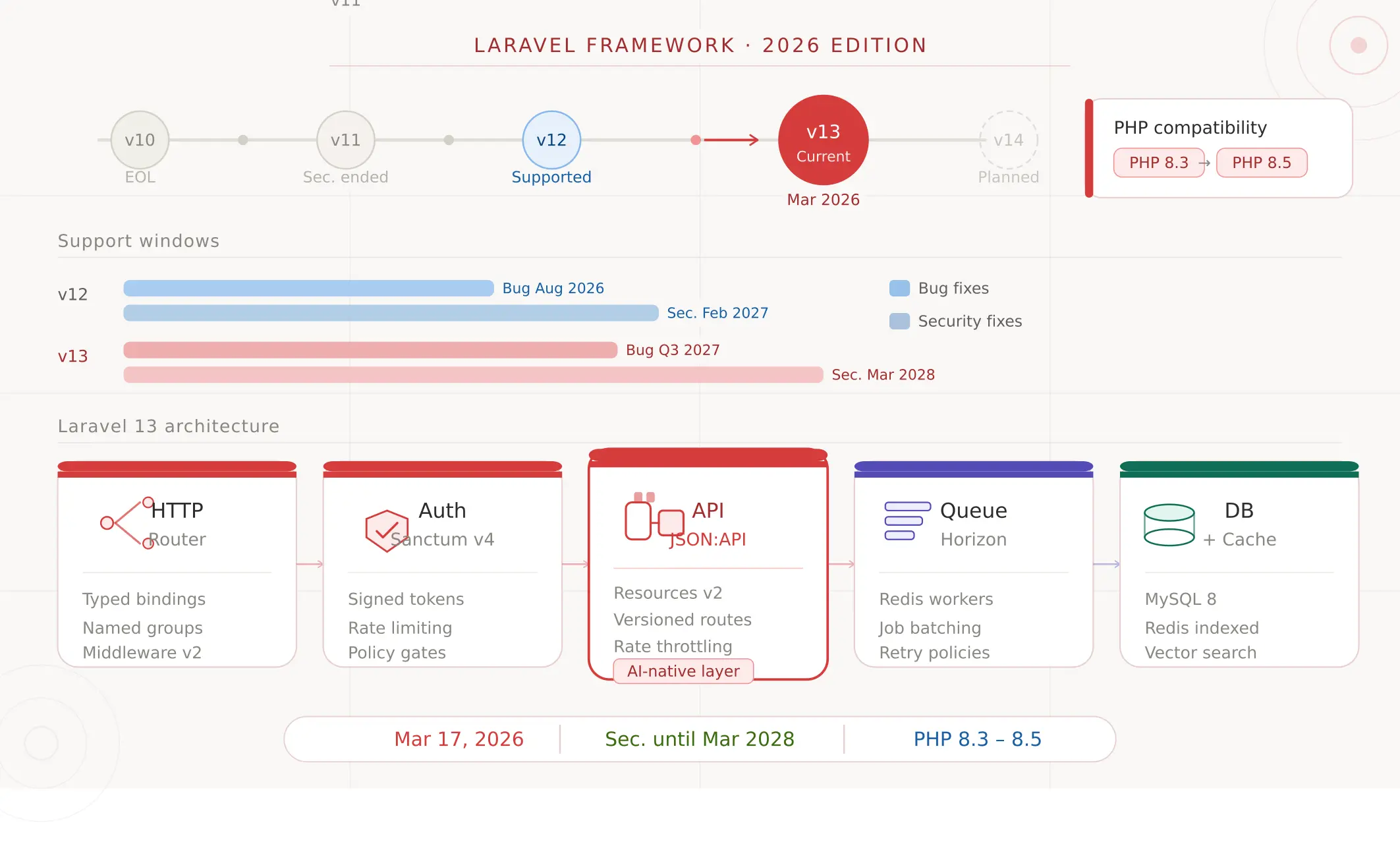
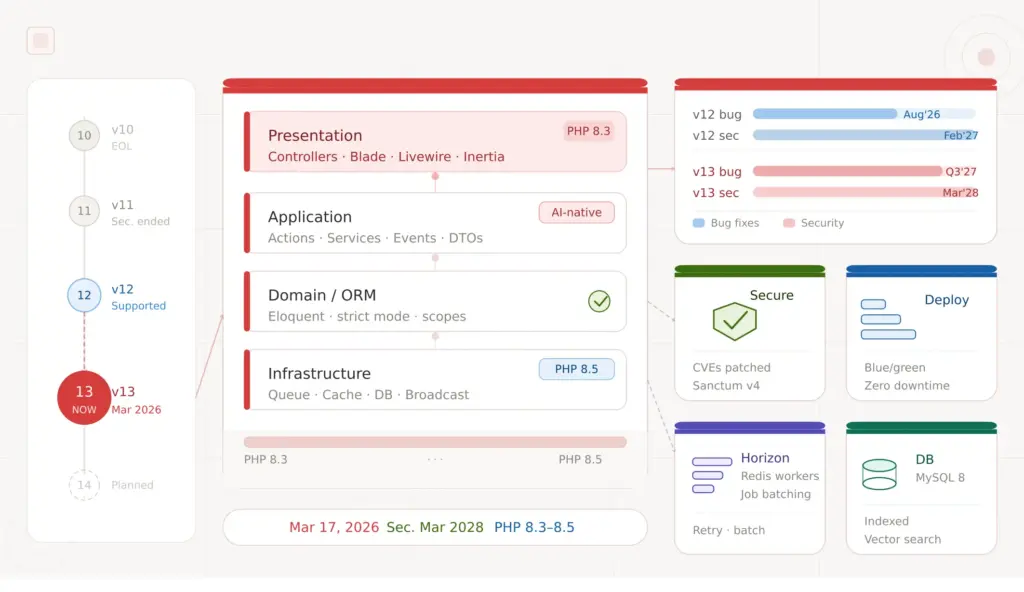
    The latest Laravel version in April 2026 is Laravel 13. Laravel 13 was released on March 17, 2026, supports PHP 8.3 to 8.5, receives bug fixes until Q3 2027, and receives security fixes until March 17, 2028. This guide is for teams checking the current Laravel version, comparing Laravel 12 vs 13, reviewing support dates, and deciding whether they should upgrade now or plan a phased move. If you already know you need a structured migration plan, our Laravel upgrade services guide is the best next step.

    Last updated: April 2026


    The short answer

    If you are asking what the latest Laravel version is right now, the answer is Laravel 13. For most teams, the more important follow-up question is not just “what is current?” but “what should we target next based on our current version, dependency health, and support window?” That is where this page helps: it gives you the current Laravel release, the support dates, the PHP compatibility range, and a practical Laravel 12 vs 13 view for planning. If you are evaluating Laravel as a long-term framework choice before deciding on upgrades, this article on Is Laravel still the right choice in 2026 is the broader starting point.

    Laravel 13 release date and support dates

    Laravel 13 was released on March 17, 2026. It follows Laravel’s annual major release cadence and continues the framework’s support policy of 18 months of bug fixes and 2 years of security fixes for each major release. Laravel 13 supports PHP 8.3 through 8.5, receives bug fixes until Q3 2027, and receives security fixes until March 17, 2028.

    If you want the official source for release cadence and support windows, Laravel’s own Laravel 13 release notes are the reference point your engineering team should use.

    Laravel support policy at a glance

    Laravel VersionSupported PHPRelease DateBug Fixes UntilSecurity Fixes Until
    Laravel 10PHP 8.1–8.3February 14, 2023August 6, 2024February 4, 2025
    Laravel 11PHP 8.2–8.4March 12, 2024September 3, 2025March 12, 2026
    Laravel 12PHP 8.2–8.5February 24, 2025August 13, 2026February 24, 2027
    Laravel 13PHP 8.3–8.5March 17, 2026Q3 2027March 17, 2028

    The practical takeaway is simple. Laravel 13 is the current version. Laravel 12 is still supported and may still be the right short-term target for some teams, but Laravel 11 has now reached the end of its security support window, and Laravel 10 is already well past it.

    Laravel 12 vs Laravel 13: what changed

    Laravel 12 was a relatively calm, maintenance-oriented release for many teams. Laravel 13 is the next major step forward and is still positioned as a relatively minor upgrade in effort for many applications. Laravel’s official release notes highlight AI-native workflows, first-party AI primitives, JSON:API resources, semantic and vector search capabilities, stronger security defaults, and ongoing improvements across queues and cache behavior.

    That means the Laravel 12 vs 13 conversation is not just about support windows. It is also about whether your team wants to stay on the current line of the framework and take advantage of a modern baseline with longer runway ahead. The official Laravel 13 upgrade guide also notes that the estimated upgrade time from 12.x is relatively short for many apps, which is another signal that Laravel 13 should now be your default evaluation point rather than a future placeholder.

    Should you upgrade to Laravel 13 now?

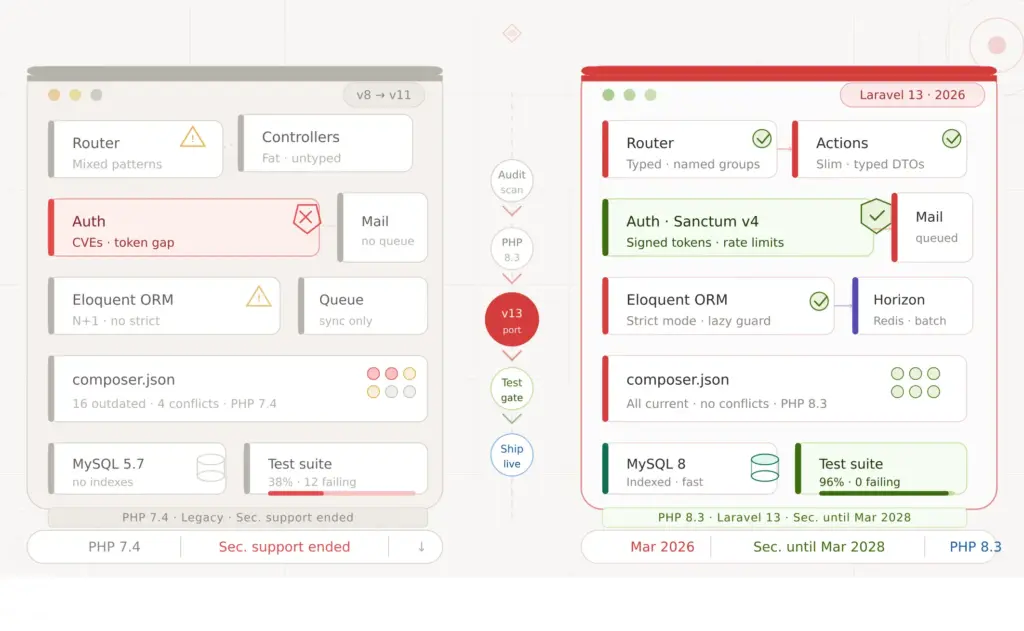
    For many teams, yes. If you are on Laravel 12 and your package ecosystem is reasonably healthy, Laravel 13 should be the first version you evaluate. If you are on Laravel 11, the situation is more urgent because its security support has already ended. If you are on Laravel 10 or older, your upgrade decision should be treated as a structured modernization effort rather than a casual framework bump.

    The right answer depends on where you are starting from, but one thing is now clear: “wait for Laravel 13” is no longer a valid planning assumption, because Laravel 13 is already here.

    Who should move to Laravel 13 now

    • Teams on Laravel 12 that want the current version and a longer support runway
    • Teams on Laravel 11 that are already past the security support deadline
    • New projects in 2026 that want to start on the current major version
    • Teams building AI-assisted, API-heavy, or search-heavy products that want the newer Laravel 13 baseline

    Who may wait briefly before moving to Laravel 13

    Some teams on Laravel 12 can wait a short period if their product is stable, their support window is still healthy, and they want to let more ecosystem packages settle. But even then, Laravel 13 should still be the version you plan around now. Waiting only makes sense as a short operational timing decision, not as a strategic question about whether Laravel 13 will become relevant later.

    How this affects upgrade planning

    Version planning only becomes useful when it connects to execution. If your team is deciding between Laravel 12 and 13 as part of a production upgrade, the best next step is not more generic reading. It is a dependency audit, a package review, a testing plan, and a rollout path. That is exactly why our Laravel upgrade services guide exists: to help teams move from version awareness to a low-risk migration strategy.

    If the upgrade is part of a larger modernization project, custom platform build, or platform re-architecture, our Laravel development services page is the more relevant commercial hub because it covers broader build, scaling, and delivery work beyond version changes alone.

    Latest Laravel version and PHP compatibility

    The latest Laravel version also matters because it changes your PHP compatibility planning. Laravel 13 requires at least PHP 8.3 and supports PHP 8.3 through 8.5. Laravel 12 supports PHP 8.2 through 8.5. So if your infrastructure is still lagging on PHP versions, your Laravel upgrade plan must include runtime planning as well as framework planning.

    This is also why framework upgrades should never be treated as an isolated Composer task. They are usually tied to infrastructure, CI pipelines, deployment routines, queue behavior, caching strategy, and performance review. If that side of the conversation is part of your planning, this Laravel performance checklist is a useful companion read.

    Our practical view

    The latest Laravel version in April 2026 is Laravel 13, and that should now be the default frame for most Laravel version and support conversations. Laravel 12 is still relevant because it remains supported and may still be the immediate stepping stone for some teams. But the center of gravity has now shifted. If you are planning new work, fresh upgrades, or support runway decisions, Laravel 13 is the version that should anchor your roadmap.

    Need help choosing the right Laravel target version?

    If your team needs help deciding whether to move directly to Laravel 13, stabilize on Laravel 12 first, or design a phased upgrade plan around real production risk, we can help. Start with our Laravel upgrade services guide if the issue is migration planning, or visit our Laravel development services page if the version decision is part of a wider platform roadmap.


    FAQs

    What is the latest Laravel version in 2026?

    The latest Laravel version in April 2026 is Laravel 13.

    When was Laravel 13 released?

    Laravel 13 was released on March 17, 2026.

    How long is Laravel 13 supported?

    Laravel 13 receives bug fixes until Q3 2027 and security fixes until March 17, 2028.

    What PHP version does Laravel 13 support?

    Laravel 13 supports PHP 8.3 through 8.5 and requires a minimum PHP version of 8.3.

    Should we choose Laravel 12 or Laravel 13 now?

    For many teams, Laravel 13 should now be the first version they evaluate. Laravel 12 may still make sense as a short-term stepping stone in some upgrade paths, but Laravel 13 is the current major release and has the longer forward support runway.

  • Why Statamic Outperforms WordPress for Core Web Vitals in 2026

    Google’s Core Web Vitals (CWV) are no longer “nice to have.”
    In 2026, they are a baseline requirement for ranking, user experience, and conversion performance—especially for marketing and SaaS websites.

    Many teams struggle to pass Core Web Vitals on WordPress, even after adding caching plugins, CDNs, and performance tweaks. This is where Statamic consistently outperforms WordPress—not because of hacks, but because of architecture.

    This article explains why Statamic wins on Core Web Vitals in 2026, how WordPress struggles structurally, and what this means for SEO, CRO, and long-term site performance.


    Core Web Vitals Refresher (2026)

    Google currently evaluates three key metrics:

    • LCP (Largest Contentful Paint) – Loading performance
    • INP (Interaction to Next Paint) – Responsiveness (replaced FID)
    • CLS (Cumulative Layout Shift) – Visual stability

    Passing CWV is now directly tied to:

    • Organic rankings
    • Crawl efficiency
    • Conversion rates
    • Mobile UX scores

    The Real Problem with WordPress Performance

    WordPress performance issues are rarely caused by “bad hosting” alone.
    They are structural.

    Typical WordPress Performance Bottlenecks

    • Database queries on every request
    • Plugin-heavy execution chains
    • Render-blocking JavaScript from themes & builders
    • CSS bloat from multipurpose themes
    • Runtime caching instead of pre-rendered output

    Even well-optimized WordPress sites often need:

    • Page caching plugins
    • Object caching (Redis/Memcached)
    • Asset optimization plugins
    • CDN configuration
    • Continuous tuning

    This increases complexity, cost, and fragility.

    👉 This is why many teams rely on ongoing
    WordPress Maintenance Services just to keep performance stable.


    Why Statamic Is Faster by Design

    Statamic is a flat-file CMS built on Laravel.
    That one design choice changes everything.

    Key Architectural Advantages

    • No database queries for content
    • Pre-rendered content delivery
    • Clean, minimal HTML output
    • No plugin execution chains
    • Full control over assets & templates

    Performance is not “optimized later”—it’s inherent.


    Core Web Vitals: Statamic vs WordPress (2026)

    1️⃣ Largest Contentful Paint (LCP)

    WordPress

    • Often delayed by:
      • Database calls
      • Theme logic
      • Plugin execution
      • Large hero images from page builders

    Statamic

    • Content is read directly from files
    • Templates are clean and predictable
    • No runtime query delays

    👉 Statamic consistently delivers faster LCP, especially on mobile.


    2️⃣ INP (Interaction to Next Paint)

    INP measures how quickly the site responds to user interaction.

    WordPress struggles because

    • JavaScript-heavy themes
    • Page builders injecting event listeners
    • Third-party scripts loading early

    Statamic excels because

    • Minimal JavaScript by default
    • No page builders
    • Developers control exactly what loads and when

    👉 Statamic sites feel instantly responsive—a major UX and SEO advantage.


    3️⃣ Cumulative Layout Shift (CLS)

    CLS failures are extremely common on WordPress.

    Common causes

    • Ads loading late
    • Fonts shifting layout
    • Plugin UI injections
    • Dynamic banners & popups

    Statamic advantage

    • Predictable layouts
    • No plugin UI injections
    • Stable templates
    • Controlled font loading

    👉 CLS issues are rare unless introduced deliberately.


    The Plugin Problem (WordPress’s Biggest Weakness)

    Every WordPress performance fix usually involves:

    • Another plugin
    • Another configuration
    • Another update risk

    This creates:

    • Plugin conflicts
    • Security exposure
    • Performance regression after updates
    • Higher maintenance cost

    Statamic avoids this entirely by:

    • Building features cleanly
    • Using Laravel-native tooling
    • Eliminating plugin dependency

    This is why long-term performance stability is much higher with Statamic.


    Hosting Impact: Why Statamic Costs Less to Run

    WordPress performance usually requires:

    • Heavier servers
    • Aggressive caching layers
    • CDN dependency

    Statamic performs extremely well on:

    • Small VPS instances
    • Simple Laravel-friendly hosting
    • Minimal infrastructure

    👉 Lower hosting cost + better performance is a rare combination.


    SEO Impact of Better Core Web Vitals

    Statamic’s CWV advantage leads to:

    • Better mobile rankings
    • Lower bounce rates
    • Higher crawl efficiency
    • Faster indexing
    • Improved conversion rates

    For marketing websites, performance directly affects:

    • Lead generation
    • Paid ad landing page scores
    • Brand perception

    This is why Statamic is increasingly chosen for SEO-driven marketing sites.


    When WordPress Can Still Pass CWV (With Effort)

    To be fair, WordPress can pass Core Web Vitals—but usually requires:

    • Custom lightweight theme
    • Zero page builders
    • Minimal plugins
    • Advanced caching
    • Continuous monitoring

    At that point, WordPress becomes:

    • Harder to maintain
    • More expensive long-term
    • Less flexible for marketers

    Many teams choose Statamic instead of fighting the platform.


    Statamic Is Not for Everyone (Important)

    Statamic may NOT be ideal if:

    • You rely on WooCommerce
    • You need dozens of plugins
    • Editors demand drag-and-drop builders
    • Your site is blog-heavy with many contributors

    In those cases, WordPress—built and maintained properly—may still fit.

    👉 Learn more about WordPress Development Services


    Why Marketing Teams Prefer Statamic in 2026

    Marketing teams choose Statamic because:

    • Pages load fast without effort
    • Core Web Vitals pass by default
    • SEO foundations are clean
    • Content is structured
    • Maintenance overhead is low

    This combination is rare—and valuable.


    Final Verdict: Performance Is Architectural

    You can optimize WordPress for performance.
    But Statamic starts fast and stays fast.

    In 2026, Core Web Vitals are not optional.
    Statamic outperforms WordPress because it avoids the structural bottlenecks WordPress cannot escape cleanly.


    Need a High-Performance Statamic Website?

    If you want:

    • CWV-optimized marketing site
    • SEO-first architecture
    • Low maintenance overhead
    • Long-term performance stability

    Explore our 👉 Statamic Development Services

    We build performance-first marketing websites, not plugin stacks.

  • Laravel Development (2026): The Complete Guide to Building & Scaling Enterprise Applications

    Laravel Development (2026): The Complete Guide to Building & Scaling Enterprise Applications

    Laravel in 2026 is no longer “just a framework.” It’s a proven application platform for building enterprise-grade systems—multi-tenant SaaS products, customer portals, partner APIs, operational dashboards, and data-heavy workflows—while keeping time-to-market and total cost of ownership under control.

    This guide explains how to evaluate Laravel strategically, how enterprise Laravel is designed, what “scaling” really means in practice, and what leadership should require to ensure reliability, security, and maintainability.


    Table of contents


    Executive summary (for C-level leaders)

    Enterprise outcomes are not determined by your tech stack alone—they’re determined by delivery predictability, operational readiness, and long-term maintainability.

    Laravel tends to win in enterprise environments when your priorities include:

    • Faster delivery of complex products (SaaS, portals, APIs) without building massive internal tooling
    • Lower total cost of ownership by reducing “stack complexity tax”
    • Hireable skill sets (teams can scale faster and ramp quicker)
    • Clear architecture patterns for modularity, background processing, and secure access control

    If you’re assessing Laravel as an enterprise option, the right question isn’t “Can Laravel scale?”—it’s:

    • Can we build a system that scales reliably with predictable operations, governance, and upgrades?
    • Can we reduce risk while increasing delivery speed over the next 12–36 months?
    • Can this platform support our security posture, integrations, and data growth?

    If the answer is “yes,” Laravel becomes a strategic advantage—especially for organizations building customer-facing platforms, SaaS products, and workflow-driven systems.


    Why Laravel in 2026 (business value first)

    1) Faster delivery without sacrificing control

    Speed at the enterprise level is about eliminating uncertainty: consistent patterns for validation, authentication, routing, queues, testing, and deployment. Laravel provides strong conventions, so your team spends less time reinventing infrastructure and more time building outcomes.

    2) Total cost of ownership is often better than “heavier” stacks

    Many organizations believe “microservices + complex stacks” automatically equal scalability. In reality, complexity often slows hiring, increases glue code, and raises incident rates. Laravel can scale extremely well when paired with:

    • a stateless application tier
    • background queues for heavy workflows
    • disciplined database design and caching
    • strong observability and runbooks

    3) A pragmatic path to modernization

    Laravel is also an excellent modernization vehicle: upgrading legacy PHP apps into a maintainable architecture, restructuring code into modules, and strengthening security + operational readiness.

    If you’re already running Laravel and planning modernization, see also:


    What “enterprise Laravel” really means

    Enterprise readiness is not a framework badge. It’s your ability to ship, secure, scale, and operate a system with confidence.

    Enterprise success requires five capabilities

    1. Reliable delivery: CI/CD, test automation, controlled releases, rollbacks
    2. Security & access control: RBAC/ABAC, audit trails, secrets handling, data protection
    3. Scalable performance: caching, queue-first workflows, DB discipline, rate limiting
    4. Operational maturity: monitoring, logs, metrics, incident response, SLOs
    5. Maintainability: modular architecture, clear boundaries, predictable upgrade path

    Laravel supports these outcomes—if you adopt the right architecture and governance.


    Architecture choices that work at scale

    Most enterprise Laravel systems succeed with a modular monolith first. Microservices are optional later, only when there is a clear business/operational payoff.

    ArchitectureBest forWatch-outs
    Modular monolithMost SaaS + internal enterprise platformsBoundaries, ownership, keeping modules decoupled
    Few services (domain split)Clear domain separation (e.g., identity, billing, reporting)Integration overhead, duplicated logic, inconsistent contracts
    Event-driven hybridHigh-throughput workflows + auditabilityObservability, idempotency, eventual consistency discipline

    How to build a modular monolith that stays maintainable

    • Domain modules: Identity, Billing, Orders, Reporting, Integrations
    • Explicit contracts: service interfaces, DTOs, domain events
    • Dependency direction rules: avoid UI and infrastructure leaking into domain logic
    • Database boundaries: shared DB is fine early; boundaries must be enforced in code and queries

    Executive rule of thumb: If your teams can’t operate 1 service well, they won’t operate 12 services better. Earn microservices through maturity, not ambition.


    The scaling playbook (what actually moves the needle)

    1) Make the application tier stateless

    Any app server should handle any request. That means:

    • sessions stored centrally (e.g., Redis) if server-side sessions are needed
    • files stored in object storage (S3-compatible)
    • background work moved to queues
    • configuration managed cleanly (environment + secrets)

    2) Use queues as a first-class system

    Queues separate “user experience” from “heavy work.” Your enterprise latency and reliability improve when:

    • imports, exports, emails, PDFs, integrations, and data processing are async
    • jobs are idempotent and retriable
    • queue depth and failure rate are monitored with alerts

    3) Cache strategically (not blindly)

    Caching is not a single feature; it’s a strategy:

    • CDN caching for public content
    • app response caching for stable pages and endpoints
    • query caching for expensive reads
    • precomputed aggregates for dashboards (daily rollups)

    Without invalidation rules, caching can reduce trust in data. Ensure you have a clear strategy for cache keys and expiry.

    4) Database discipline (where most systems fail)

    At scale, most performance issues are database issues:

    • N+1 query patterns
    • missing/incorrect indexes
    • unbounded reporting queries running on the production OLTP database
    • slow joins across poorly structured tables

    Enterprise pattern: Use production DB for transactions, replicas for heavy reads, and separate analytics/warehouse for reporting once you hit scale.

    5) Resilience patterns: rate limiting, retries, and idempotency

    • Rate limit APIs and expensive endpoints per token/client
    • Retries with backoff for flaky upstream services
    • Idempotency keys for payment and external “write” operations
    • Circuit breakers to prevent cascading failures when dependencies degrade

    Security & compliance: what leaders should require

    Laravel can support strong security, but the enterprise outcome comes from policies, implementation discipline, and operational guardrails.

    Minimum enterprise security baseline

    Identity & access

    • role-based access control (RBAC) or attribute-based access (ABAC) for complex organizations
    • least privilege by default
    • separate “admin plane” from “user plane” for sensitive actions
    • SSO readiness where needed (OIDC/SAML patterns)

    Data protection

    • encryption in transit (TLS) and encryption at rest (DB + storage)
    • field-level encryption for sensitive data when necessary
    • secrets managed in a vault/secrets manager—not scattered across servers

    Auditability

    • immutable audit logs for sensitive actions (who/what/when)
    • export logging for regulated workflows
    • retention policy aligned with legal and business requirements

    What executives should ask vendors/teams

    • “Show me the access model (roles/permissions) and how you prevent privilege escalation.”
    • “How do you log sensitive actions, and how do we audit changes over time?”
    • “How are secrets managed across environments?”
    • “What is your patching and dependency policy?”

    Reliability & operations: “run it like a bank”

    Set SLOs (service level objectives)

    Enterprise systems must define measurable targets, such as:

    • availability (e.g., 99.9%)
    • API latency targets (p95 and p99)
    • error rates (by endpoint)
    • queue processing time (time-to-complete async work)

    What to monitor in a Laravel enterprise system

    • request latency (p50/p95/p99)
    • error rate by endpoint and by release version
    • queue depth, failures, and job runtimes
    • database slow queries and replication lag
    • cache hit rate and eviction issues
    • external dependency health (payments, email, upstream APIs)

    Incident response expectations

    • runbooks for common incidents
    • defined on-call policy (even if business-hours on-call)
    • postmortems that produce clear action items

    Enterprise delivery model: reducing execution risk

    A delivery structure that works

    For complex enterprise builds, a “product squad” model is typically the most reliable:

    • Tech lead / architect
    • 2–6 backend engineers
    • frontend engineer (if needed)
    • QA automation (or QA engineer)
    • DevOps/SRE support (shared or embedded)
    • Product owner on your side

    Governance that supports speed (not bureaucracy)

    • weekly demo + stakeholder review
    • monthly architecture review (short and decision-driven)
    • release process with rollbacks
    • definition-of-done includes tests, monitoring hooks, and security checks

    Enterprise use cases Laravel fits exceptionally well

    • Multi-tenant SaaS platforms (plans, billing, RBAC, onboarding, integrations)
    • Customer & partner portals (workflows, approvals, complex permissions)
    • API-first products (mobile apps, marketplaces, partner integrations)
    • Data-heavy pipelines (imports, billing/reconciliation, reporting jobs)
    • Operational platforms (admin systems, compliance workflows, back-office tools)

    Decision framework: is Laravel right for your business?

    Laravel is a strong fit if:

    • you need to ship complex platforms quickly (SaaS, portals, workflows, APIs)
    • you want a maintainable architecture with clear conventions
    • you want predictable operational patterns (queues, caching, modularity)
    • you value hireability and delivery velocity

    Consider alternatives if:

    • your system is ultra-low-latency computing (rare enterprise case)
    • your organization mandates a single ecosystem for governance reasons
    • you have extremely specialized constraints better served by niche tooling

    Executive reality: Most SaaS and line-of-business systems fit Laravel very well—when designed with discipline.


    A practical 90-day enterprise Laravel blueprint

    This is a delivery blueprint executives can use to validate a roadmap and reduce risk early.

    Days 0–15: Discovery & risk reduction

    • define business outcomes and constraints
    • map integrations (SSO, payments, ERP, data sources)
    • threat model critical workflows
    • decide architecture (modular monolith vs split domains)
    • define SLOs and monitoring plan

    Days 16–45: Foundation build

    • implement identity + RBAC baseline
    • build core domain modules and database design
    • establish CI/CD and automated test baseline
    • add logging/metrics/tracing and dashboards
    • design queue architecture: retry strategy + idempotency

    Days 46–90: Scale readiness + first production workloads

    • performance pass: indexing, caching, query optimization
    • load test key customer journeys
    • operational dashboards + alerting ready for production
    • incident playbooks prepared
    • ship first high-value workflows with measurable outcomes

    FAQs

    Is Laravel suitable for enterprise applications in 2026?

    Yes—Laravel is widely used for enterprise portals, SaaS platforms, and API-heavy systems when paired with strong architecture, security baselines, and operational maturity.

    How does Laravel scale under high traffic?

    Laravel scales effectively with a stateless app tier, caching strategy, queue-first background processing, database indexing discipline, and robust observability.

    Should we start with microservices?

    Not usually. Most enterprise products succeed with a modular monolith first, then split services only when there is a clear domain or operational payoff.

    What’s the biggest risk with Laravel projects?

    The biggest risk is not Laravel—it’s weak engineering discipline: lack of boundaries, poor DB design, limited tests, and missing monitoring/runbooks.

    How long does an enterprise Laravel build take?

    Most organizations see meaningful production outcomes in 8–12 weeks if scope is focused. Larger platforms typically roll out in phases over 3–9 months.

    Can Laravel meet security and audit requirements?

    Yes. With RBAC/ABAC, encryption, secrets handling, audit logs, and secure delivery practices, Laravel systems can meet enterprise security and audit needs.

    How do upgrades work over time?

    Use a planned upgrade cadence (quarterly dependency reviews + scheduled framework upgrades). This reduces risk and avoids “big-bang” modernization projects.

    How do we reduce vendor lock-in?

    Demand clean modular architecture, automated tests, documented infrastructure, operational dashboards, and clear ownership boundaries—these reduce switching cost more than contracts.


    Next step

    If you’re planning a new build or modernization in 2026, you can start with a short architecture and risk review. From there, we recommend a phased roadmap aligned to business outcomes, SLOs, and delivery milestones.

    Related service: Laravel Development Services


    Further reading

  • How to Choose a Statamic Development Agency in 2026 (Pricing, Process & Red Flags)

    How to Choose a Statamic Development Agency in 2026 (Pricing, Process & Red Flags)

    Statamic has emerged as one of the most powerful CMS platforms for high-performance marketing websites, SaaS landing pages, and brand sites. Built on Laravel and designed around speed, security, and structured content, Statamic is no longer a “niche CMS” in 2026.

    But here’s the catch:

    👉 Statamic’s success depends heavily on who builds it.

    Unlike WordPress, Statamic is not plug-and-play. Choosing the wrong development agency can turn a fast, elegant CMS into an expensive, hard-to-maintain project.

    This guide explains how to choose the right Statamic development agency in 2026, covering:

    • Realistic pricing
    • What a good Statamic process looks like
    • Red flags to avoid
    • Maintenance and long-term cost considerations

    Why Choosing the Right Statamic Agency Matters

    Statamic is developer-centric by design. It assumes:

    • Strong Laravel fundamentals
    • Clean frontend architecture
    • Structured content modeling
    • Performance-first thinking

    Agencies that come from a WordPress-only mindset often struggle with Statamic because:

    • There is no plugin marketplace to “patch” problems
    • Architecture decisions matter more
    • Poor early decisions increase long-term costs

    That’s why choosing a true Statamic development agency is critical.


    What a Good Statamic Development Agency Should Do

    1. Strong Laravel Expertise (Non-Negotiable)

    Statamic runs on Laravel. A good agency should be comfortable with:

    • Laravel routing & middleware
    • Blade or modern frontend stacks
    • Data modeling using Statamic collections & blueprints
    • Performance optimization at the framework level

    🚩 If an agency says “Statamic is easier than Laravel,” that’s a warning sign.


    2. Marketing-First Content Architecture

    A professional Statamic agency designs content for marketers, not just developers.

    You should see:

    • Clean content blueprints
    • Reusable page sections
    • Flexible landing page structures
    • SEO-friendly URLs and metadata control

    This is where Statamic truly shines for marketing websites.


    3. Performance & Core Web Vitals Focus

    Statamic’s flat-file approach enables:

    • Extremely fast load times
    • Minimal server overhead
    • Excellent Core Web Vitals

    A good agency will:

    • Design for static caching
    • Optimize images and assets
    • Avoid unnecessary JavaScript bloat

    Performance is not optional in 2026—it’s a ranking factor and conversion driver.


    Statamic Development Pricing in 2026 (Realistic Ranges)

    Statamic pricing varies widely depending on scope, design, and integrations.

    Typical Price Ranges

    Project TypeEstimated Cost
    Basic marketing site$1,500 – $3,000
    SaaS or brand site$3,000 – $7,000
    Enterprise marketing site$7,000 – $15,000+

    Why Statamic Often Costs Less Long-Term

    • No recurring plugin licenses
    • Lower hosting requirements
    • Minimal security overhead
    • Reduced maintenance hours

    Compared to WordPress, Statamic’s total cost of ownership is usually lower over 2–3 years.


    Statamic vs WordPress Agencies: Key Differences

    AspectWordPress AgencyStatamic Agency
    ApproachPlugin-drivenArchitecture-driven
    PerformanceNeeds optimizationFast by default
    SecurityPlugin riskMinimal surface
    MaintenanceContinuousLightweight
    Ideal forContent-heavy blogsMarketing & SaaS sites

    If your site depends on plugins for basic functionality, WordPress may be better.
    If performance and structure matter, Statamic is the better fit.


    Red Flags When Hiring a Statamic Development Company

    Avoid agencies that:

    🚩 Push WordPress plugins as alternatives
    🚩 Can’t explain Statamic blueprints clearly
    🚩 Lack real Laravel project experience
    🚩 Promise “instant” builds with no architecture discussion
    🚩 Don’t talk about performance or SEO
    🚩 Have no post-launch maintenance plan

    Statamic is powerful—but only in the right hands.


    Maintenance & Long-Term Support Considerations

    Statamic requires far less maintenance than WordPress, but not zero.

    A professional agency should offer:

    • Laravel & Statamic updates
    • Server & deployment support
    • Performance monitoring
    • Minor content or layout enhancements

    This is where Statamic truly reduces operational burden compared to WordPress.


    When Should You Choose a Statamic Agency?

    Statamic is ideal if:

    • Your site is marketing-focused
    • Performance & SEO matter
    • You want lower long-term costs
    • You prefer structured content
    • You don’t want plugin dependency

    If you rely heavily on third-party plugins or non-technical editors, WordPress may still be suitable.


    Why Work With a Specialized Statamic Agency?

    A specialized Statamic team understands:

    • Laravel-first architecture
    • Marketing-driven content modeling
    • Performance & SEO alignment
    • Long-term maintainability

    At itmarkerz, our 👉 Statamic Development Services
    focus on building fast, secure, SEO-ready marketing websites using modern CMS practices—without plugin bloat.


    Final Checklist Before You Decide

    Before hiring a Statamic agency, ask:

    ✔ Do they have Laravel experience?
    ✔ Can they explain Statamic blueprints clearly?
    ✔ Do they design for marketers, not just developers?
    ✔ Do they talk about performance and SEO?
    ✔ Do they offer post-launch support?

    If the answer is “yes” to all five—you’re on the right track.

  • Bagisto Development Services (2026): The Complete Guide to Building, Customizing & Scaling a Laravel eCommerce Store

    If you’re evaluating Bagisto eCommerce development in 2026, you’re probably looking for a platform that gives you Laravel-level flexibility without the long-term cost and complexity of legacy enterprise stacks.

    Bagisto is an open-source eCommerce platform built on Laravel and is widely used for custom storefronts, marketplaces, and headless builds using APIs (REST/GraphQL).

    This guide is written for founders, CTOs, and eCommerce managers who want a clear plan to build a Bagisto store the right way: architecture, customization, performance, integrations, security, migration, and ongoing support.

    Need a team to build or scale your Bagisto store?
    Explore our Bagisto development services for implementation, custom modules, integrations, performance optimization, and maintenance.


    Why Bagisto in 2026?

    Bagisto is a strong fit when you want:

    • Full code ownership (no platform lock-in)
    • A Laravel-based stack your team can extend
    • A clear path for custom modules, workflows, and integrations
    • Options for headless commerce via GraphQL APIs
    • The ability to evolve into a marketplace or multi-store architecture

    It’s especially attractive for brands that outgrow “template-first” platforms but don’t want the weight of a massive enterprise replatform.


    Bagisto development services: what you should actually expect

    When companies say “Bagisto development,” they often mean very different things. Here’s what a professional Bagisto development company should deliver in 2026:

    1) Strategy + architecture (before code)

    • Requirements discovery (catalog, pricing, tax, shipping, checkout rules)
    • Data model and attribute strategy (how you scale products cleanly)
    • Integration mapping (ERP/CRM/PIM/payment/shipping)
    • Performance plan (cache strategy, search strategy, image/CDN strategy)
    • Security and compliance plan (roles, data handling, auditability)

    2) Implementation (build the store)

    • Theme + storefront build (UX, navigation, templates, components)
    • Catalog setup (attributes, categories, variants, filters)
    • Checkout and payments
    • Shipping rules and order lifecycle

    3) Customization (where Bagisto shines)

    • Bagisto custom development for unique workflows
    • Bagisto module development (new business logic)
    • Bagisto extension development (feature packages)
    • Bagisto theme development (pixel-perfect storefronts)

    4) Growth + reliability

    • Bagisto performance optimization (Core Web Vitals, caching, DB tuning)
    • Observability (logs, metrics, uptime alerts)
    • CI/CD deployments
    • Ongoing Bagisto support and maintenance

    If you want this done end-to-end, start here: Bagisto development services.


    Common Bagisto build types (and what changes technically)

    A) Standard D2C / B2C store

    Best for: single brand selling directly online.
    Typical customization: theme + checkout + integrations + SEO + performance.

    B) B2B commerce

    Best for: negotiated pricing, customer groups, net terms, internal approvals.
    Typical customization:

    • Tier pricing / customer group rules
    • Quote / purchase order flows
    • Invoice and credit workflows
    • Role-based access

    C) Multi-vendor marketplace

    Best for: platform businesses and aggregators.

    Bagisto supports marketplace patterns via marketplace extensions that turn a single-vendor store into a multi-seller marketplace (seller panels, commission logic, approvals, etc.). Bagisto+1

    Typical customization:

    • Commission rules, settlements, payouts
    • Vendor onboarding, KYC steps
    • Vendor-level shipping rules
    • Moderation and content policies
    • Marketplace search + ranking logic

    If you’re planning a marketplace build, talk to a team that has done marketplace-grade workflows. You can hire Bagisto developers who handle both platform engineering and marketplace operations logic.

    D) Headless commerce (Next.js / mobile apps)

    Best for: high-performance UX, omnichannel, custom UI/UX, apps.

    Bagisto provides GraphQL APIs designed for headless commerce use cases.

    Typical customization:

    • GraphQL-first storefront architecture
    • Authentication/session strategy
    • Cache strategy + edge rendering
    • Content + commerce integration (CMS)

    Bagisto customization: themes, modules, and extensions (how to plan it)

    Bagisto theme development (front-end)

    Use this when:

    • You need a unique brand experience (not template-based)
    • You want SEO-friendly category structures and landing pages
    • You care about performance (LCP/CLS) and conversion rate

    Deliverables should include:

    • Component-based UI (reusable sections)
    • Accessible markup and clean templates
    • Core Web Vitals optimization plan
    • Technical SEO hooks (schema-ready, index control, canonical logic)

    Bagisto module development (core business logic)

    This is where you implement:

    • Custom pricing rules and promotions
    • Complex checkout validation
    • Special shipping logic
    • Custom product types / bundles
    • Custom admin workflows

    Bagisto extension development (packaged functionality)

    Extensions are best when:

    • The feature should be reusable across multiple stores
    • You want upgrade-safe customization
    • You want clean separation for future scaling

    If you’re unsure what should be theme vs module vs extension, a good Bagisto development team will map it out before writing production code.


    Integrations: what “done right” looks like

    Most eCommerce failures are not “storefront failures”—they’re integration failures.

    A reliable Bagisto integration services plan usually includes:

    Payments

    • Payment gateway selection and implementation
    • Webhook reliability and retry strategy
    • Refunds and partial captures
    • Fraud signals

    Shipping & fulfillment

    • Multi-carrier logic, zones, surcharges
    • Label generation, tracking updates
    • Partial shipments, split shipments

    ERP / CRM / PIM

    • Product sync rules (source of truth)
    • Inventory sync strategy (real-time vs batch)
    • Customer and order sync strategy
    • Error queues + reconciliation dashboards

    Analytics & marketing

    • Event tracking design (server-side when needed)
    • Clean data layer plan
    • Attribution readiness

    If you want a team that can handle integrations end-to-end, see: Bagisto development services.


    Performance & scaling checklist for Bagisto stores (2026)

    Performance is not “one task”—it’s a system.

    What to optimize first (highest ROI)

    • Page weight: images, fonts, unused scripts
    • Cache strategy: full page where safe + fragments where needed
    • Database: indexing for catalog/search/filter flows
    • Search strategy: fast category filters and on-site search
    • Background jobs: imports, feeds, email, syncs

    Core store scaling areas

    • Catalog growth (attributes, variants, filtering)
    • Peak traffic events (sales campaigns)
    • Checkout reliability and payment resilience
    • Admin operations at scale (bulk tools, imports, workflows)

    Security hardening & reliability

    In 2026, “security” isn’t optional—even for small stores.

    A solid Bagisto security hardening and reliability baseline should include:

    • Secure authentication and admin access controls
    • Audit trails for critical operations
    • Least-privilege roles (admin, manager, fulfillment, content editor)
    • Dependency monitoring and patch workflow
    • Backup and restore drills
    • Webhook validation and replay protection

    Upgrades & long-term maintenance (don’t skip this)

    A store is never “done.” You need ongoing:

    • Patch management
    • Dependency upgrades
    • Performance tuning
    • Feature rollouts
    • Incident response

    That’s why many brands choose a retainer-based model for Bagisto support and maintenance.

    If you’re already running Bagisto and want stability, your best next step is a structured maintenance plan: Bagisto support & maintenance .


    Migration services: moving to Bagisto without breaking revenue

    Bagisto migration services typically cover:

    • Data mapping (products, categories, attributes, customers, orders)
    • SEO preservation (URLs, redirects, canonicals, index strategy)
    • Payment and shipping cutover plan
    • Staged rollout and rollback safety

    Common migration sources:

    If migration is your use case, treat it like a project with a clear cutover plan—not a “data import.”


    How to choose the right Bagisto development company

    Use this checklist when you evaluate a vendor/agency:

    1. Can they explain architecture trade-offs (not just “we can do it”)?
    2. Do they separate theme vs module vs extension correctly?
    3. Do they provide a performance plan (not generic advice)?
    4. Do they include QA + test strategy?
    5. Do they handle integrations with retries, logging, and reconciliation?
    6. Do they offer support and maintenance after launch?
    7. Can you hire Bagisto developers as a dedicated team if needed?

    If you want a single partner for build + scale + support:
    ➡️ Bagisto development services


    Pricing & timelines (realistic expectations)

    Every Bagisto build is different, but here are practical ranges:

    • Starter store (standard features + theme customization): 3–6 weeks
    • Custom store (custom modules + integrations): 6–12+ weeks
    • Marketplace build (multi-vendor + payouts + moderation): 10–20+ weeks
    • Headless build (GraphQL + custom frontend): 8–16+ weeks

    Cost depends on:

    • Number of integrations
    • Custom workflows
    • Catalog complexity (attributes/variants)
    • Headless vs traditional storefront
    • Marketplace complexity (vendor logic and payouts)

    For an accurate estimate, request a scoped plan here: Bagisto development company – get a quote


    FAQ (Bagisto Development Services)

    1) What are Bagisto development services?

    Bagisto development services include building and customizing Bagisto stores—theme development, custom modules, extensions, integrations, performance optimization, security hardening, and ongoing maintenance.

    2) Should I hire Bagisto developers or use a Bagisto development company?

    If your build involves integrations, custom business logic, performance, or marketplace/headless architecture, a Bagisto development company usually reduces risk and speeds up delivery. If you have strong in-house leadership, you can hire Bagisto developers to extend your team.

    3) Can Bagisto handle headless commerce?

    Yes—Bagisto supports headless patterns using GraphQL APIs for building modern storefronts and apps.

    4) Can Bagisto be used for a multi-vendor marketplace?

    Yes—Bagisto marketplace builds are commonly implemented using marketplace extensions and custom workflows (commissions, approvals, vendor panels, etc.).

    5) What’s the difference between Bagisto module development and extension development?

    A module usually adds or changes business logic inside the platform for your store. An extension is often packaged functionality designed to be reusable and upgrade-friendly across projects.

    6) Do you provide Bagisto theme development?

    Yes—theme development typically includes custom UI components, performance-focused templates, and SEO-ready structures. If you want a theme built for conversions and speed, start here: Bagisto theme development.

    7) Do you offer Bagisto support and maintenance after launch?

    You should plan for ongoing maintenance: updates, security patches, monitoring, performance improvements, and feature releases. You can request a maintenance plan via Bagisto support and maintenance.

    8) How do Bagisto upgrade services work?

    Upgrades usually include dependency updates, regression testing, custom code compatibility fixes, staging validation, and a safe production rollout plan.

    9) Can you migrate from Magento/WooCommerce to Bagisto?

    Yes—Bagisto migration services typically include data mapping/imports and SEO preservation (redirects, canonical and indexing strategy), plus checkout/payment cutover planning.

    10) How do we start—discovery call or requirements doc?

    Either works. The fastest path is a discovery call + a short requirements checklist. If you want us to scope it properly, begin here: Bagisto development services.

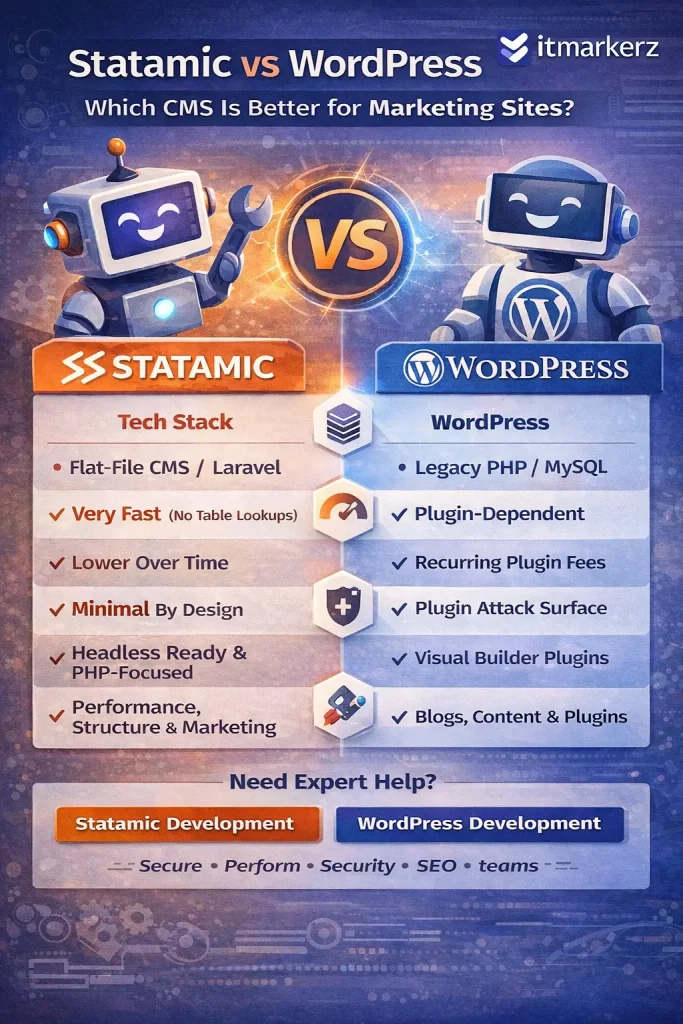
  • Statamic vs WordPress (2026): Which CMS Is Better for Marketing Sites?

    Statamic vs WordPress (2026): Which CMS Is Better for Marketing Sites?

    Choosing the right CMS for a marketing website in 2026 is no longer just about popularity. It’s about performance, total cost of ownership, security, scalability, and how efficiently your marketing team can publish and iterate.

    For years, WordPress has been the default choice. But modern teams are increasingly evaluating Statamic, a flat-file CMS built on Laravel, as a serious alternative—especially for high-performance marketing sites, SaaS landing pages, and brand websites.

    In this guide, we’ll compare Statamic vs WordPress in 2026, with a strong focus on usage cost, technology stack, maintenance overhead, and real-world marketing needs, so you can make the right decision for your business.

    What Is WordPress?

    WordPress is the world’s most widely used CMS, powering over 40% of all websites. It’s database-driven, plugin-based, and supported by a massive ecosystem of themes, plugins, and developers.

    Businesses typically choose WordPress for:

    • Blogs and content-heavy sites
    • Marketing websites with frequent updates
    • WooCommerce stores
    • Editorial workflows with non-technical users

    If you’re planning a WordPress-based site or customization, our👉 WordPress Development Services help businesses build scalable, SEO-optimized WordPress solutions.


    What Is Statamic?

    Statamic is a modern, flat-file CMS built on Laravel. Instead of a database, it stores content in files (YAML/Markdown), making it extremely fast, secure, and developer-friendly.

    Statamic is ideal for:

    • Marketing and brand websites
    • SaaS landing pages
    • Performance-critical sites
    • Teams already using Laravel

    If you’re exploring a modern CMS approach, our 👉 Statamic Development Services help companies design fast, clean, and future-proof marketing sites.

    Infographic comparing Statamic vs WordPress in 2026 for marketing websites, highlighting differences in tech stack, performance, cost, security, content flexibility, and overall focus, with itmarkerz branding.

    Technology Stack Comparison (2026)

    FeatureWordPressStatamic
    Core LanguagePHPPHP (Laravel)
    StorageMySQL DatabaseFlat Files (YAML/Markdown)
    FrameworkCustom / LegacyLaravel
    API ReadyPlugin-basedNative
    Headless SupportPossible (complex)Native
    PerformancePlugin dependentVery high by default
    Security SurfaceLargeMinimal

    Key takeaway:

    • WordPress relies heavily on plugins and database queries.
    • Statamic benefits from Laravel’s modern architecture and file-based speed

    Usage Cost & Total Cost of Ownership

    WordPress Cost Breakdown

    WordPress itself is free, but real costs add up quickly:

    • Premium themes & plugins
    • Hosting optimized for WordPress
    • Security plugins
    • Performance plugins (cache, CDN, image optimization)
    • Ongoing maintenance & updates

    For serious marketing sites, WordPress is rarely “free” in practice.

    That’s why many businesses opt for professional 👉 WordPress Maintenance Services to handle updates, backups, security, and performance tuning.

    Statamic Cost Breakdown

    Statamic uses a one-time license fee (for advanced features), but:

    • No plugin sprawl
    • No database optimization costs
    • Fewer security layers needed
    • Lower long-term maintenance effort

    Over 2–3 years, Statamic often costs less than WordPress for marketing-focused websites.


    Performance & Speed (Critical for Marketing SEO)

    WordPress

    • Performance depends on:
      • Theme quality
      • Number of plugins
      • Hosting
      • Caching setup
    • Poorly managed WordPress sites often suffer from:
      • Slow TTFB
      • Plugin conflicts
      • Bloated frontend assets

    Statamic

    • Flat-file = no database queries
    • Extremely fast page loads
    • Built for static caching and CDN usage
    • Excellent Core Web Vitals out of the box

    For SEO-driven marketing sites, Statamic has a clear performance advantage.


    Security & Maintenance Effort

    WordPress

    • Frequent plugin/theme updates
    • Common attack target due to popularity
    • Requires continuous monitoring
    • Higher risk if updates are skipped

    This is why ongoing 👉 WordPress Maintenance is almost mandatory for business-critical sites.

    Statamic

    • No database = smaller attack surface
    • No third-party plugin ecosystem chaos
    • Laravel security updates
    • Minimal maintenance overhead

    Statamic is inherently more secure by design.


    Content Editing Experience (Marketing Teams)

    WordPress

    Pros:

    • Familiar editor (Gutenberg)
    • Huge ecosystem
    • Easy for non-technical users

    Cons:

    • Editors can break layouts
    • Plugin-dependent features
    • Performance trade-offs

    Statamic

    Pros:

    • Clean, structured content
    • Flexible fields
    • Safer editorial control
    • Excellent for multi-language & structured marketing pages

    Cons:

    • Slight learning curve for teams new to Laravel-based CMSs

    SEO Capabilities (2026)

    Both CMSs can rank well in Google, but the approach differs:

    WordPress SEO

    • Strong plugin ecosystem (Yoast, RankMath)
    • Requires configuration and discipline
    • Performance impacts SEO if not optimized

    Statamic SEO

    • Clean HTML output
    • Excellent page speed
    • SEO baked into templates
    • Fewer technical SEO issues by default

    Statamic rewards teams who care about technical SEO and performance.


    When Should You Choose WordPress?

    Choose WordPress if:

    • You need a familiar CMS for editors
    • Your site relies heavily on plugins
    • You publish large volumes of content
    • You want fast onboarding of content teams
    • You plan WooCommerce or heavy integrations

    👉 Ideal with professional WordPress development & maintenance


    When Should You Choose Statamic?

    Choose Statamic if:

    • Your site is marketing-focused (SaaS, brand, landing pages)
    • Performance & security matter
    • You want lower long-term costs
    • You prefer structured content
    • You already use Laravel or modern stacks

    👉 Ideal with expert Statamic development


    Statamic vs WordPress: Final Verdict (2026)

    WordPress is still powerful—but heavy.
    Statamic is lean, modern, and built for performance-first marketing.

    Use CaseBest Choice
    Blog-heavy sitesWordPress
    Enterprise marketing siteStatamic
    SaaS landing pagesStatamic
    Content teams with pluginsWordPress
    Low-maintenance marketingStatamic

    Need Help Choosing or Building?

    If you’re unsure which CMS fits your marketing goals, our team can help you evaluate, build, and maintain the right solution:

    We focus on performance, security, SEO, and long-term cost efficiency—not just CMS popularity.

  • JetBrains State of PHP 2025: Laravel Leads PHP Frameworks — What It Means in 2026

    JetBrains State of PHP 2025: Laravel Leads PHP Frameworks — What It Means in 2026

    Quick answer: JetBrains’ State of PHP 2025 shows Laravel remains the dominant PHP framework, leading at ~64% usage with no major framework shake-ups.
    In this guide, you’ll get the top 5 takeaways and what they mean for 2026 planning:

    • which PHP/tooling direction teams are moving toward
    • what to prioritize (testing, performance, DX)
    • how to turn survey signals into your next sprint decisions
      If you’re running Laravel in production, this is the fastest way to align roadmap + hiring + upgrades with real ecosystem data.

    JetBrains’ State of PHP 2025 paints a very specific picture of where PHP (and Laravel) is heading as we enter 2026: PHP is not “dying” — it’s professionalizing. The ecosystem is modernizing, tooling is maturing fast, and AI is becoming a default part of day-to-day development workflows.

    For Laravel teams, that translates into a clear set of strategic priorities for 2026:

    • standardize on modern PHP versions (and align framework upgrades with support windows),
    • invest in automated code quality + testing,
    • decide how you’ll operationalize AI safely,
    • and keep an eye on runtime/deployment innovation (FrankenPHP is moving from “interesting” to “real”).

    Below is a practical, Laravel-team-focused breakdown of the report’s most important findings — and what you should do about them in 2026.

    If your Laravel stack is heading into 2026 with an upgrade backlog or performance concerns, our team can help you modernize safely—framework upgrades, CI hardening, and production-grade architecture via our Laravel development services. For ongoing stability (security patches, uptime, speed), pair it with a monthly maintenance & monitoring plan.

    1) The survey signals stability (and it’s mostly experienced teams)

    JetBrains’ PHP findings come from their Developer Ecosystem Survey 2025, with 1,720 respondents who identified PHP as their main language.

    The broader JetBrains survey ran April–June 2025 and included 24,534 developers after data cleaning, with weighting applied (and an explicit note that JetBrains users may be more likely to respond).

    Why Laravel teams should care: this isn’t just “hobby PHP” — the data is skewed toward professional teams and real workflows. The report also notes 56% of PHP developers work in small teams (2–7 people), which matches how many Laravel shops operate.

    What this means in 2026: you don’t need heavyweight “enterprise process” to improve outcomes — you need lightweight automation (tests, static analysis, CI) that fits small teams.

    2) Laravel remains the dominant PHP framework — and its ecosystem is accelerating

    There were “no major shifts” in framework adoption: Laravel leads with 64% usage among PHP developers in the survey.
    JetBrains also includes a Laravel ecosystem note from Taylor Otwell pointing to Laravel Cloud and AI-related integrations like Laravel Boost and “MCP”.

    What this means in 2026: Laravel’s center of gravity is moving toward:

    • more “platform” thinking (deployment/ops via Laravel Cloud),
    • more first-party or standardized tooling integrations,
    • more AI-assisted developer experience.

    If you’re running Laravel in 2026 and still treating it like “just a PHP framework”, you’ll miss the speed gains that the ecosystem is trying to hand you.
    3) PHP version reality: modernization is winning — but 2026 is a support-window trap

    JetBrains reports PHP 8.x dominates with 89% usage, while PHP 7.x is still present (and legacy versions aren’t totally gone).

    Now pair that with PHP’s official support timeline:

    • PHP 8.3 active support ended Dec 31, 2025 (security fixes continue after that).
    • PHP 8.4 remains in active support through Dec 31, 2026.

    So as of January 2026, if your production baseline is PHP 8.3, you’re already in “security-fixes-only” territory. That’s not a crisis — but it is a strategic signal: 8.4 becomes the sensible default for 2026 for teams that want active support.

    Laravel version alignment (this is the key planning lever)

    Laravel’s own support policy table (official docs) makes planning much easier:

    • Laravel 11: supports PHP 8.2–8.4; security fixes until March 12, 2026.
    • Laravel 12: supports PHP 8.2–8.5; security fixes until Feb 24, 2027.
    • Laravel 13: planned Q1 2026, supports PHP 8.3–8.5 (per the same table).

    What this means in 2026 (practical guidance):

    • If you’re on Laravel 10 or older, you’re already behind on framework security windows — prioritize upgrading.
    • If you’re on Laravel 11, plan to move to Laravel 12 in 2026 to extend runway (and target PHP 8.4+ where possible).

    treat PHP + Laravel upgrades as a planned release cycle—not an emergency. If you want a staged, low-risk upgrade plan (audit → compatibility fixes → test coverage → CI rollout → deployment hardening), we offer this as part of our Laravel development services, and we can keep your app secure and fast long-term with our laravel maintenance & monitoring.


    4) Testing: PHP is improving — but a big chunk still ships without tests

    JetBrains reports:

    • PHPUnit remains the standard at 50%,
    • Pest reached 17% (gaining momentum),
    • and 32% of developers don’t write tests at all.

    For Laravel teams, this is a big deal because the “Laravel advantage” is largely speed of change. If your team moves fast but has low test coverage, you’ll eventually pay for it with regressions, slow releases, and high support load.

    What to do in 2026 (high ROI, low drama):

    • Pick a baseline: PHPUnit-only is fine; Pest is also fine — the point is consistency.
    • Make it measurable: a simple rule like “new features require tests” + CI gating beats a perfect testing strategy that never happens.

    5) Code quality is moving toward static analysis — but many teams still do nothing

    JetBrains highlights a clear leader: PHPStan at 36% usage (up significantly), with tools like PHP CS Fixer (30%) and PHP_CodeSniffer (22%) also widely used — while 42% don’t use any code quality tools regularly.

    For Laravel teams in 2026, static analysis is not “nice to have” anymore. It’s the cheapest way to reduce bugs when:

    • team size is small,
    • change velocity is high,
    • and AI-generated code is increasingly common.

    What to do in 2026:

    • Make PHPStan (or equivalent) part of CI.
    • Add style checks that are automated (don’t rely on humans to remember rules).
    Infographic summarizing JetBrains State of PHP 2025 and what it means for Laravel teams in 2026: survey overview, Laravel usage, PHP 8.4 and Laravel 12 upgrade focus, testing and code quality, AI adoption, FrankenPHP watch, and a 2026 action plan.

    6) AI is now default — your team needs policy, not debate

    This is the loudest shift in the report:

    • 95% of developers have tried at least one AI tool.
    • 80% regularly use AI assistants/editors.
    • Daily usage leaders: ChatGPT (49%), GitHub Copilot (29%), JetBrains AI Assistant (20%) (and JetBrains AI tripled adoption vs last year).

    The bigger “2026 signal” is what’s next:

    • 72% are likely to try AI coding agents in the next year.
    • JetBrains points to their agent Junie as part of that shift.
    • Top blockers are not technical — they’re governance: privacy/security (44%), IP concerns (24%), and lack of knowledge (22%).

    What Laravel teams should do in 2026

    If you do nothing, AI use will still happen — just inconsistently and unsafely. A simple policy beats chaos. Examples of what to standardize:

    • What’s allowed: refactors, boilerplate tests, scaffolding, docs, query optimization suggestions.
    • What’s restricted: pasting secrets, customer data, proprietary code in public tools.
    • How to review: require human review for AI-generated code (especially auth, payments, permissions, billing).

    7) Deployment & runtime innovation: FrankenPHP is getting real attention

    JetBrains calls out FrankenPHP as a 2025 ecosystem highlight and notes it became a project backed by the PHP Foundation, plus it has “worker mode” and performance-oriented features.

    This matters for Laravel teams because deployment options shape cost/performance — and Laravel itself now documents FrankenPHP as a server configuration option in its deployment docs.

    What to do in 2026:

    • You don’t have to migrate production to FrankenPHP immediately.
    • But you should track it, test it in a non-critical service, and evaluate if it changes your scaling/cost profile.

    A practical “2026 action plan” for Laravel teams

    2025 finding2026 risk for Laravel teamsAction to take
    PHP 8.x dominates, but support windows move fast Running on “security-only” branches without realizing itStandardize on PHP 8.4 for 2026 where possible; align Laravel version accordingly
    Laravel leads framework adoption Teams fall behind on ecosystem leverage (platform + tooling)Treat Laravel upgrades as a strategic cadence, not a painful event
    32% don’t write tests Shipping speed collapses as codebase growsAdd CI test gating + minimum coverage expectations
    PHPStan rising, but many teams still skip code quality More bugs + slower reviews, especially with AI codeAdd static analysis + formatting checks to CI
    AI is mainstream; agents nextIP/security exposure + inconsistent qualityWrite a short AI usage policy + enforce review rules

    The bottom line for 2026

    JetBrains’ State of PHP 2025 is essentially telling Laravel teams: the winners in 2026 won’t be the teams who argue about whether PHP is modern — they’ll be the teams who operationalize modernization.

    That means:

    • stay inside support windows (PHP + Laravel),
    • automate quality (tests + static analysis),
    • and put guardrails around AI so it speeds you up instead of creating risk.

    If you’re planning a Laravel upgrade in 2026—or want to standardize testing, PHPStan, CI, and secure AI usage—we can do the heavy lifting end-to-end. Explore our Laravel development services for upgrades and new builds, and our laravel maintenance & monitoring plan for ongoing security, performance, and uptime.