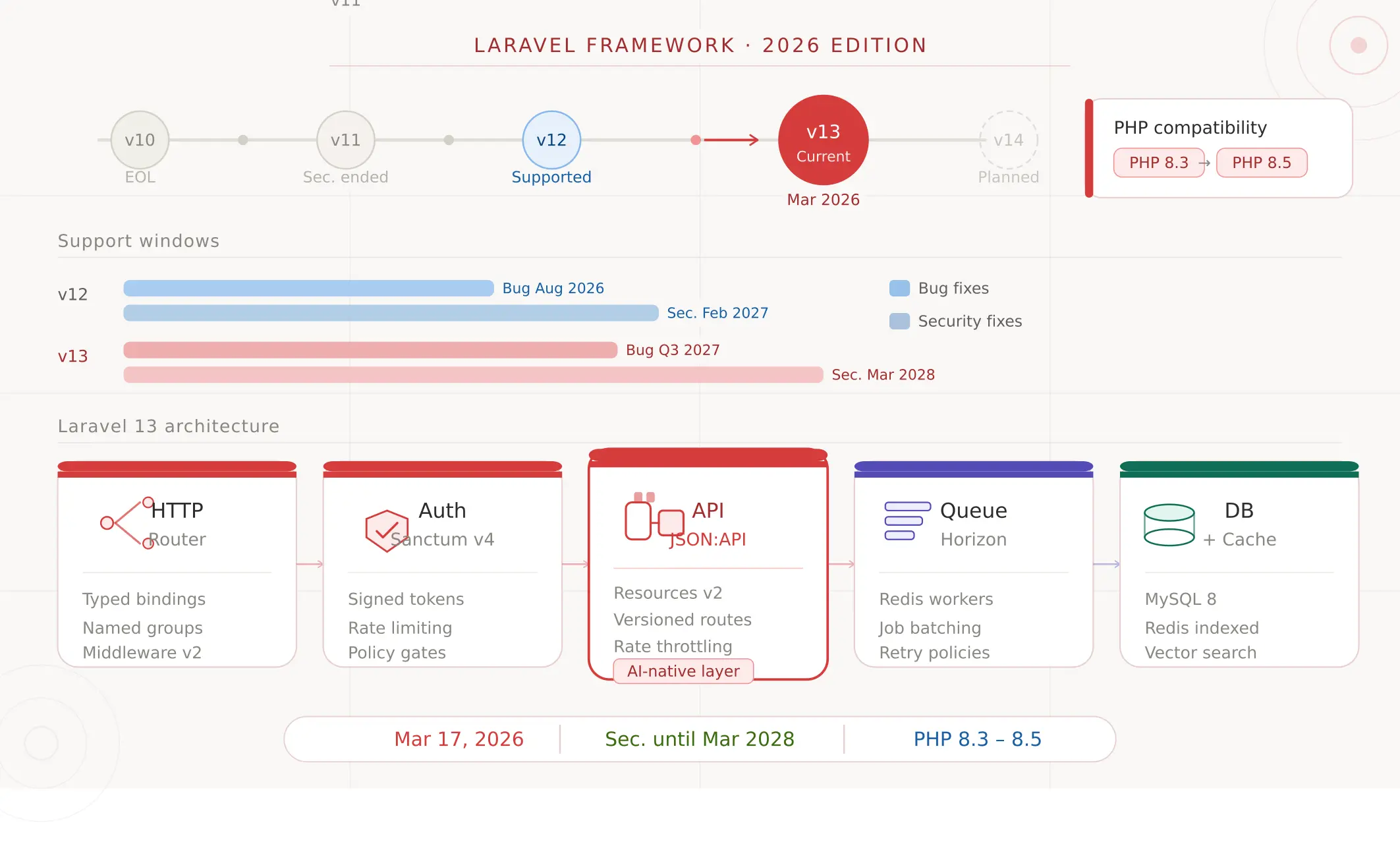
The latest Laravel version in April 2026 is Laravel 13. Laravel 13 was released on March 17, 2026, supports PHP 8.3 to 8.5, receives bug fixes until Q3 2027, and receives security fixes until March 17, 2028. This guide is for teams checking the current Laravel version, comparing Laravel 12 vs 13, reviewing support dates, and deciding whether they should upgrade now or plan a phased move. If you already know you need a structured migration plan, our Laravel upgrade services guide is the best next step.
Last updated: April 2026
The short answer
If you are asking what the latest Laravel version is right now, the answer is Laravel 13. For most teams, the more important follow-up question is not just “what is current?” but “what should we target next based on our current version, dependency health, and support window?” That is where this page helps: it gives you the current Laravel release, the support dates, the PHP compatibility range, and a practical Laravel 12 vs 13 view for planning. If you are evaluating Laravel as a long-term framework choice before deciding on upgrades, this article on Is Laravel still the right choice in 2026 is the broader starting point.
Laravel 13 release date and support dates
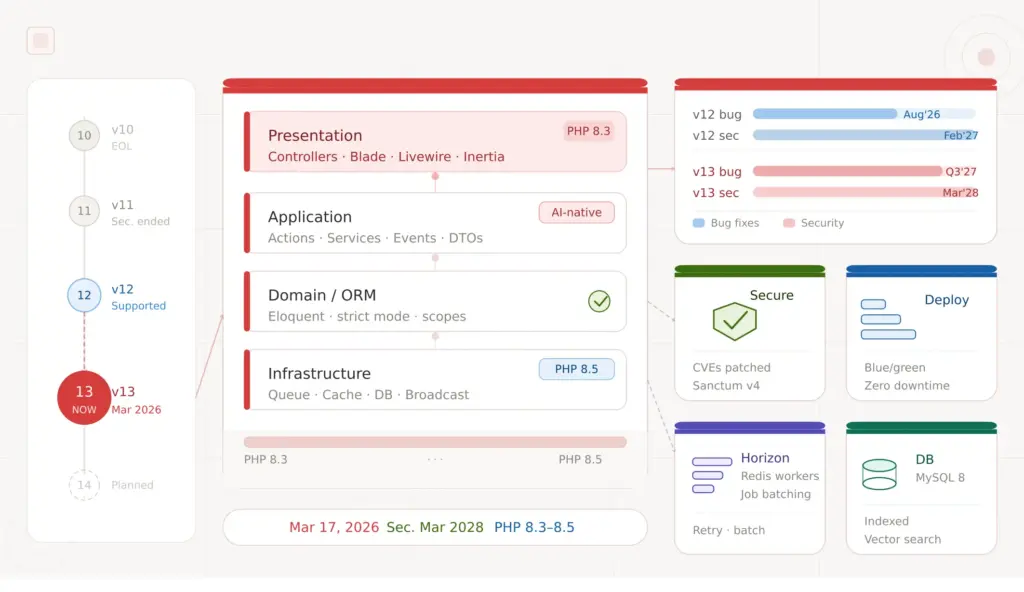
Laravel 13 was released on March 17, 2026. It follows Laravel’s annual major release cadence and continues the framework’s support policy of 18 months of bug fixes and 2 years of security fixes for each major release. Laravel 13 supports PHP 8.3 through 8.5, receives bug fixes until Q3 2027, and receives security fixes until March 17, 2028.
If you want the official source for release cadence and support windows, Laravel’s own Laravel 13 release notes are the reference point your engineering team should use.
Laravel support policy at a glance
| Laravel Version | Supported PHP | Release Date | Bug Fixes Until | Security Fixes Until |
|---|---|---|---|---|
| Laravel 10 | PHP 8.1–8.3 | February 14, 2023 | August 6, 2024 | February 4, 2025 |
| Laravel 11 | PHP 8.2–8.4 | March 12, 2024 | September 3, 2025 | March 12, 2026 |
| Laravel 12 | PHP 8.2–8.5 | February 24, 2025 | August 13, 2026 | February 24, 2027 |
| Laravel 13 | PHP 8.3–8.5 | March 17, 2026 | Q3 2027 | March 17, 2028 |
The practical takeaway is simple. Laravel 13 is the current version. Laravel 12 is still supported and may still be the right short-term target for some teams, but Laravel 11 has now reached the end of its security support window, and Laravel 10 is already well past it.
Laravel 12 vs Laravel 13: what changed
Laravel 12 was a relatively calm, maintenance-oriented release for many teams. Laravel 13 is the next major step forward and is still positioned as a relatively minor upgrade in effort for many applications. Laravel’s official release notes highlight AI-native workflows, first-party AI primitives, JSON:API resources, semantic and vector search capabilities, stronger security defaults, and ongoing improvements across queues and cache behavior.
That means the Laravel 12 vs 13 conversation is not just about support windows. It is also about whether your team wants to stay on the current line of the framework and take advantage of a modern baseline with longer runway ahead. The official Laravel 13 upgrade guide also notes that the estimated upgrade time from 12.x is relatively short for many apps, which is another signal that Laravel 13 should now be your default evaluation point rather than a future placeholder.
Should you upgrade to Laravel 13 now?
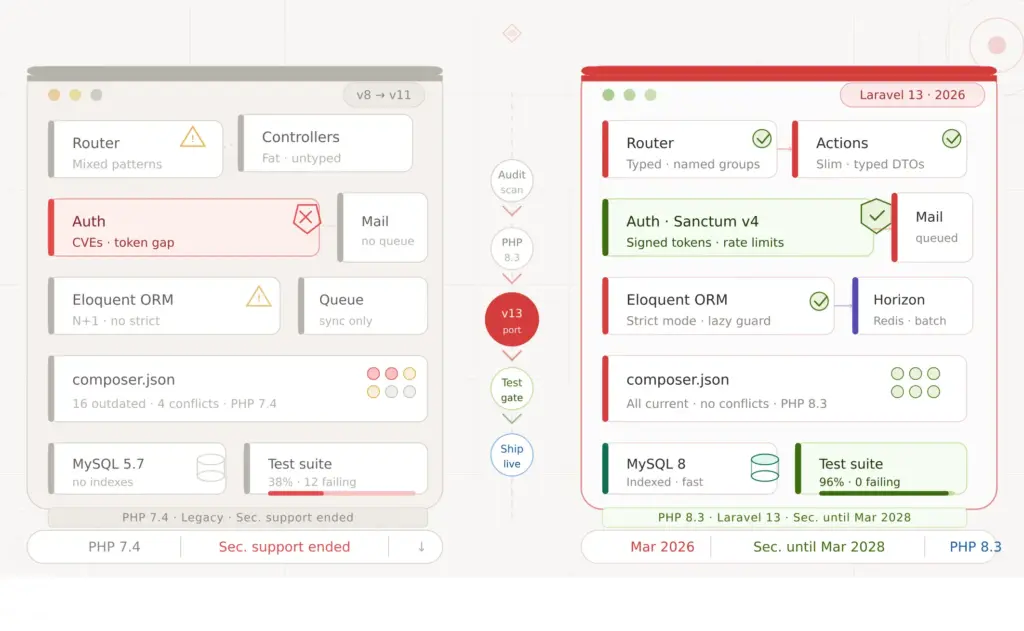
For many teams, yes. If you are on Laravel 12 and your package ecosystem is reasonably healthy, Laravel 13 should be the first version you evaluate. If you are on Laravel 11, the situation is more urgent because its security support has already ended. If you are on Laravel 10 or older, your upgrade decision should be treated as a structured modernization effort rather than a casual framework bump.
The right answer depends on where you are starting from, but one thing is now clear: “wait for Laravel 13” is no longer a valid planning assumption, because Laravel 13 is already here.
Who should move to Laravel 13 now
- Teams on Laravel 12 that want the current version and a longer support runway
- Teams on Laravel 11 that are already past the security support deadline
- New projects in 2026 that want to start on the current major version
- Teams building AI-assisted, API-heavy, or search-heavy products that want the newer Laravel 13 baseline
Who may wait briefly before moving to Laravel 13
Some teams on Laravel 12 can wait a short period if their product is stable, their support window is still healthy, and they want to let more ecosystem packages settle. But even then, Laravel 13 should still be the version you plan around now. Waiting only makes sense as a short operational timing decision, not as a strategic question about whether Laravel 13 will become relevant later.
How this affects upgrade planning
Version planning only becomes useful when it connects to execution. If your team is deciding between Laravel 12 and 13 as part of a production upgrade, the best next step is not more generic reading. It is a dependency audit, a package review, a testing plan, and a rollout path. That is exactly why our Laravel upgrade services guide exists: to help teams move from version awareness to a low-risk migration strategy.
If the upgrade is part of a larger modernization project, custom platform build, or platform re-architecture, our Laravel development services page is the more relevant commercial hub because it covers broader build, scaling, and delivery work beyond version changes alone.
Latest Laravel version and PHP compatibility
The latest Laravel version also matters because it changes your PHP compatibility planning. Laravel 13 requires at least PHP 8.3 and supports PHP 8.3 through 8.5. Laravel 12 supports PHP 8.2 through 8.5. So if your infrastructure is still lagging on PHP versions, your Laravel upgrade plan must include runtime planning as well as framework planning.
This is also why framework upgrades should never be treated as an isolated Composer task. They are usually tied to infrastructure, CI pipelines, deployment routines, queue behavior, caching strategy, and performance review. If that side of the conversation is part of your planning, this Laravel performance checklist is a useful companion read.
Our practical view
The latest Laravel version in April 2026 is Laravel 13, and that should now be the default frame for most Laravel version and support conversations. Laravel 12 is still relevant because it remains supported and may still be the immediate stepping stone for some teams. But the center of gravity has now shifted. If you are planning new work, fresh upgrades, or support runway decisions, Laravel 13 is the version that should anchor your roadmap.
Need help choosing the right Laravel target version?
If your team needs help deciding whether to move directly to Laravel 13, stabilize on Laravel 12 first, or design a phased upgrade plan around real production risk, we can help. Start with our Laravel upgrade services guide if the issue is migration planning, or visit our Laravel development services page if the version decision is part of a wider platform roadmap.
FAQs
What is the latest Laravel version in 2026?
The latest Laravel version in April 2026 is Laravel 13.
When was Laravel 13 released?
Laravel 13 was released on March 17, 2026.
How long is Laravel 13 supported?
Laravel 13 receives bug fixes until Q3 2027 and security fixes until March 17, 2028.
What PHP version does Laravel 13 support?
Laravel 13 supports PHP 8.3 through 8.5 and requires a minimum PHP version of 8.3.
Should we choose Laravel 12 or Laravel 13 now?
For many teams, Laravel 13 should now be the first version they evaluate. Laravel 12 may still make sense as a short-term stepping stone in some upgrade paths, but Laravel 13 is the current major release and has the longer forward support runway.
Leave a Reply